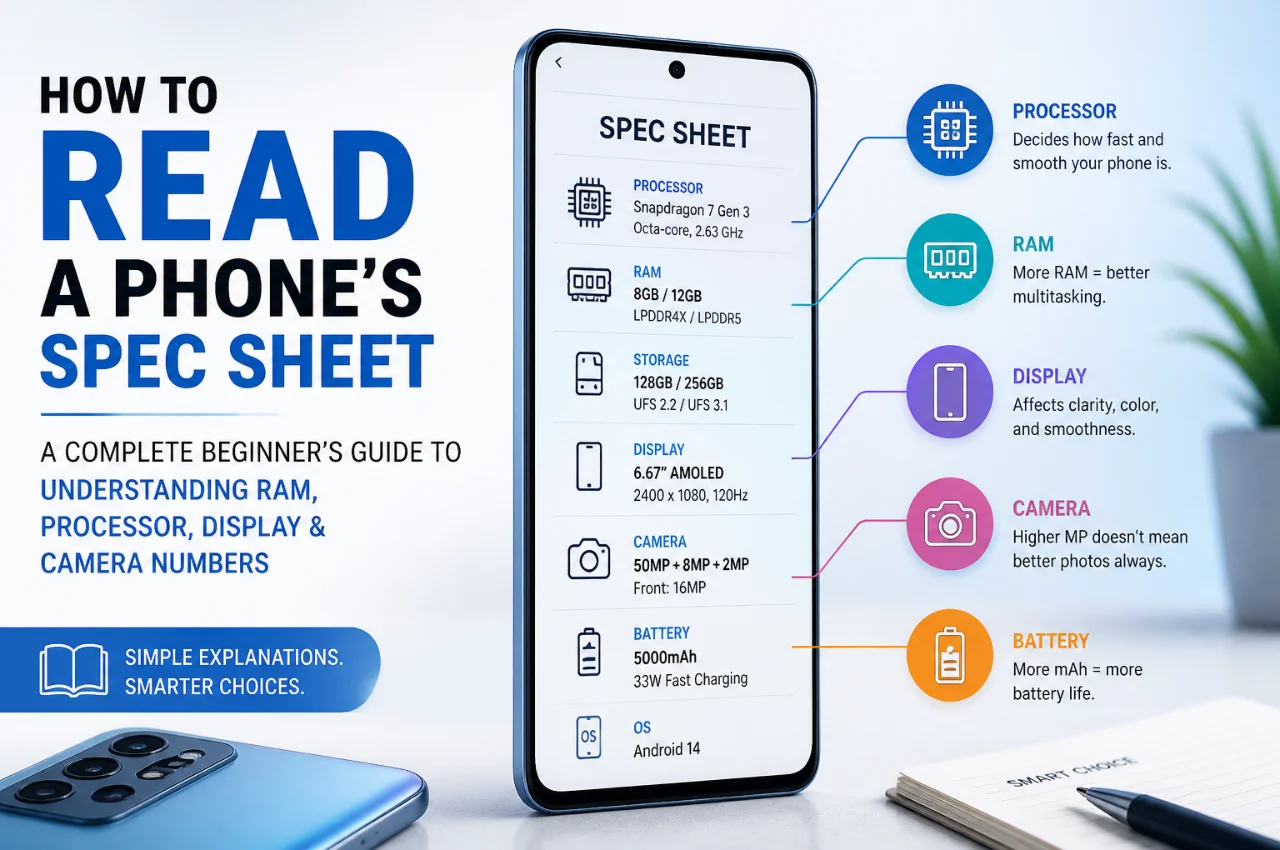
Ever looked at a phone’s spec sheet and felt completely lost? Numbers like “8GB RAM,” “Snapdragon 8 Gen 3,” “120Hz AMOLED,” and “f/1.8 aperture” can feel like a foreign language. You’re not alone — most people buy smartphones based on brand name or price, without truly understanding what they’re paying for.
This guide changes that. By the end, you’ll be able to read any smartphone spec sheet with confidence — whether you’re buying your first Android phone, upgrading to a flagship, or simply comparing two models side by side.
Let’s break it all down, section by section, in plain simple language.
What is a Spec Sheet?
A spec sheet (short for “specifications sheet”) is a technical summary of a phone’s hardware. It lists every major component — the processor, screen, camera, battery, and more — using specific numbers and technical terms.
Companies like Samsung, OnePlus, Realme, and Apple publish these on their official websites. Third-party sites like GSMArena and 91Mobiles also compile them for easy comparison.
The problem? These numbers mean nothing unless you understand what they represent. A 200MP camera doesn’t automatically mean better photos. 12GB RAM doesn’t always mean faster performance. Let’s decode each one.
1. Processor (Chipset / SoC) — The Brain of Your Phone
The processor, also called a chipset or SoC (System on a Chip), is the single most important component in a smartphone. It controls everything — how fast apps open, how smoothly games run, how efficiently the battery drains, and even how good your camera photos turn out.
Key Processor Brands:
Qualcomm makes the Snapdragon series, found in Samsung, OnePlus, Realme, Motorola, and most Android flagships. MediaTek makes the Dimensity and Helio series, commonly found in budget and mid-range Android phones. Apple makes its own A-series chips (A18, A17, etc.) used exclusively in iPhones. Samsung makes the Exynos series, used in some Galaxy phones in specific regions.
Processor Tiers — How to Compare:
Think of processors in tiers, like movie ratings. A flagship-tier chip like the Snapdragon 8 Gen 3 or Dimensity 9400 is ideal for heavy gaming, 4K video, and AI tasks. Upper mid-range chips like Snapdragon 7s Gen 3 or Dimensity 8300 handle smooth daily use and casual gaming well. Mid-range chips like Snapdragon 6 Gen 3 are fine for regular use, social media, and calls. Budget chips like Snapdragon 4 Gen 2 suit basic tasks and first-time smartphone buyers.
Key Terms Explained:
Cores are like workers inside the processor. More cores allow the phone to handle multiple tasks simultaneously. Most modern phones have 8 cores (octa-core). Clock Speed (measured in GHz) tells you how fast each core works — a 3.3 GHz core is faster than a 2.0 GHz core. The nm (nanometer) process refers to how small the chip is built — smaller means more efficient. A 4nm chip is better than a 7nm chip because it’s faster and uses less battery.
Pro Tip: Don’t just compare GHz numbers. A newer-generation chip at 2.8 GHz can easily outperform an older chip at 3.2 GHz. Always check the generation — “Snapdragon 8 Gen 3” is far better than “Snapdragon 888” even though 888 sounds like a bigger number.
2. RAM — How Much Do You Really Need?
RAM (Random Access Memory) is your phone’s short-term memory. It stores apps and data you’re currently using so you can switch between them quickly without everything reloading from scratch.
Think of RAM like your desk space. More desk space means more things you can keep open at once without needing to put them away and pick them back up.
4GB RAM is too little in 2026 and should be avoided. 6GB is the minimum acceptable for light social media use. 8GB is the sweet spot for most users — great for everyday multitasking. 12GB suits heavy multitaskers and demanding gamers. 16GB and above is overkill for most people.
Spec sheets also mention RAM type — LPDDR4X, LPDDR5, or LPDDR5X. Simply put, higher number means faster and more efficient. LPDDR5X is the latest, found in flagships. LPDDR5 is more than enough for most users.
Important: Apple iPhones typically have less RAM than Android phones (6–8GB) but still outperform many 12GB Android phones. This is because iOS manages memory far more efficiently. So don’t compare iPhone and Android RAM numbers directly.
3. Storage (ROM / Internal Memory) — Where Your Files Live
Storage, sometimes called ROM or internal memory, is where your photos, videos, apps, music, and files are permanently saved. Unlike RAM, it does not get wiped when you restart your phone.
64GB is too little in 2026. 128GB is the minimum you should buy. 256GB is the best choice for most people, especially if you shoot videos or install many apps. 512GB and above is for professional content creators who truly need it.
Storage Speed — UFS Explained:
UFS 2.2 is basic and adequate for budget phones. UFS 3.1 is noticeably faster for app loading and found in mid-range devices. UFS 4.0 is the fastest available, found in 2025–2026 flagships, and makes a visible difference for large games and file-heavy work.
Also check whether the phone supports a microSD card for expandable storage. Many mid-range Android phones support this. Flagship phones — including all iPhones and some Samsung Galaxy S models — do not, so the storage you buy at purchase is what you’re stuck with.
4. Display — The Window to Your Phone
The display is what you look at all day. A good screen makes scrolling, watching videos, and gaming far more enjoyable. Here’s what every display number on the spec sheet actually means.
Display Size
Measured diagonally in inches — such as 6.1″ or 6.7″. Bigger screens are great for media and gaming but harder to use one-handed. Most people find 6.1″–6.5″ to be the comfortable sweet spot.
Display Type — AMOLED vs LCD
AMOLED and OLED displays offer vivid colors, deep blacks, excellent contrast, and great performance in dark mode. Super AMOLED is Samsung’s version and is slightly brighter. IPS LCD displays offer more natural colors and can be easier to see outdoors in some conditions, but they’re generally considered inferior to AMOLED for most use cases. If a budget phone offers an AMOLED screen, that’s excellent value.
Resolution — How Sharp is the Screen?
HD+ (720p) is basic and only acceptable on very cheap phones. Full HD+ (1080p) is the standard — sharp and clear for most screen sizes up to 6.7 inches. QHD+ (1440p) is extra sharp and found mainly in premium flagships, though it uses more battery. For most users, Full HD+ is the ideal choice.
Refresh Rate — The Smoothness Factor
Refresh rate is measured in Hz and tells you how many times per second the screen updates. 60Hz feels standard but noticeably laggy when scrolling. 90Hz is smoother and suitable for everyday use. 120Hz is very smooth and should be the minimum you aim for in 2026. 144Hz and 165Hz are mainly beneficial for gaming.
Brightness — Nits Explained
Brightness is measured in nits. Under 500 nits makes outdoor use difficult. 800–1000 nits is decent for outdoor visibility. 1500+ nits is excellent in direct sunlight and is the flagship standard. 2000–3000 nits is top-tier, found in Samsung S series and iPhone Pro models.
Look for LTPO displays if battery life matters to you. These automatically adjust their refresh rate between 1Hz and 120Hz depending on what’s on screen — keeping things smooth when needed while saving battery during static content.
5. Camera Specs — There’s Much More Than Megapixels
Camera marketing is full of misleading numbers. The biggest myth in smartphone buying is that more megapixels always means better photos. Here’s what actually matters.
Megapixels — What They Really Mean
A megapixel is one million pixels. More megapixels means more detail and the ability to crop photos without losing sharpness. But megapixels alone do not determine photo quality. A 12MP camera with a large sensor will consistently outperform a 108MP camera with a tiny sensor — especially in low light. This is exactly why iPhone and Pixel phones produce stunning images despite their relatively lower megapixel counts.
Sensor Size — The Most Important Camera Spec
The sensor is the physical chip that captures light. A bigger sensor captures more light, leading to better photos in all conditions and especially at night. Sensor sizes are written as fractions like 1/1.28″ or 1/1.56″. The smaller the denominator, the larger the sensor. So 1/1.28″ is a bigger and better sensor than 1/2.8″.
Aperture — For Low Light Performance
Aperture describes how wide the lens opens to let in light, written as an f-number such as f/1.8 or f/2.4. A lower f-number means a wider aperture, which means more light enters the sensor, resulting in better low-light photos. f/1.5 to f/1.8 is excellent for night shots. f/1.9 to f/2.2 is good for most conditions. f/2.4 and above is weaker in low light.
OIS — Optical Image Stabilization
OIS physically moves the camera lens to counteract hand shake. This results in sharper photos and more stable videos, especially in low light. Always look for OIS in any camera you care about. Budget phones may only offer EIS (Electronic Image Stabilization), which is a software-based solution and noticeably less effective.
Multi-Camera Setup — What Do All Those Lenses Do?
The main (wide) camera is your primary shooter used for most photos. The ultrawide camera offers a wider field of view, great for landscapes and group shots. The telephoto camera provides optical zoom, bringing distant subjects closer without losing quality. The macro camera is for extreme close-ups but is usually very low quality on budget phones. The depth sensor helps blur backgrounds in portrait mode — it is not a real camera in any meaningful sense.
Be cautious of fake multi-camera setups. Many budget phones list 3 or 4 cameras, but two of them are often useless 2MP depth or macro sensors. A phone with one great main camera and a useful ultrawide is far better than a phone with four mediocre cameras.
Video Recording
Look for 4K video at 30fps or 60fps on the main camera. For content creators, also check for 4K on the front camera and OIS for video recording.
6. Battery — mAh, Charging Speed and Efficiency
Battery Capacity — mAh
Battery capacity is measured in mAh (milliampere-hours). Higher mAh generally means longer battery life, but this also depends heavily on processor efficiency and screen size.
3,000–4,000 mAh gives roughly 5–7 hours of screen time, mostly seen in older flagships. 4,500–5,000 mAh gives 8–12 hours and is the standard for 2026. 5,500–6,000 mAh gives 12–16 hours and is great for heavy users. 6,000 mAh and above provides all-day-plus usage and is found in some budget and rugged phones.
Charging Speed — Watts Explained
Charging speed is measured in Watts. 18W–25W is slow, taking 1.5–2 hours for a full charge. 33W–45W is decent, giving roughly 50% charge in 30 minutes. 65W–80W is fast, fully charging in about 45 minutes. 100W–120W and above is very fast, achieving a full charge in 20–30 minutes, mainly found in OnePlus and Xiaomi flagships.
Note that many companies, including Samsung on budget models, do not include a charger in the box. Always check what’s included before buying.
Wireless Charging
Wireless charging lets you place your phone on a pad without a cable. It’s slower than wired charging and mainly found in mid-range to flagship phones.
7. Connectivity — 5G, Wi-Fi, Bluetooth and NFC
5G vs 4G
5G is the latest mobile network standard, offering significantly faster speeds and lower latency than 4G LTE. In 2026, 5G is available in most mid-range and all flagship phones. If you plan to keep your phone for 2–3 years, a 5G-capable phone is worth considering for future-proofing.
Wi-Fi Standards
Wi-Fi 5 (802.11ac) is older but still fine for browsing and streaming. Wi-Fi 6 (802.11ax) is faster with less congestion in busy areas. Wi-Fi 6E and Wi-Fi 7 are the latest, found in 2025–2026 flagships.
Bluetooth
Look for Bluetooth 5.0 or higher. It offers better range, more stable connections, and lower battery consumption compared to older versions. Bluetooth 5.3 and 5.4 are now standard on most new phones.
NFC
NFC enables contactless payments through apps like Google Pay and PhonePe, as well as quick file sharing. Most mid-range and flagship phones include NFC in 2026. Budget phones may skip it — check if digital payments matter to you before buying.
8. Build, IP Rating and Other Specs
IP Rating — Water and Dust Resistance
IP54 means splash-resistant only — not suitable for submersion. IP67 means dust-proof and can survive in 1 meter of water for 30 minutes. IP68 means dust-proof and can survive in 1.5 meters or more of water for 30 minutes — the best rating for daily use. No IP rating means no official protection, so be careful around water.
Build Material
A glass back with a metal frame offers a premium feel and supports wireless charging, but it can crack on drops. Plastic (polycarbonate) backs are more durable against drops, lighter, and used in budget phones. Aluminum is lightweight and sturdy, used in Apple devices and premium Androids. Titanium is the most premium material, found in iPhone 15 Pro and newer top-tier flagships.
Biometrics
In-display fingerprint sensors can be optical or ultrasonic. Ultrasonic (found in Samsung Galaxy S series) is more accurate and faster than optical. Side-mounted fingerprint sensors are very fast and reliable, found in many mid-range phones. Face unlock is fast but less secure than fingerprint for banking apps.
Quick Buying Guide by Budget (India 2026)
Under ₹10,000 — Expect a Helio G99 or Snapdragon 4 Gen 2 processor, 4–6GB RAM, 64–128GB storage, an HD+ display at 90Hz, and a 50MP main camera.
₹10,000–20,000 — Expect a Dimensity 7300 or Snapdragon 6 Gen 1, 6–8GB RAM, 128GB storage, a Full HD+ AMOLED display at 120Hz, and a 50MP main camera with ultrawide.
₹20,000–35,000 — Expect a Snapdragon 7s Gen 3 or Dimensity 8300, 8–12GB RAM, 128–256GB storage, Full HD+ AMOLED at 120Hz, and a 50MP OIS camera with a quality ultrawide.
₹35,000–60,000 — Expect a Snapdragon 8 Gen 2 or 8 Gen 3, 12GB RAM, 256GB storage, QHD+ LTPO AMOLED display, and a pro camera system with telephoto.
₹60,000 and above — Expect a Snapdragon 8 Elite or Apple A18 Pro, 12–16GB RAM, 256–512GB storage, a QHD+ LTPO display at 1–120Hz, and a full pro camera system with periscope zoom.
Key Takeaway
When reading a spec sheet, prioritize in this order — Processor first, then Battery, Display, Camera, RAM, and finally Storage. A great processor with decent RAM will always outperform a phone that has loads of RAM but a weak chip.
Frequently Asked Questions
Is more RAM always better in a smartphone?
Not necessarily. Beyond 8GB, extra RAM gives diminishing returns for most users. 8GB is the sweet spot for smooth daily use. The processor and software optimization matter far more than raw RAM numbers.
Does a higher megapixel count always mean a better camera?
No — this is one of the most common myths. Sensor size, aperture, and image processing software have far more impact on real-world photo quality than megapixels alone.
What does a 120Hz display mean in real life?
It means the screen refreshes 120 times per second. The result is silky smooth scrolling, fluid animations, and more responsive gaming. Once you experience 120Hz, going back to 60Hz feels noticeably sluggish.
Is 5G worth it if my city doesn’t have 5G coverage yet?
If you plan to keep your phone for 2–3 years or more, yes. 5G is rapidly expanding across India, and having a 5G phone means you won’t need to upgrade just to access faster networks later.
What is the difference between UFS 3.1 and UFS 4.0 storage?
UFS 4.0 is roughly twice as fast as UFS 3.1. In practice, apps load quicker, large files transfer faster, and games install in less time. For everyday browsing and social media, the difference is less noticeable.
Can I trust the battery mAh number for battery life comparisons?
Only partially. A 5000mAh phone with an efficient modern processor will last longer than a 5000mAh phone with a power-hungry older chip. Always check real-world battery test reviews alongside the mAh spec.
Final Thoughts
Reading a smartphone spec sheet doesn’t have to be overwhelming. Once you understand what each number means and what actually matters for your personal use case, buying a phone becomes a confident, informed decision — not a leap of faith.
The most important things to look for: a recent-generation processor, at least 8GB RAM and 128GB storage, a Full HD+ AMOLED display with 120Hz refresh rate, a main camera with OIS and a decent-sized sensor, a 4500–5000mAh battery with 45W or faster charging, and 5G connectivity for future-proofing.
Bookmark this guide and refer to it the next time you’re shopping for a new smartphone. And if you found this helpful, share it with someone who’s currently confused about which phone to buy!