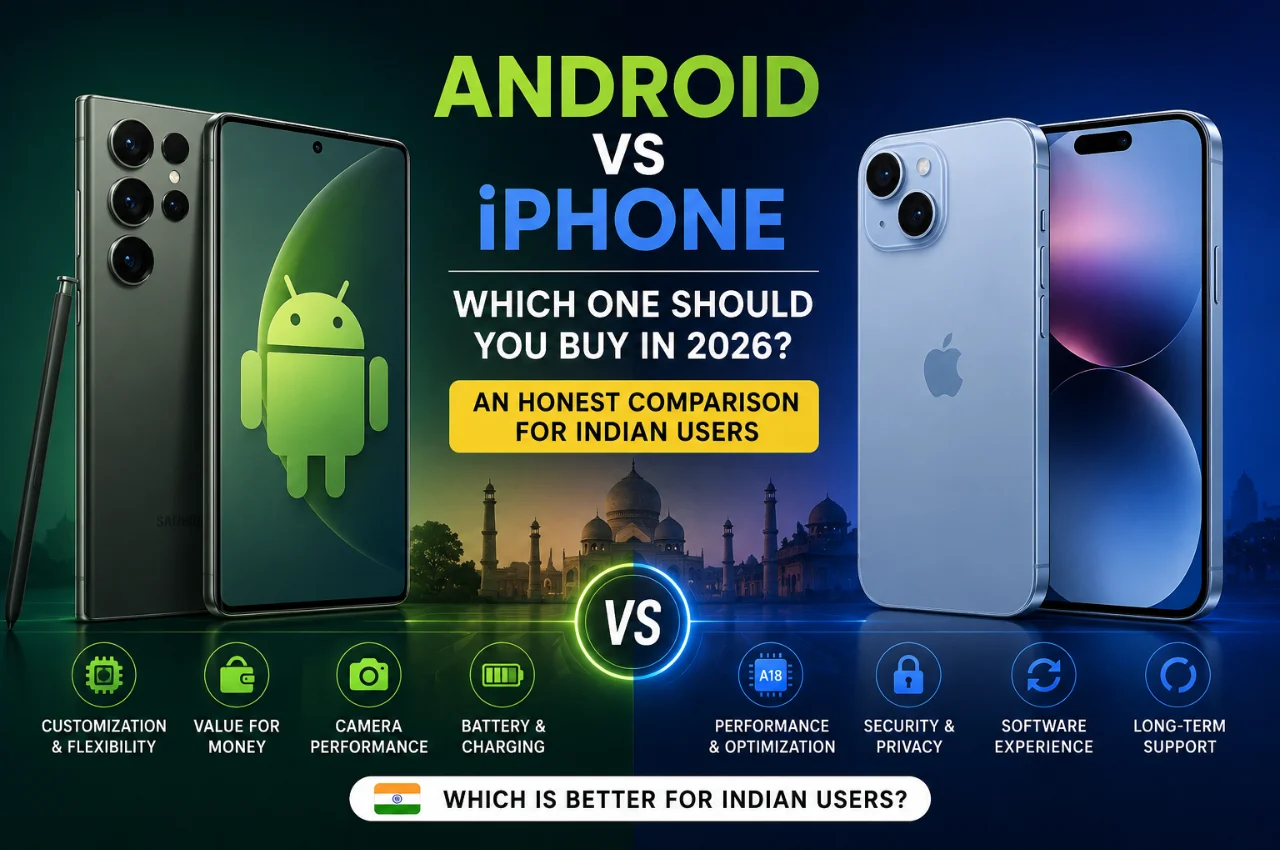
It is the most debated question in every phone shop, every tech group chat, and every family WhatsApp thread in India — Android ya iPhone?
Your cousin swears by his Samsung. Your colleague just switched to iPhone and won’t stop talking about it. And you’re standing at the Reliance Digital counter, looking at both options side by side, completely unsure which one to spend your hard-earned money on.
This guide gives you an honest, no-nonsense answer. Not a technical spec dump — a real-world comparison designed specifically for Indian users, covering every factor that actually matters when you’re spending anywhere from ₹20,000 to ₹1,50,000 on a smartphone in 2026.
By the end of this article, you will know exactly which one is right for you.
First — Understand What You’re Actually Choosing Between
Before we compare, one important clarification that confuses many buyers.
Android is not a phone brand. Android is a mobile operating system developed by Google. It runs on phones from dozens of different manufacturers — Samsung, OnePlus, Realme, Vivo, Xiaomi, Motorola, Google Pixel, and many more. When someone says “I have an Android phone,” they could mean any of these brands.
iPhone is both a brand and an operating system. Apple makes the iPhone hardware and its own operating system called iOS. Every iPhone — whether it’s the base iPhone 17 or the iPhone 17 Pro Max — runs iOS. Only Apple makes iPhones.
So when you’re choosing between Android and iPhone, you’re choosing between two completely different software ecosystems and two completely different philosophies about how a smartphone should work.
1. Price — Android Wins Clearly
This is where the comparison starts for most Indian buyers, and Android wins this category without any contest.
Android phones are available at literally every price point. You can get a capable Android phone for under ₹10,000. A genuinely excellent mid-range Android experience is available between ₹15,000 and ₹30,000. Flagship-level Android phones from brands like OnePlus, Samsung Galaxy S series, or Google Pixel start around ₹50,000–₹80,000.
iPhones start at a significantly higher price point in India. The entry-level iPhone 16e starts at approximately ₹59,000. The standard iPhone 17 is around ₹79,000. The iPhone 17 Pro starts above ₹1,20,000. And the iPhone 17 Pro Max crosses ₹1,50,000.
For the vast majority of Indian buyers — students, young professionals, and anyone with a budget under ₹50,000 — Android is simply the only practical option because Apple does not compete in that price segment at all.
The one exception is the refurbished iPhone market. Certified refurbished iPhones — from platforms like Cashify, Amazon Renewed, or Apple-authorized resellers — are available at 30 to 50 percent lower prices than new ones. A refurbished iPhone 14 or 15 can often be found in the ₹35,000–₹55,000 range, which makes them competitive with upper mid-range Android phones.
Verdict: Android wins on price, especially for budgets under ₹60,000.
2. Performance — iPhone Wins on Consistency, Android Wins on Raw Power
This is where the comparison gets more nuanced.
Apple designs both the iPhone hardware and the iOS operating system in-house. This tight integration means iPhones are extraordinarily well-optimized. The A18 chip in the latest iPhones delivers exceptional performance with industry-leading power efficiency. Apps open instantly, multitasking is smooth, and the phone maintains this performance for years without slowing down noticeably. An iPhone 3–4 years old still feels fast in daily use.
Flagship Android phones — particularly those running Snapdragon 8 Elite or Dimensity 9400 — match or exceed iPhone in raw benchmark numbers and excel in multi-core tasks, gaming, and AI processing. In head-to-head tests, these flagship Android chips are genuinely competitive with Apple silicon.
However, mid-range and budget Android phones vary enormously. A ₹20,000 Android phone with a Dimensity 7300 is capable but noticeably slower than any iPhone. A ₹15,000 Android phone will feel slower over time as apps grow heavier.
The key point: iPhones deliver consistent, reliable performance regardless of price point. Every iPhone in 2026, including the older models currently available refurbished, feels fast. With Android, performance varies dramatically by price range.
Verdict: iPhone wins on long-term consistency. Flagship Android phones match iPhone. Budget Android phones do not.
3. Camera — Both Are Excellent, But in Different Ways
Camera quality is one of the most important buying factors for Indian users, and both platforms have genuine strengths here.
iPhones are known for producing consistent, natural-looking photos with excellent color science, outstanding video quality, and reliable performance across all lighting conditions. Apple’s computational photography — the AI processing that happens after you tap the shutter — is among the best in the industry. iPhone video recording is widely considered the gold standard for smartphone videography. Reels, YouTube vlogs, and even some independent films are shot on iPhones.
Flagship Android phones — particularly Samsung Galaxy S series, Google Pixel, and OnePlus — offer more flexibility, higher megapixel counts, stronger optical zoom through periscope telephoto lenses, and in some cases, more creative control over how photos look. Google Pixel phones in particular use AI image processing in ways that consistently win in blind photo comparisons.
Mid-range Android phones in the ₹20,000–₹40,000 range offer very capable cameras for social media, everyday photos, and well-lit conditions. They may struggle more in low light compared to flagships.
For video content creators and social media users who shoot Reels and YouTube videos, iPhone’s video quality and stability are hard to beat. For photography enthusiasts who want zoom capabilities and more creative control, high-end Android offers more options.
Verdict: Tie at flagship level — depends on whether you prioritize video (iPhone) or photo versatility (Android). Mid-range camera quality favors better-specified Android phones.
4. Battery Life and Charging — Android Wins on Speed
Android phones have a clear advantage when it comes to charging speed. Most mid-range and flagship Android phones in 2026 support 65W, 80W, or even 120W fast charging — giving you a full charge in 30 to 45 minutes. Brands like OnePlus and Xiaomi offer 100W+ charging that can fully charge a 5000mAh battery in under 25 minutes.
iPhones support slower wired charging — typically around 27W–30W for the latest models — which means a full charge takes approximately 90 minutes to 2 hours. Apple prioritizes long-term battery health over raw charging speed.
However, iPhones consistently deliver all-day battery life, and their battery health degrades more slowly over time compared to Android phones. The tight hardware-software integration means iOS is highly efficient — a 3000mAh iPhone often lasts as long as a 4500mAh Android in real-world use.
Battery capacity in Android phones is typically larger — 4500mAh to 6000mAh is standard — but actual screen-on time depends heavily on the processor, software optimization, and display settings.
Verdict: Android wins on charging speed. iPhone wins on long-term battery health. Both deliver good all-day battery life at flagship level.
5. Software and Customization — Android Wins on Freedom
This is one of the biggest philosophical differences between the two platforms and comes down to personal preference.
Android gives you complete freedom to customize your phone. You can change the default launcher, install third-party app stores, sideload apps, set any app as the default for calls or messages, use file managers to access your storage directly, and customize the look and feel of the interface in hundreds of ways. Android also gives you more control over file management — connecting to a computer and transferring files is simple and works like a USB drive.
iOS is more controlled and consistent. Apple decides how apps work, what they can access, and how the interface looks. You have limited customization compared to Android. However, this control is exactly what makes iPhones feel so smooth and consistent — there is less room for things to go wrong.
For users who like to personalize their phones, experiment with settings, and have full control over their device — Android is the clear winner. For users who want things to “just work” without needing to configure anything — iOS is simpler and less overwhelming.
Verdict: Android wins on customization and freedom. iOS wins on simplicity and consistency.
6. Software Updates — iPhone Wins Clearly
This is one of the most important factors for long-term value, and iPhone wins this category decisively.
Apple supports iPhones with software updates for a minimum of 6 years and often longer. An iPhone bought today will receive the latest iOS updates until at least 2031. This means security patches, new features, and performance improvements keep arriving for years.
Android update support varies significantly by manufacturer. Samsung currently offers 7 years of updates for its Galaxy S series — the best in Android. OnePlus offers 4 years for flagships. Most mid-range Android phones from Realme, Vivo, and Xiaomi offer only 2 to 3 years of updates. After that, your phone stops receiving security patches and new features, even if it still works fine physically.
For Indian buyers who keep their phones for 4–5 years — which many do — this is a critical consideration. An iPhone bought today will still be secure and fully functional in 2030. Many mid-range Android phones bought today will stop receiving security updates by 2027 or 2028.
Verdict: iPhone wins clearly. Among Android brands, Samsung Galaxy S series offers the best update support at 7 years.
7. Security and Privacy — iPhone Wins
Apple has built its brand significantly around privacy, and the iPhone’s security architecture reflects this.
iOS uses a closed ecosystem approach — Apple tightly controls what apps can do, reviews every app in the App Store before it’s published, and prevents apps from accessing data they don’t need. Features like App Tracking Transparency — which requires apps to ask permission before tracking your behavior across other apps — were pioneered by Apple and have significantly reduced advertiser surveillance on iPhones.
Android’s more open nature is its strength for customization but a weakness for security. Because Android allows installing apps from outside the Play Store, and because third-party manufacturers add their own software layers, there are more potential entry points for malware. Google Play Protect has improved significantly, but Android phones — particularly those from less-established brands — remain more vulnerable to security issues than iPhones.
For Indian users who use their phones for banking, UPI transactions, and sensitive personal data — which is most people — iPhone’s security track record is stronger.
Verdict: iPhone wins on security and privacy.
8. Ecosystem and Integration — iPhone Wins If You Have Apple Devices
Apple’s ecosystem is one of its most powerful advantages — but only if you already own or plan to own other Apple products.
If you use a MacBook, iPad, Apple Watch, or AirPods alongside an iPhone, the integration is genuinely seamless. Features like Handoff allow you to start something on your iPhone and continue it on your Mac. AirDrop makes file sharing instant. Universal Clipboard lets you copy on one device and paste on another. FaceTime and iMessage work together across all Apple devices.
If you don’t own any other Apple devices, this ecosystem advantage is completely irrelevant to you.
Android integrates well with Google services — Gmail, Google Drive, Google Photos, Google Maps — which are the services most Indian users already depend on. Android also works natively with Windows computers, which most Indian users have.
Verdict: iPhone wins if you’re in the Apple ecosystem. Android wins for users with Windows computers and Google services.
9. Resale Value — iPhone Wins
This matters more in India than many buyers realize.
iPhones hold their resale value significantly better than Android phones. An iPhone 15 bought two years ago still commands a strong resale price — often 50 to 70 percent of the original price. This is because iPhones remain fast and updated for years, and there is strong demand in the second-hand market.
Most Android phones lose value quickly. A mid-range Android phone bought for ₹25,000 two years ago may resell for ₹8,000 to ₹12,000 today. Even flagship Android phones depreciate faster than iPhones.
For buyers who plan to sell their phone after 2–3 years and upgrade, the higher upfront cost of an iPhone can be partially offset by the stronger resale value.
Verdict: iPhone wins on resale value.
10. AI Features — Android Currently Leads
Artificial intelligence features in smartphones are becoming a major differentiator in 2026, and Android phones currently have an edge here — particularly in India.
Android phones from Samsung, Google Pixel, and OnePlus have deeply integrated on-device AI features — real-time translation, AI-powered photo editing, live call transcription, voice assistants that can take actions within apps, and more. Google’s Gemini AI is deeply embedded into Android and available in Indian languages.
Apple’s AI features, branded as Apple Intelligence, are expanding but remain limited compared to what Android offers in terms of on-device AI tasks. Apple Intelligence features are also only available on iPhone 15 Pro and newer models.
Verdict: Android currently leads on AI features and AI integration.
The Final Verdict — Who Should Buy What
There is no single winner between Android and iPhone. The right choice depends entirely on your situation. Here is a clear decision guide:
Choose Android if your budget is under ₹60,000. There is simply no comparable iPhone option in this price range.
Choose Android if you like customizing your phone, experimenting with settings, and having full control over your device.
Choose Android if you want the fastest charging speeds or the most AI features.
Choose Android if you use a Windows computer and rely on Google services.
Choose Android if you want a foldable phone, a phone with microSD card support, or stylus functionality.
Choose iPhone if you want the best long-term software support and plan to use your phone for 5 or more years.
Choose iPhone if security and privacy are top priorities — especially for banking and sensitive data.
Choose iPhone if you want the best video recording quality for Reels, YouTube, or content creation.
Choose iPhone if you already own a MacBook, iPad, or AirPods and want seamless integration.
Choose iPhone if resale value matters — you plan to sell and upgrade in 2–3 years.
Choose iPhone if you want a phone that “just works” without needing to configure anything.
Quick Comparison Table
Price Range — Android wins (₹10,000 to ₹1,00,000+) vs iPhone (₹60,000+)
Performance — Tie at flagship level. iPhone wins for long-term consistency.
Camera — Tie. iPhone leads in video. Android leads in zoom and variety.
Battery Charging — Android wins (65W–120W) vs iPhone (27W–30W)
Battery Longevity — iPhone wins on long-term health.
Customization — Android wins clearly.
Software Updates — iPhone wins (6+ years) vs Android (2–7 years by brand).
Security and Privacy — iPhone wins.
AI Features — Android currently leads.
Ecosystem — iPhone wins if you own Apple devices.
Resale Value — iPhone wins.
Best For Budget Users — Android wins.
What About Switching From Android to iPhone or Vice Versa?
Switching is easier in 2026 than ever before. Both platforms offer migration tools that transfer your contacts, photos, WhatsApp chats, and some app data.
The main things you lose when switching from Android to iPhone are your Google ecosystem integrations, any paid Android apps you’ve purchased, and the flexibility you’re used to. You gain security, update support, and ecosystem integration.
The main things you lose when switching from iPhone to Android are iMessage, FaceTime, seamless Apple device integration, and the simplicity of iOS. You gain more customization, faster charging, and a much wider price range.
Most Indian users who switch from Android to iPhone say they took a few weeks to adjust but are happy they switched. Most who switch from iPhone to Android say they miss the simplicity but appreciate the freedom.
Frequently Asked Questions
Is iPhone worth the high price in India?
For users who keep their phones for 4–5 years, iPhone can offer better overall value than it initially appears. Strong resale value, 6+ years of updates, consistent performance, and security make the total cost of ownership competitive with premium Android phones. However, for users on a budget or those who upgrade frequently, Android offers far more options.
Which brand makes the best Android phone in India?
For flagship Android, Samsung Galaxy S series and Google Pixel lead in updates and camera quality. For mid-range, OnePlus and Nothing offer excellent value. For budget, Realme and Redmi consistently punch above their price. The best choice depends on your budget and priorities.
Can I use UPI and banking apps on iPhone?
Yes, completely. All major Indian banking apps, UPI apps including PhonePe and Google Pay, and BHIM work perfectly on iPhone. There is no practical limitation for Indian digital payments on either platform.
Is Android more likely to get viruses than iPhone?
Android’s more open nature does make it more susceptible to malware — particularly from installing apps outside the Play Store. Sticking to the official Google Play Store and keeping your phone updated significantly reduces this risk. iPhones have a stronger track record on security due to Apple’s closed ecosystem, but they are not completely invulnerable.
Which is better for students in India?
For most students with a budget of ₹15,000–₹30,000, a mid-range Android phone from Realme, Redmi, or OnePlus Nord series offers the best value. These phones handle WhatsApp, Instagram, YouTube, online classes, and productivity apps very well. iPhone becomes relevant for students whose budget exceeds ₹60,000 and who value long-term durability.
Final Thoughts
In 2026, both Android and iPhone are genuinely excellent platforms. The gap between them has narrowed significantly over the last few years — both offer outstanding cameras, powerful performance, good battery life, and strong AI features.
The choice comes down to what matters most to you. Budget, flexibility, ecosystem, long-term value, security, and charging speed will all point you toward different answers depending on your priorities.
Use the decision guide in this article, be honest about your budget and how long you plan to keep the phone, and you will make the right choice. Both platforms will serve you well — the question is simply which one fits your specific life better.