You have heard the word blockchain everywhere — in news articles about Bitcoin, in conversations about digital payments, in discussions about the future of banking, and in headlines about NFTs and cryptocurrency. People talk about it as if it will change the world. But ask most people what blockchain actually is, and you get a vague answer involving “digital ledger” and “cryptocurrency” that explains nothing.
This guide is different. By the end of it, you will genuinely understand what blockchain is, how it works step by step, why it is considered such a significant technology, and where it is already being used in real life — including in India. No prior technical knowledge required.
What is Blockchain? — The Simplest Possible Explanation
A blockchain is a shared digital record book that is stored simultaneously on thousands of computers around the world, where every entry is permanent, transparent, and cannot be changed or deleted by any single person or organization.
Let us break that down with a simple analogy.
Imagine a village where every financial transaction — every payment, every loan, every purchase — is recorded in a large public book kept in the village square. Every villager has a copy of this exact same book. When someone wants to make a transaction, they announce it to the village. Every villager with a copy checks whether the transaction is valid. If the majority agree it is legitimate, the transaction gets written into every copy of the book simultaneously. Nobody can secretly go back and change an old entry — because they would need to change every single copy of the book in every villager’s home at the same time, which is practically impossible.
That village record book, replicated across thousands of locations instead of one, is essentially what a blockchain is — except the villagers are computers spread across the world, and the record book is maintained through mathematics and cryptography rather than physical copies.
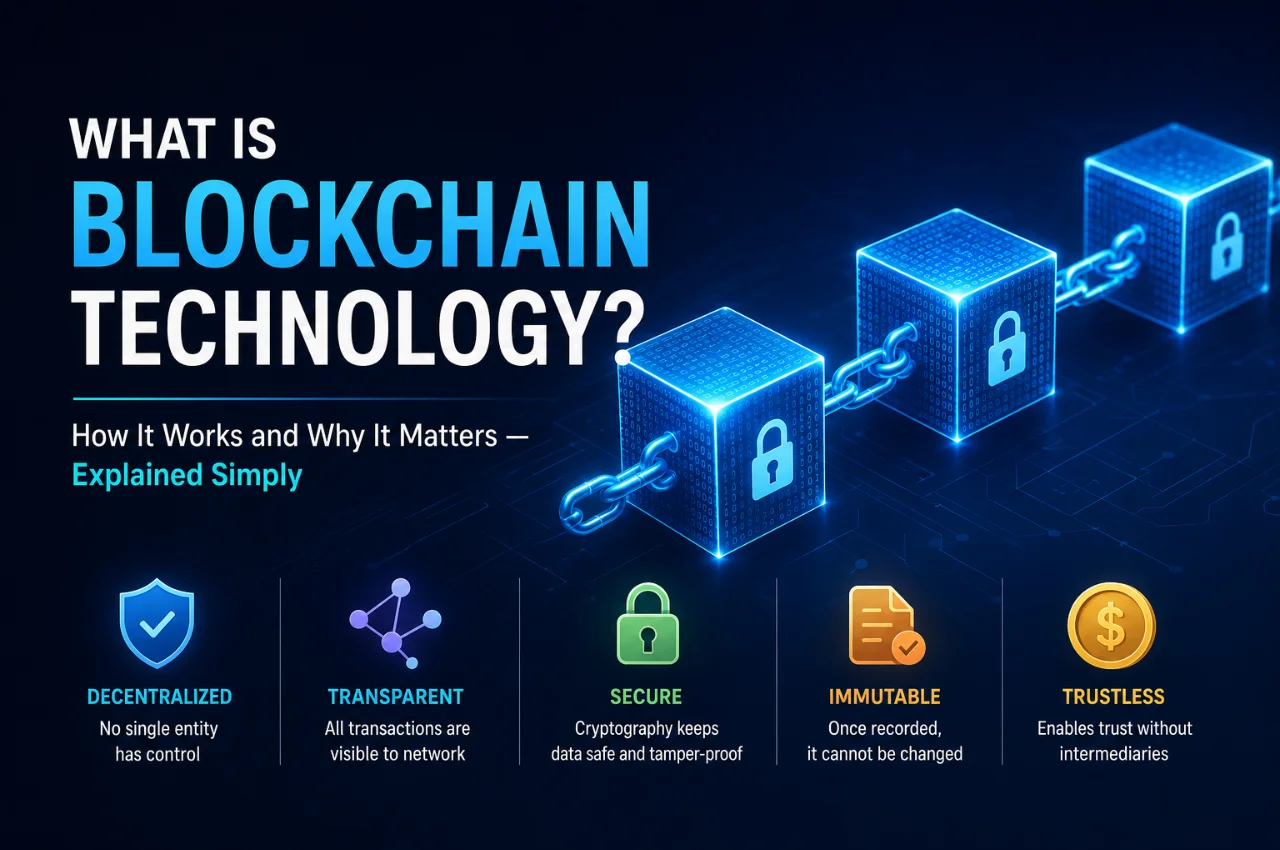
The name blockchain comes directly from how the system is structured. Transactions are grouped together into packages called blocks. Each block is connected to the block before it, forming a continuous chain. Hence: blockchain.
How is Blockchain Different From a Regular Database?
To understand why blockchain is considered significant, you need to understand what makes it fundamentally different from how data is normally stored.
Traditional databases — like the ones banks, governments, and companies use — are centralized. One organization controls the database. They can add records, modify records, delete records, restrict access, and in worst cases, manipulate data for their own interests. When you check your bank balance, you are trusting that your bank’s database is accurate and that they have not made an error or committed fraud. You have no independent way to verify it.
Blockchain is decentralized. No single person, company, or government controls it. The database exists simultaneously on thousands of computers — called nodes — spread across the world. Nobody can unilaterally change the records because changing one copy would immediately conflict with the thousands of other copies that have not changed. Any discrepancy is detected automatically and rejected.
This decentralization creates three properties that traditional databases cannot offer:
Immutability means that once data is recorded on a blockchain, it cannot be altered or deleted. It is permanent. Every transaction ever made on the Bitcoin blockchain, for example, is visible and unchanged since 2009.
Transparency means that anyone can view the complete record of all transactions on a public blockchain. Every transaction is visible to every participant. Nothing is hidden.
Trustlessness means that you do not need to trust any particular person or organization — you trust the mathematics and the consensus of the network. The system itself provides the guarantee, not a central authority.
How Does Blockchain Actually Work? — Step by Step
Here is exactly what happens when a transaction is made on a blockchain, explained step by step in simple terms.
Step one — A transaction is initiated. Someone wants to send money, record a contract, or store any kind of data on the blockchain. They create a transaction request that includes the details of what they want to do.
Step two — The transaction is broadcast to the network. This request is sent out to thousands of computers — nodes — that participate in the blockchain network. Think of it like announcing your transaction to the entire village simultaneously.
Step three — The network validates the transaction. The nodes on the network check whether the transaction is legitimate — does the sender actually have the funds they want to send, or the authority to make the record they want to create? They check this against the existing history of all previous transactions already recorded on the blockchain.
Step four — The transaction is combined with others into a block. Once verified, this transaction is grouped together with other recently validated transactions into a block. Each block typically contains hundreds or thousands of transactions.
Step five — The block is added to the chain. This new block gets attached to the previous block in the chain. This attachment is done through cryptography — specifically, each block contains a unique mathematical fingerprint called a hash of the previous block. This links them permanently together. Changing any data in an old block would change its hash, which would make it no longer match the reference stored in the next block, which would cascade forward through every subsequent block — making tampering immediately detectable.
Step six — The transaction is complete and permanent. Once the block is added to the chain and confirmed by enough nodes in the network, the transaction is permanently recorded. It cannot be reversed, altered, or deleted.
This entire process, which sounds complex in description, happens in seconds to minutes depending on the blockchain being used.
What is a Hash? — The Mathematics Behind Blockchain Security
The word hash appears throughout blockchain explanations and is fundamental to understanding why blockchain is secure. Here is a simple explanation.
A hash is a fixed-length string of characters that is generated by running any piece of data through a mathematical function. The key properties of a hash are that the same input always produces the same output, even a tiny change in the input produces a completely different output, and it is computationally impossible to work backwards from the hash to figure out the original input.
Think of it like a fingerprint for data. Just as every person’s fingerprint is unique and you cannot reconstruct the person from the fingerprint, a hash is a unique fingerprint of any piece of data.
In blockchain, each block contains the hash of the previous block. This creates an unbreakable chain — because if anyone tries to change data in an old block, its hash changes, which breaks its connection to the next block, which breaks every block after that. The modification is immediately visible to the entire network, which rejects it.
This hash-linking is why blockchain records are practically impossible to tamper with — you would need to recalculate the hash of every subsequent block across thousands of computers simultaneously, which would require more computing power than exists on Earth.
What is a Consensus Mechanism? — How the Network Agrees
Since there is no central authority to decide which transactions are valid, blockchain networks need a method for all the participating computers to reach agreement. This is called a consensus mechanism.
Proof of Work is the original consensus mechanism used by Bitcoin. Participating computers called miners compete to solve a complex mathematical puzzle. The first one to solve it gets to add the next block to the chain and earns a reward in cryptocurrency. This competition requires significant computing power and electricity, which is why Bitcoin mining consumes substantial energy. The difficulty of the puzzle is what makes the system secure — attacking the network would require more computing power than all honest participants combined, which is economically prohibitive.
Proof of Stake is a newer consensus mechanism used by Ethereum and many modern blockchains. Instead of competing with computing power, participants lock up a quantity of their own cryptocurrency as a security deposit called a stake. The network randomly selects participants to validate blocks, weighted by the size of their stake. If a validator tries to approve fraudulent transactions, they lose their staked funds. Proof of Stake uses approximately 99 percent less energy than Proof of Work, making it far more environmentally sustainable while maintaining security.
What is Bitcoin? — The First Blockchain Application
Bitcoin is the first and most widely known application of blockchain technology. It was created in 2008 by an anonymous person or group using the name Satoshi Nakamoto and launched in January 2009.
Bitcoin is a digital currency that operates without any central bank, government, or financial institution. Every Bitcoin transaction is recorded permanently on the Bitcoin blockchain — a public record that anyone in the world can verify. Nobody controls Bitcoin — not a company, not a government, not its creator. It operates purely through the decentralized consensus of its network participants.
Bitcoin demonstrated for the first time that it was possible to transfer value between two people anywhere in the world without needing any bank or payment processor in the middle. This was genuinely revolutionary — for the first time in financial history, you could send money directly to someone in another country in minutes without any institution taking a cut, imposing a waiting period, or having the authority to block the transaction.
However, it is critically important to understand something that confuses many people: Bitcoin is an application built on blockchain technology, not blockchain itself. Blockchain is the underlying technology. Bitcoin is one specific use of that technology — digital currency. Blockchain has thousands of other applications that have nothing to do with cryptocurrency.
This relationship is similar to how the internet is a technology, and Gmail is one application built on the internet. You can use the internet for countless things that have nothing to do with email.
What are Smart Contracts? — Blockchain That Executes Itself
Smart contracts are one of the most powerful and important extensions of basic blockchain technology, and they are worth understanding because they are the foundation of most advanced blockchain applications.
A smart contract is a program stored on a blockchain that automatically executes when predetermined conditions are met — without requiring any human intermediary to trigger or verify the execution.
The simplest way to understand smart contracts is through an example. Imagine you are renting an apartment. Normally, the process requires a landlord, a tenant, a rental agreement, and monthly bank transfers — multiple parties and multiple manual steps. A smart contract handles this automatically: when the tenant sends the correct payment amount on the correct date, the smart contract automatically grants access to the digital door lock. If payment is not received, access is automatically revoked. No landlord needs to manually check whether payment arrived and then manually unlock the door. The contract executes itself based purely on whether the conditions were met.
Smart contracts eliminate the need for intermediaries — lawyers, banks, notaries, insurance companies, escrow services — in many types of transactions and agreements. They execute automatically, transparently, and without the possibility of human error, bias, or fraud in the execution step.
Smart contracts were made popular by the Ethereum blockchain, launched in 2015 by Vitalik Buterin. Ethereum was built specifically to support smart contracts — making it a programmable blockchain platform rather than just a currency system.
How is Blockchain Being Used in the Real World?
Blockchain has moved well beyond cryptocurrency into practical applications across many industries. Here are the most significant real-world uses in 2026.
In finance and payments, blockchain enables near-instant cross-border money transfers that bypass the expensive and slow traditional banking correspondent network. What previously took three to five business days and cost significant fees can now happen in minutes at a fraction of the cost. International remittances — money sent home by Indians working abroad — are one area where blockchain-based payment networks are providing genuine cost savings.
In supply chain management, blockchain provides a tamper-proof record of a product’s entire journey — from raw material to final consumer. Walmart uses blockchain to trace food items from farm to shelf in seconds, a process that previously took days of document checking. When a food contamination incident occurs, blockchain allows authorities to identify the exact source within minutes rather than conducting a week-long investigation that results in discarding millions of products.
In healthcare, blockchain provides a secure, patient-controlled record of medical history that can be shared with any authorized healthcare provider while preventing unauthorized access or modification. A patient moving between hospitals can share their verified medical history instantly rather than relying on faxed documents or verbal descriptions of previous treatments.
In digital identity, blockchain enables self-sovereign identity — where individuals control their own verified identity credentials without needing to depend on any government database or corporate platform. This has significant implications for the 1.1 billion people worldwide who lack official government identification documents.
In India specifically, blockchain is being explored and implemented in several significant contexts. The National Informatics Centre is working on blockchain-based land record systems to reduce property fraud — a major problem in India where paper-based records are susceptible to forgery and manipulation. NPCI, which runs UPI, is actively researching blockchain for cross-border payment systems. Several Indian states are piloting blockchain for educational certificate verification to prevent the widespread problem of fake degrees. The Reserve Bank of India launched a Central Bank Digital Currency called the Digital Rupee, which uses distributed ledger technology related to blockchain principles.
In voting systems, blockchain offers the potential for tamper-proof digital voting where every vote is permanently recorded and independently verifiable while maintaining voter anonymity — addressing concerns about election fraud that plague both paper and traditional electronic voting systems.
In NFTs and digital ownership, blockchain enables verifiable, transferable ownership of digital assets — whether digital art, music, gaming items, or any other digital content. While NFT speculation attracted enormous media attention during the 2021 boom, the underlying concept of blockchain-verified digital ownership has lasting applications in creative industries and gaming.
The Four Types of Blockchain
Not all blockchains are the same. They are designed differently for different purposes.
Public blockchains are completely open — anyone can participate, view all transactions, and contribute to validation. Bitcoin and Ethereum are public blockchains. They are the most decentralized and transparent but also the slowest and most energy-intensive.
Private blockchains are controlled by a single organization. Only authorized participants can join, view transactions, and contribute to validation. A bank building its own internal blockchain for transaction processing would use a private blockchain. These are faster and more efficient but sacrifice decentralization.
Consortium blockchains are controlled by a group of organizations rather than a single one. For example, a group of banks, shipping companies, or healthcare providers might collectively operate a consortium blockchain where each member is a validator. This balances the efficiency of private blockchains with some of the trust benefits of decentralization.
Hybrid blockchains combine elements of public and private blockchains — some data is public and verifiable while other data remains private. These are increasingly used by enterprises that want blockchain benefits without exposing proprietary information.
Why Does Blockchain Matter? The Three Biggest Reasons
After understanding what blockchain is and how it works, the question becomes: why does it actually matter for ordinary people?
First, it removes the need to trust intermediaries. Virtually every important transaction in modern life requires trusting an intermediary — a bank to hold and transfer your money, a government to record property ownership, a company to accurately maintain your account. Each of these intermediaries charges fees, creates delays, can make errors, can commit fraud, and can be subject to political pressure. Blockchain creates systems where trust is built into the mathematics of the network itself rather than into any specific organization. You do not need to trust the bank — you trust the blockchain.
Second, it enables genuine financial inclusion. Approximately 1.4 billion adults worldwide have no bank account — including significant populations in India, Africa, and Southeast Asia. Traditional banking requires physical infrastructure, documentation, minimum balances, and formal employment that billions of people simply cannot provide. A blockchain-based financial system requires nothing more than a smartphone and internet connection to participate fully.
Third, it creates permanent, verifiable records. In many parts of the world — including India — property records, educational certificates, business registrations, and other important documents are still paper-based and susceptible to fraud, loss, or manipulation. Blockchain creates permanent, unalterable records that anyone can verify without needing to trust any specific government office or institution.
What Blockchain is Not — Clearing Up Common Misconceptions
Several widespread misconceptions about blockchain are worth addressing directly.
Blockchain is not the same as Bitcoin. Bitcoin is one application of blockchain technology. Blockchain has thousands of applications that have nothing to do with cryptocurrency. Conflating the two is like saying “the internet is the same as email.”
Blockchain is not anonymous. Most public blockchains — including Bitcoin — are pseudonymous rather than anonymous. Every transaction is publicly visible to anyone in the world. While wallet addresses do not automatically reveal the owner’s identity, sophisticated analysis can often link addresses to real-world identities. Privacy-focused blockchains that use additional cryptographic techniques offer stronger anonymity, but most standard blockchains are actually more transparent than traditional banking.
Blockchain is not unhackable. The blockchain itself — the chain of blocks — is extremely difficult to alter due to the distributed consensus mechanism. However, applications built on top of blockchain — cryptocurrency exchanges, wallets, and smart contracts — have security vulnerabilities. Billions of dollars have been stolen from blockchain-based applications through software vulnerabilities, phishing attacks, and poorly written smart contracts. The chain is secure; the applications built on it require their own rigorous security.
Blockchain is not a solution for everything. Blockchain introduces complexity, energy consumption, and slower processing compared to centralized databases for many applications. The advantages of decentralization and immutability are genuinely valuable for some use cases — financial transactions, ownership records, supply chain tracking. For other applications, a traditional centralized database is simpler, faster, and more appropriate. Blockchain is a powerful tool for specific problems, not a universal replacement for all existing systems.
Key Takeaway
Blockchain is a genuinely significant technology — not because of cryptocurrency speculation, but because it solves a fundamental problem that has limited human economic activity for centuries: how to create permanent, verifiable, tamper-proof records and enable trustworthy transactions between parties who do not need to rely on a central authority.
For the first time in history, it is possible to record ownership, transfer value, and execute agreements between any two people anywhere in the world — permanently, transparently, and without needing to trust any bank, government, or institution to mediate the process.
Whether you interact with blockchain directly through cryptocurrency, encounter it through a supply chain tracking system, benefit from it through reduced remittance fees, or eventually use it through India’s digital currency — understanding what it is and how it works puts you in a much better position to navigate the digital economy of the coming decade.
Frequently Asked Questions
Is blockchain the same as cryptocurrency?
No — blockchain is the underlying technology, and cryptocurrency is one application of that technology. Bitcoin and Ethereum are cryptocurrencies that run on their respective blockchains. But blockchain is used for supply chain tracking, healthcare records, digital identity, voting systems, and many other applications that have nothing to do with cryptocurrency. The relationship is similar to the internet and email — email is one application that runs on the internet, but the internet is used for vastly more.
Is blockchain safe and secure?
The blockchain structure itself is extremely secure due to its distributed nature and cryptographic linking of blocks. Altering recorded data would require simultaneously controlling more computing power than the entire rest of the network combined, which is practically impossible for established blockchains. However, applications built on blockchain — wallets, exchanges, and smart contracts — can have vulnerabilities and have been exploited. The chain is secure; caution is required with applications built on top of it.
Does blockchain use a lot of electricity?
Proof of Work blockchains — primarily Bitcoin — do consume significant electricity because mining requires enormous computational power. This is a legitimate environmental concern. However, Proof of Stake blockchains — including Ethereum since 2022 and most newer blockchains — use approximately 99 percent less energy than Proof of Work. The environmental impact of blockchain depends heavily on which specific blockchain is being discussed.
Can blockchain be used without cryptocurrency?
Absolutely. Many enterprise blockchain implementations — including those used for supply chain tracking, healthcare records, land registration, and identity verification — operate without any cryptocurrency component. The distributed ledger technology can be used purely for record-keeping without any digital currency element.
What is the difference between blockchain and a regular database?
A regular database is controlled by a single organization that can add, modify, or delete records. It requires you to trust that organization to maintain the data accurately and honestly. A blockchain is distributed across thousands of computers with no single controller, and once data is recorded it cannot be altered. It does not require trust in any specific organization — the system’s mathematics provides the guarantee instead.
Is India using blockchain technology?
Yes — blockchain adoption in India is growing across multiple sectors. The RBI has launched the Digital Rupee using distributed ledger technology. Several state governments are piloting blockchain-based land records to reduce property fraud. NPCI is researching blockchain for cross-border UPI payments. Educational institutions are using blockchain for certificate verification. The Indian blockchain market was valued at approximately 1.6 billion dollars in 2026 and is growing rapidly.
Final Thoughts
Blockchain is one of those technologies that seems complicated from the outside but becomes clear and logical once you understand the core problem it solves: creating trust without requiring a trustworthy central authority.
The implications of that capability are genuinely profound. Financial systems that cannot be corrupted or controlled by any government or bank. Property records that cannot be forged. Supply chains that cannot be falsified. Medical records that cannot be lost or altered. Contracts that execute themselves automatically and cannot be manipulated.
We are still in the early stages of blockchain’s deployment. Many of the applications described in this guide are being built right now. The technology has real limitations — speed, energy consumption, complexity, and regulatory uncertainty — that are being actively worked on.
But the core innovation is real, the use cases are practical, and the impact is already being felt in payments, supply chains, identity systems, and financial inclusion worldwide. Understanding blockchain is increasingly part of understanding how the digital world around you actually works.