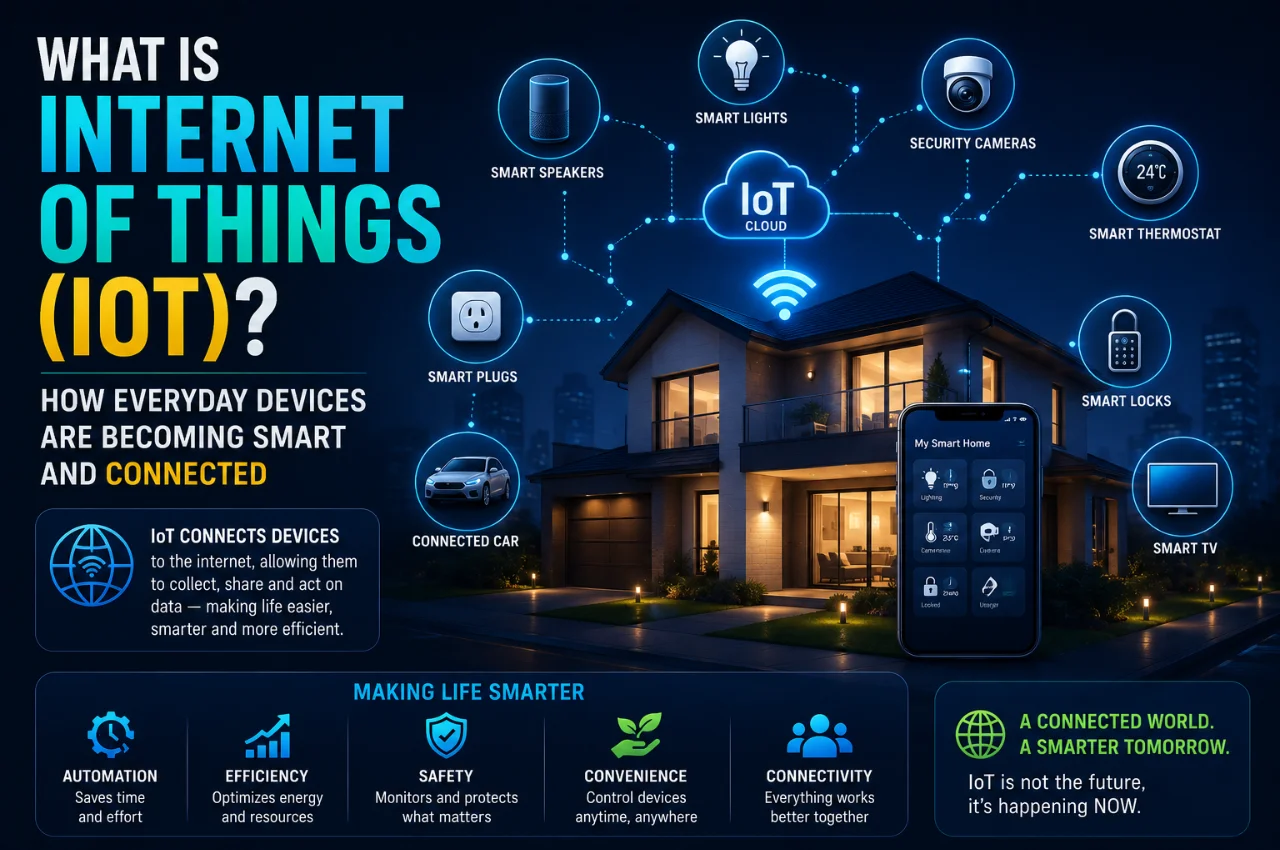
Your smartwatch tracks your steps and heart rate without you doing anything. Your smart TV suggests shows based on what you watched last week. Your friend’s refrigerator sends an alert when milk runs low. Your building’s air conditioner adjusts automatically when the room temperature changes.
None of these devices need you to manually check, update, or instruct them. They collect data, process it, and act on it — on their own, through the internet.
This is the Internet of Things. And in 2026, it is no longer a futuristic concept from science fiction. It is the technology quietly running in the background of homes, hospitals, factories, farms, and cities around the world — and its impact on everyday life is growing faster than almost any technology in history.
This guide explains exactly what IoT is, how it works, where it already exists in your daily life, and where it is heading next — in plain, simple language with real examples anyone can understand.
What is the Internet of Things (IoT)?
The Internet of Things, commonly abbreviated as IoT, refers to the vast network of physical objects — devices, appliances, vehicles, machines, and sensors — that are embedded with technology enabling them to connect to the internet, collect data, and communicate with each other and with us, often without requiring any human involvement.
The name itself tells you exactly what it means. The “Internet” refers to the global network that connects computers and devices worldwide. “Things” refers to physical objects in the real world — your watch, your light bulb, your car, your water meter, your medical device. “Internet of Things” means connecting these physical things to the internet so they can share data and take actions intelligently.
For most of the internet’s history, the only devices connected to it were computers and smartphones — screens that humans looked at and interacted with directly. The Internet of Things expands this concept dramatically: now it is not just our screens that are connected, but the physical objects all around us.
A traditional light switch does one thing — it turns a light on or off when you physically flip it. A smart light bulb connected to the IoT can turn itself on when you arrive home, adjust its brightness based on the time of day, respond to your voice commands, be controlled from the other side of the world through an app on your phone, and track how much electricity it is using over time.
That transformation — from a passive, single-function object to an intelligent, connected, data-sharing device — is what IoT does to every physical object it touches.
How Does IoT Actually Work? — The Four Steps
Every IoT system, regardless of how simple or complex it is, follows the same fundamental four-step process.
Step One — Sensing
The first step is collecting data from the physical world. IoT devices are embedded with sensors — tiny components that can measure and detect things in the environment. Different sensors detect different things. Temperature sensors measure heat and cold. Motion sensors detect movement. Pressure sensors measure force. Light sensors detect brightness. GPS sensors track location. Heart rate sensors measure pulse. Humidity sensors measure moisture in the air.
These sensors are constantly monitoring the physical world around them and generating data. A smartwatch sensor records your heart rate every second. A factory machine sensor monitors vibration levels continuously. A smart thermostat sensor tracks the temperature in your home all day and night.
Step Two — Connectivity
The data collected by sensors needs to travel somewhere to be useful. IoT devices connect to networks to transmit this data — using a variety of connectivity technologies depending on the device and its purpose. Common connectivity methods include Wi-Fi for home devices, Bluetooth for short-range device-to-device communication, 4G and 5G cellular networks for mobile and outdoor devices, Zigbee and Z-Wave for smart home device networks, and LoRaWAN for low-power devices that need to transmit small amounts of data over long distances.
The arrival of 5G networks has been a major accelerator for IoT in 2026. 5G’s combination of extremely high speed, very low latency, and the ability to support enormous numbers of simultaneously connected devices makes it the ideal network infrastructure for large-scale IoT deployments — from smart cities to industrial automation.
Step Three — Data Processing
Once the data reaches its destination — either a cloud server or an edge computing device located nearby — it is processed and analyzed. This is where the intelligence in IoT lives. Raw sensor data on its own is not very useful. Analysis of that data is what creates value.
A smart thermostat does not just record that the temperature is 28 degrees. It analyzes your behavior patterns over weeks, learns what temperature you prefer at what times of day, notices when you typically arrive home, and uses all of this to predict and adjust the temperature in advance — so your home is comfortable when you arrive without wasting energy while you are away.
Increasingly, artificial intelligence and machine learning are integrated into IoT data processing. Rather than simple if-then rules, AI-powered IoT systems can identify complex patterns, make predictions, and improve their decision-making over time through experience. This combination — IoT hardware collecting real-world data and AI making sense of it — is called AIoT (Artificial Intelligence of Things) and represents the cutting edge of this technology in 2026.
Step Four — Action
The final step is where IoT creates its most visible value — taking action based on the processed data. This action can be physical — a smart lock unlocking a door, a smart sprinkler starting to water a lawn, a factory robot adjusting its speed, a medical device releasing medication at the correct dosage. Or it can be informational — sending you an alert on your phone, displaying updated data on a dashboard, or sharing information with another connected device.
The beauty of IoT is that this entire four-step process — sense, connect, process, act — can happen continuously, automatically, and with minimal or zero human involvement. The system monitors, thinks, and responds on its own.
IoT in Your Daily Life — Real Examples You Already Use
IoT is not an abstract future technology. It is already present in the lives of hundreds of millions of people right now. Here are the most common ways you are likely already interacting with it.
Smart Homes
The smart home is the most familiar face of IoT for most consumers. Smart speakers like Amazon Echo and Google Home respond to voice commands and control other connected devices. Smart thermostats like Google Nest learn your preferences and optimize heating and cooling automatically. Smart lighting systems like Philips Hue allow you to control every light in your home from your phone, set schedules, and adjust brightness and color. Smart door locks let you lock and unlock your home remotely and know who is coming and going. Smart security cameras detect motion, send alerts, and allow you to check a live feed from anywhere. Smart plugs let you control any appliance — a fan, a lamp, a coffee machine — through an app.
In India, smart home adoption is growing rapidly, driven by affordable devices from brands like Xiaomi, Wipro, and Havells, and integration with Google Home and Amazon Alexa ecosystems that work seamlessly with Android phones.
Wearable Devices
Your smartwatch or fitness band is an IoT device. It continuously collects data about your body — steps taken, heart rate, blood oxygen levels, sleep quality, calories burned — and syncs this data to your phone and to cloud servers where it is analyzed and presented back to you as health insights. Some advanced wearables can detect irregular heart rhythms and alert both the wearer and their doctor. Others can measure blood glucose levels continuously for diabetics — eliminating the need for multiple daily finger-prick tests.
Connected Vehicles
Modern cars are increasingly IoT-enabled. They have built-in GPS that tracks location in real time, sensors that monitor engine health and alert you when maintenance is needed, systems that automatically call emergency services after an accident, and connectivity that allows manufacturers to push software updates remotely. Electric vehicles like Tesla take this further — the car continuously sends performance data to the manufacturer, which can diagnose issues remotely and in many cases fix them through over-the-air software updates without the car ever visiting a service centre.
Healthcare and Medical Devices
IoT is transforming healthcare in ways that save lives. Patients with chronic conditions wear continuous monitoring devices that track vital signs in real time and send data directly to their doctors. If a reading falls outside safe parameters — a heart rate becomes dangerously irregular, blood pressure spikes — the system alerts the medical team immediately, often before the patient is even aware something is wrong. Hospitals use IoT to track the location of expensive medical equipment within the facility in real time, dramatically reducing time spent searching for devices. Smart pill dispensers remind patients to take medication at the correct times and track whether doses have been taken.
Smart Agriculture
Farming is one of the most impactful and least-discussed applications of IoT. Indian farmers are increasingly using IoT sensors embedded in soil to monitor moisture levels, temperature, nutrient content, and pH in real time. When soil moisture drops below a threshold, smart irrigation systems activate automatically — delivering precisely the right amount of water to exactly the right place. This reduces water waste by up to 30 percent compared to traditional irrigation. Drone-mounted sensors survey crop health from the air, identifying disease, pest infestations, or nutrient deficiencies in specific sections of a field before they spread. Weather stations connected to IoT networks provide hyperlocal real-time weather data that helps farmers make better decisions about planting, harvesting, and applying fertilizers.
Smart Cities
IoT is the technology that makes smart cities possible. Street lighting that automatically adjusts brightness based on whether anyone is present — saving significant electricity. Traffic signals that analyze real-time traffic flow and adjust signal timing to reduce congestion. Smart waste management bins that alert collection services only when they are full — eliminating unnecessary collection runs. Smart water meters that detect leaks in distribution pipes immediately. Public transport systems that provide real-time arrival information and optimize routes based on passenger demand. Air quality monitoring networks that track pollution levels across an entire city continuously. India’s Smart Cities Mission has deployed IoT infrastructure across dozens of Indian cities, with projects in Pune, Surat, Bhopal, and others demonstrating measurable improvements in urban efficiency.
Industrial IoT (IIoT)
In factories, manufacturing plants, and industrial facilities, IoT is delivering some of its most dramatic economic value. Sensors on machinery continuously monitor vibration, temperature, pressure, and other indicators of mechanical health. Predictive maintenance systems analyze this data to identify when a machine is likely to fail — days or weeks in advance — so maintenance can be scheduled before a breakdown occurs rather than after. This shift from reactive to predictive maintenance reduces unplanned downtime by up to 50 percent in well-implemented industrial IoT deployments. Supply chain management uses IoT to track the location and condition of goods in transit in real time — knowing exactly where every shipment is, its temperature if it requires refrigeration, and whether it has been handled correctly throughout its journey.
How Many IoT Devices Exist? — The Scale of the Network
The scale of the Internet of Things is difficult to comprehend. As of 2026, there are approximately 20 to 21 billion IoT devices connected and active worldwide. This number is growing rapidly and is projected to reach nearly 40 billion by 2030.
To put that in perspective — that is more than four connected devices for every person on Earth, and most of these devices are not smartphones or computers. They are sensors, monitors, trackers, and actuators embedded in the physical world around us, silently collecting data and performing actions around the clock.
India is one of the fastest-growing IoT markets in the world. The Indian IoT market is expected to reach approximately 9.8 billion dollars by 2026, growing at a compound annual growth rate of over 28 percent. This growth is driven by smart manufacturing under the Make in India initiative, agricultural IoT adoption, rapid smart city development, and the explosion of affordable consumer IoT devices accessible to India’s massive and growing middle class.
The Technology That Makes IoT Possible
Several technologies work together to make the Internet of Things function. Understanding them helps you understand why IoT has grown so rapidly in recent years.
Miniaturization of sensors and chips has been the foundational enabler. Computer chips and sensors have shrunk to the point where they can be embedded in almost any object — a ring, a soil probe, a medical patch, a factory bolt — at very low cost. What once required a device the size of a desktop computer can now fit in something smaller than a fingernail.
Wireless connectivity proliferation means that virtually everywhere in the developed world — and increasingly everywhere in India — there is reliable wireless connectivity available. Wi-Fi, cellular networks, and low-power wireless protocols mean IoT devices can connect from almost any location.
Cloud computing provides the storage and computing power to process the enormous volumes of data that billions of IoT devices generate. Without scalable cloud infrastructure, storing and analyzing IoT data would be impossibly expensive.
Edge computing has become increasingly important as IoT scales. Rather than sending all data to distant cloud servers for processing, edge computing processes data locally — on a nearby device or gateway — before sending only the relevant results to the cloud. This reduces latency, saves bandwidth, and enables faster real-time responses.
Artificial intelligence transforms raw IoT data into genuine intelligence. Pattern recognition, anomaly detection, predictive modeling, and automated decision-making all become possible when AI is applied to the continuous streams of data that IoT devices generate.
5G networks provide the high-speed, low-latency, high-density connectivity that large-scale IoT deployments require. A smart city with thousands of connected sensors, or a factory floor with hundreds of connected machines, needs network infrastructure that can handle massive simultaneous data transmission reliably.
IoT and Privacy — What Data Is Being Collected About You
IoT devices are extraordinarily useful — but they are also extraordinarily good at collecting data. And that data collection raises serious privacy questions that every IoT user should understand.
Your smart speaker is always listening for its wake word — which means it is always listening. Your smart TV tracks what you watch. Your fitness tracker knows your daily routine, your sleep patterns, and your health metrics. Your smart car tracks your driving routes. Your smart home devices collectively create a detailed picture of when you are home, what rooms you use, what your habits are, and much more.
All of this data is typically stored on the servers of the companies that make these devices. It may be used to improve the service, to serve you targeted advertising, or in some cases to share with third parties. In the event of a data breach, this intimate behavioral data could be exposed.
The practical advice for IoT users is to review privacy settings on all connected devices, understand what data each device collects and how it is used, use strong unique passwords for all IoT device accounts, keep device firmware updated to protect against security vulnerabilities, and disable features you do not actively use — a camera or microphone you do not need does not need to be enabled.
IoT Security — Why Connected Devices Need Protecting
Every IoT device connected to the internet is a potential entry point for attackers. This is one of the most significant challenges facing IoT in 2026 — and one that many consumers significantly underestimate.
Many IoT devices — particularly inexpensive smart home products — are manufactured with minimal security features. They may use default passwords that are never changed, run outdated software with known vulnerabilities, lack encryption for the data they transmit, or have no mechanism for receiving security updates after purchase.
Attackers who compromise IoT devices can use them to spy on the people in the home, gain access to the local network and from there to computers and sensitive data, or recruit the device into a botnet — a network of compromised devices used to conduct attacks on other targets. AI-driven attacks on IoT endpoints increased by 33 percent in 2025 alone, demonstrating how rapidly this threat is growing.
The security precautions for IoT devices are straightforward but important. Always change default passwords immediately after setting up any IoT device. Keep device firmware updated — manufacturers release updates that patch security vulnerabilities. Use a separate Wi-Fi network for IoT devices if your router supports it, so that a compromised device cannot reach your computer or phone. Research any IoT product’s security practices before purchasing — established brands from reputable manufacturers invest more in security than no-name cheap imports.
The Future of IoT — Where This Is All Going
IoT in 2026 is impressive — but it is still early in its development. The trajectory of this technology points toward a world where the boundary between the physical and digital dissolves almost entirely.
AIoT — the combination of artificial intelligence with IoT — is the most significant direction. As AI models become embedded directly in IoT devices rather than requiring cloud processing, these devices will become capable of sophisticated local intelligence. A security camera that can identify specific people, understand context, and make nuanced decisions locally without sending video to the cloud. A medical device that can diagnose conditions and adjust treatment in real time without needing a doctor to review data.
Smart cities will become dramatically more sophisticated — real-time optimization of every urban system simultaneously, from traffic and energy to waste and water, creating cities that are measurably safer, cleaner, and more efficient.
Healthcare will be transformed by continuous monitoring combined with AI diagnosis — shifting medicine from treating illness after it occurs to detecting and preventing it before symptoms appear.
Agriculture will become dramatically more precise — every plant in a field individually monitored and given exactly the inputs it needs, eliminating waste and maximizing yield.
And in homes, the vision of a truly intelligent home that anticipates your needs, adapts to your preferences automatically, and manages energy and resources with complete efficiency is steadily becoming reality.
Key Takeaway
The Internet of Things is the technology that is turning the physical world into an intelligent, connected network. It is already in your smartwatch, your TV, your car, your city’s infrastructure, and the farms that grow your food. By 2026, over 20 billion physical objects are connected to this network — and that number will double again by 2030.
IoT creates genuine value — in convenience, efficiency, health monitoring, industrial productivity, and resource conservation. It also creates genuine risks — in privacy, data security, and the vulnerability of connected devices to attack. Understanding both sides is essential for anyone navigating the increasingly IoT-connected world.
The smart devices around you are not just gadgets. They are nodes in a global network that is quietly, continuously making the physical world more intelligent. Now you understand exactly how that works.
Frequently Asked Questions
What is the difference between IoT and the regular internet?
The regular internet connects computers and smartphones — screens that humans look at and interact with. IoT extends internet connectivity to physical objects — sensors, appliances, machines, and devices that interact with the physical world. IoT is an expansion of the internet into the physical environment, not a replacement for it.
Is my smartphone an IoT device?
Not typically, by the standard definition. Smartphones are general-purpose computing devices designed primarily for human interaction. IoT devices are typically purpose-specific objects — a sensor, an appliance, a monitor — that are embedded with connectivity to perform a specific function automatically. However, smartphones often serve as the control hub and companion interface for IoT devices.
How does IoT affect ordinary people in India?
IoT affects Indian consumers through smart home devices, fitness trackers and smartwatches, connected vehicles, smart electricity and water meters being installed by utilities, precision agriculture benefiting farmers, smart city infrastructure being deployed in dozens of Indian cities, and healthcare monitoring devices that are increasingly accessible. The Indian IoT market is one of the fastest-growing in the world.
Are IoT devices safe to use?
IoT devices from reputable manufacturers with strong security practices are generally safe when set up and used correctly. The main risks come from devices with weak default passwords, outdated firmware, or poor security implementation — particularly from inexpensive no-name products. Following basic security practices — changing default passwords, keeping firmware updated, using separate network segments for IoT devices — significantly reduces the risk.
What is the difference between IoT and smart devices?
The terms are closely related. A smart device is any device with computing capability and connectivity — a smart TV, a smartwatch, a smart thermostat. IoT is the broader concept — the network that these smart devices form when they are connected and communicating with each other and with cloud systems. Smart devices are the individual nodes; IoT is the network they create together.
What is the connection between IoT and 5G?
5G provides the network infrastructure that enables large-scale IoT deployments to reach their full potential. 5G’s high speed, very low latency, and ability to support a very large number of simultaneously connected devices per area makes it ideal for smart city deployments, industrial IoT, and connected vehicle systems that require reliable real-time communication between large numbers of devices.
Final Thoughts
The Internet of Things is one of the most consequential technology developments of the 21st century. It represents a fundamental shift — from a world where the internet exists in screens we look at, to a world where intelligence and connectivity are woven into the physical fabric of everything around us.
The implications are enormous — for how we manage our health, run our homes, grow our food, build our cities, and operate our industries. Most of these changes are already underway. The IoT revolution is not coming. It is already here.
Understanding what IoT is, how it works, and how it is already affecting your life puts you in a far stronger position to benefit from it, to make informed choices about the connected devices you adopt, and to protect your privacy and security as the physical world around you becomes increasingly connected.