Netflix knows you are going to love that new series before you have even heard of it. Spotify creates a playlist that somehow matches your exact mood. Your bank automatically blocks a suspicious transaction before you even notice it. Your email filters spam without you setting any rules. Your phone’s camera recognizes your face in a fraction of a second.
None of these experiences involve a human programmer who wrote specific rules for every situation. Instead, they are powered by a technology called machine learning — computers that have learned to make intelligent decisions on their own, by studying patterns in enormous amounts of data.
Machine learning is arguably the most important technology of the 21st century. It is the engine behind artificial intelligence, behind ChatGPT, behind Google Search, behind self-driving cars, and behind almost every smart feature on your phone. And yet most people have only the vaguest understanding of what it actually is.
This guide explains machine learning completely, in plain language, with real examples you can relate to — no prior technical knowledge required.
What is Machine Learning? — The Simplest Explanation
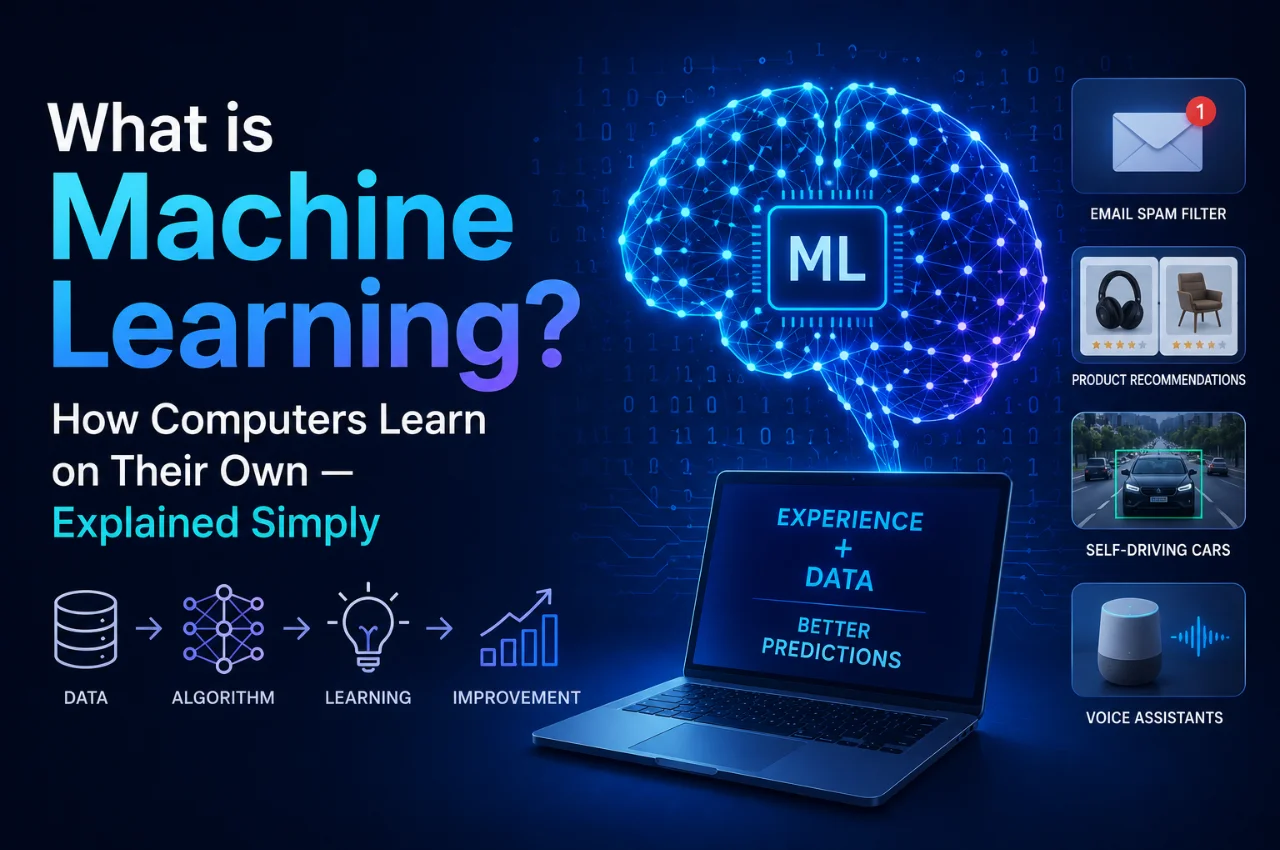
Machine learning is a way of teaching computers to learn from experience and improve their performance over time — without being explicitly programmed for every specific situation they might encounter.
Traditional computer programming works like this: a human programmer writes specific rules — if this happens, do that. The computer follows those rules exactly. It can only handle situations that the programmer anticipated and wrote rules for. It cannot adapt to new situations on its own.
Machine learning works differently. Instead of programming rules, you give the computer thousands — or millions — of examples, and let it figure out the patterns on its own. The computer studies these examples, identifies the underlying patterns, and learns to make predictions or decisions when it encounters new, unseen situations.
Here is the most useful analogy to understand machine learning intuitively. Imagine teaching a child to recognize dogs. You do not sit down and explain the rules of what makes something a dog — four legs, fur, barks, wagging tail, and so on. Instead, you show the child hundreds of photos and say “dog” for each one that is a dog and “not a dog” for each one that is not. After enough examples, the child learns to recognize dogs on their own — even dog breeds they have never seen before, in photos taken from unfamiliar angles.
Machine learning works exactly the same way. You show the computer thousands of labeled examples. It learns the patterns. It applies those patterns to new situations.
This is why machine learning can do things that traditional programming cannot — like recognizing faces in photos, understanding spoken language, detecting cancer in medical scans, or predicting what product a person wants to buy next. There are no fixed rules that a programmer could write for these tasks. The patterns are too complex, too varied, and too numerous. Machine learning finds those patterns automatically from data.
A Brief History — How Machine Learning Was Born
Machine learning did not appear suddenly. Its development spans over seven decades of research, with several key breakthroughs that completely changed what was possible.
The concept was first named and demonstrated in 1959 by Arthur Samuel, an IBM researcher who created a checkers-playing program. What was revolutionary about Samuel’s program was not that it played checkers — it was that it improved its own play by analyzing thousands of games. It was not programmed with specific strategies. It learned strategies on its own through experience. Samuel called this ability “machine learning” — and the name stuck.
Throughout the 1960s and 1970s, researchers developed foundational algorithms and the concept of artificial neural networks — computer systems loosely inspired by how neurons in the human brain connect and communicate. These early networks were limited by the computing power and data volumes of the time.
The 1980s and 1990s saw the development of more practical machine learning algorithms — decision trees, support vector machines, and statistical methods that could be applied to real business problems like credit scoring and medical diagnosis.
The modern machine learning era truly began in 2012 when a deep neural network called AlexNet won the ImageNet image recognition competition by a dramatic margin — using a GPU-accelerated deep learning approach that outperformed all previous methods. This demonstrated that deep learning — a specific type of machine learning using many layers of neural networks — could solve problems that had seemed intractable. The deep learning revolution had begun.
Between 2012 and 2022, machine learning capabilities advanced at an extraordinary rate — from image recognition to speech understanding to language generation. The launch of ChatGPT in November 2022 brought machine learning to the mainstream public consciousness — showing ordinary people for the first time what the technology could do in a directly accessible form.
In 2026, machine learning is the foundation of virtually every major AI product and service in the world, and the pace of advancement continues to accelerate.
How Does Machine Learning Actually Work? — Step by Step
Understanding the basic process behind machine learning makes everything else clearer. Here is what happens, step by step, in simple terms.
Step one — data collection. Machine learning starts with data. Large amounts of it. To teach a computer to recognize spam emails, you need thousands of examples of spam emails and thousands of examples of legitimate emails. To teach a computer to predict house prices, you need data from thousands of property sales. The quality and quantity of this data is the foundation of everything — garbage data produces garbage results, regardless of how sophisticated the algorithm is.
Step two — data preparation. Raw data is almost never ready to use directly. It needs to be cleaned, organized, and formatted. Inconsistencies are removed. Missing values are handled. The data is divided into a training set — used to teach the model — and a test set — held back to evaluate how well the model performs on data it has never seen.
Step three — choosing a model. A machine learning model is the mathematical framework that will learn from the data. Different types of problems require different types of models. The choice of model is one of the key decisions in building any machine learning system.
Step four — training. The model is exposed to the training data and begins learning. It makes predictions. It compares its predictions to the correct answers. It measures the error — how far off its predictions were. It adjusts its internal settings slightly to reduce that error. This process repeats thousands or millions of times, with the model gradually getting better at making accurate predictions. This iterative process of making predictions and adjusting based on errors is the core of how machine learning happens.
Step five — evaluation. After training, the model is tested on the test set — data it has never seen before. This tells you how well the model has genuinely learned the patterns versus simply memorizing the training examples. A model that performs well on training data but poorly on new data has a problem called overfitting — it has learned the training data too specifically rather than learning the underlying patterns that generalize to new situations.
Step six — deployment. Once the model performs well on test data, it is deployed — put into real-world use. But the process does not stop there. The model continues to receive new data and can continue to improve its performance over time. This is why Netflix’s recommendations get better the more you use it, and why spam filters become more accurate over time — the models continue learning from new data even after deployment.
The Three Main Types of Machine Learning
Not all machine learning works the same way. There are three fundamental approaches, each suited to different types of problems.
Supervised learning is the most common type.
The model is trained on labeled data — examples where the correct answer is already known. You provide the computer with input data and the corresponding correct output, and it learns to map inputs to outputs.
Think of it like a student studying with an answer key.
The student sees the question and the correct answer, and learns the patterns that connect them. After studying enough examples, the student can answer new questions correctly even without seeing the answer key.
Examples of supervised learning in everyday life include email spam filters — trained on thousands of emails labeled as spam or not spam. Image recognition — trained on millions of photos labeled with what they contain. Credit card fraud detection — trained on historical transactions labeled as fraudulent or legitimate. Medical diagnosis AI — trained on patient records labeled with their diagnoses. Voice assistants — trained on recordings of spoken words labeled with their text transcriptions.
Unsupervised learning works with unlabeled data.
There are no correct answers provided. The model must find patterns and structures in the data on its own. Rather than learning to map inputs to known outputs, it discovers hidden groupings and relationships within the data.
Think of it like a librarian who is given thousands of books with no titles, authors, or categories, and asked to organize them in a way that makes sense. The librarian reads the books and groups similar ones together — mysteries in one section, science fiction in another, romance in another — based on their content, without being told what categories to use.
Examples of unsupervised learning include customer segmentation — grouping customers with similar behavior without predefined categories. Recommendation systems — discovering that customers who bought item A also tend to buy item B. Anomaly detection — identifying unusual patterns that might indicate fraud or equipment failure. Data compression — finding the most important patterns in large datasets and representing them more efficiently.
Reinforcement learning is fundamentally different from both of the above.
The model — called an agent — learns by interacting with an environment and receiving rewards for good decisions and penalties for bad ones. It learns through trial and error, gradually figuring out which actions lead to the best outcomes over time.
Think of it like training a dog. You do not explain to the dog in detail what you want it to do. You reward it with treats when it does something right and withhold rewards when it does something wrong. Over time, the dog learns to repeat the actions that earn rewards. Reinforcement learning works on exactly this principle.
Examples of reinforcement learning include game-playing AI — the systems that learned to play chess, Go, and video games at superhuman levels. Robot control — teaching robots to walk, balance, and manipulate objects. Autonomous vehicles — training self-driving systems to make driving decisions in complex environments. Personalized content delivery — learning which content to show each user to maximize engagement.
What is Deep Learning? — The Powerful Subset of Machine Learning
You have probably heard “deep learning” mentioned alongside machine learning. Here is exactly what it means and how it differs.
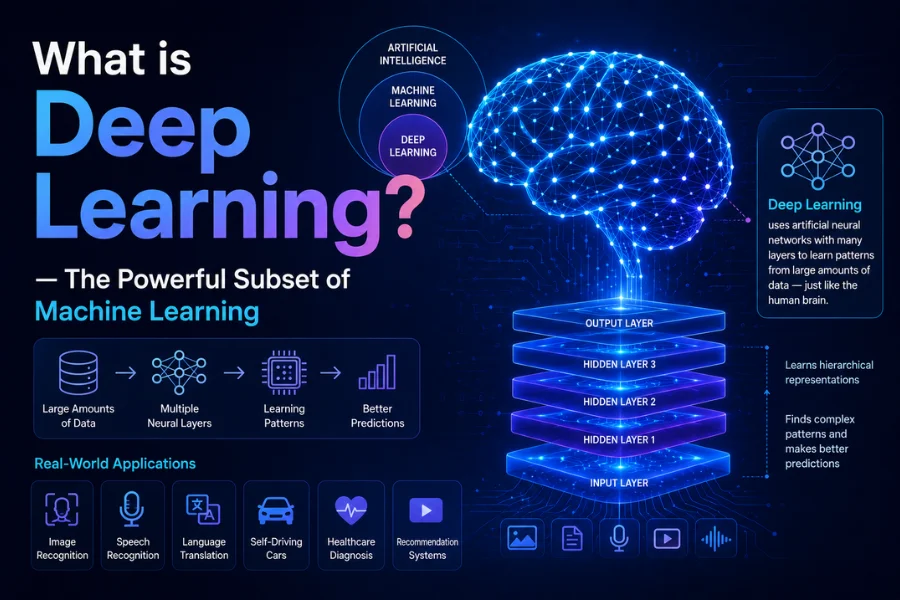
Deep learning is a specific type of machine learning that uses artificial neural networks with many layers — hence “deep” — to learn from data. The term neural network comes from a loose inspiration in the structure of the human brain, where billions of neurons are connected to each other and information flows through these connections.
An artificial neural network consists of layers of mathematical nodes — called neurons — that are connected to each other. Data enters through the input layer, passes through multiple hidden layers where it is progressively transformed, and exits through the output layer as a prediction or classification.
What makes deep learning powerful is that each layer learns to recognize increasingly complex features. In an image recognition system, the first layers might learn to detect basic edges and colors. The next layers combine those to recognize shapes. Later layers combine shapes to recognize objects like eyes, ears, and noses. The final layers combine these features to recognize faces or animals or specific objects.
Traditional machine learning requires humans to identify and engineer the specific features the model should look at. Deep learning learns these features automatically from raw data — which is what makes it capable of handling enormously complex tasks like understanding natural language, recognizing speech, generating images, and playing complex games.
Deep learning is the technology behind virtually every advanced AI capability you use today — the language understanding in ChatGPT and Gemini, the face recognition on your phone, the image generation in DALL-E and Midjourney, and the recommendation algorithms on YouTube, Netflix, and Instagram.
The downside of deep learning is that it requires very large amounts of data and significant computing power to train. It is also less interpretable than traditional machine learning — it is often difficult to understand exactly why a deep learning model made a specific decision, which creates challenges for applications where explainability matters, such as medical diagnosis or legal decisions.
Machine Learning in Your Everyday Life — Where You Already Encounter It
Machine learning is not a future technology. It is woven into the fabric of everyday digital life in ways most people never notice — because the best machine learning is invisible.
When you open Spotify and see a Discover Weekly playlist, machine learning analyzed your listening history, compared it to millions of other users with similar tastes, identified artists and songs you have not discovered yet but are likely to love, and assembled them specifically for you. No human programmer selected those songs. The algorithm learned your taste from data.
When you search for something on Google, machine learning interprets the meaning of your query — not just the words you typed — and ranks billions of web pages to show you the most relevant results. It has learned from billions of previous searches what kinds of results satisfy users for particular queries.
When you take a photo with your phone, machine learning detects faces, identifies the scene type, adjusts the exposure and color balance, applies portrait blur around the subject, and enhances the image using a model trained on millions of photos — all in a fraction of a second before you even see the result.
When you receive a notification that your bank has blocked a suspicious transaction, machine learning compared that transaction to your spending patterns and identified it as anomalous. It made that determination in milliseconds by finding the pattern that distinguished this transaction from the thousands of legitimate transactions in your history.
When you watch YouTube, machine learning constantly predicts which videos will keep you watching and serves them next. When Instagram shows you an ad for something you were recently thinking about, machine learning has found the correlation between your behavior patterns and your likely interests. When your email automatically sorts messages into Primary, Social, and Promotions, machine learning is categorizing them based on what it has learned about the characteristics of each type of email.
Even the autocorrect on your keyboard is machine learning — predicting the most likely word you intended to type based on the context of what you have been writing.
Machine Learning vs Artificial Intelligence vs Deep Learning — Cleared Up
These three terms are used interchangeably in most media coverage, which creates significant confusion. Here is the precise relationship between them.
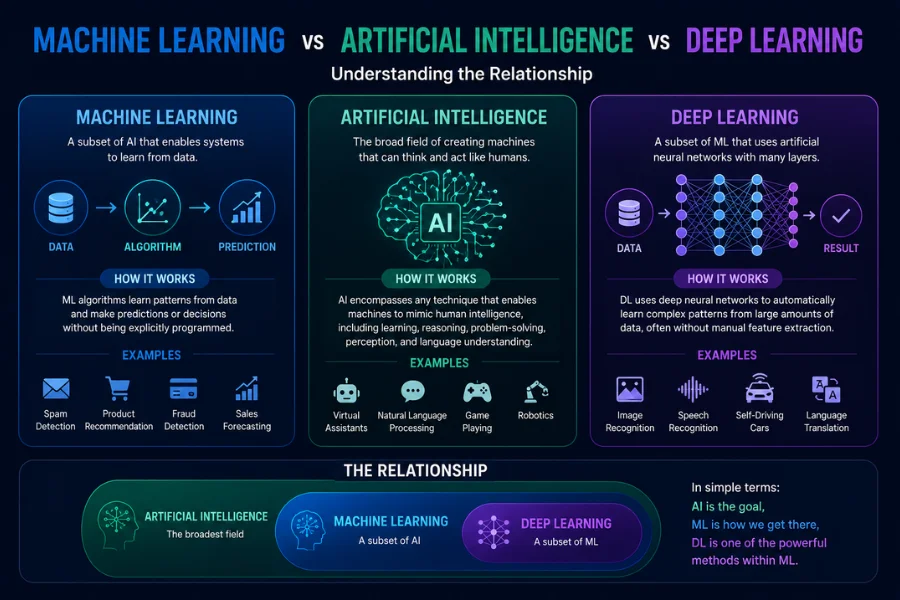
Artificial Intelligence is the broadest term. It refers to any technique that enables machines to simulate intelligent behavior — including problem-solving, understanding language, recognizing patterns, and making decisions. AI is the entire field.
Machine Learning is a subset of AI. It is a specific approach to achieving artificial intelligence — by having machines learn from data rather than following explicitly programmed rules. Most modern AI is built using machine learning. When people say AI in everyday conversation, they usually mean machine learning.
Deep Learning is a subset of machine learning. It is a specific technique within machine learning that uses multi-layered neural networks. Deep learning is what powers the most impressive AI capabilities today — language understanding, image recognition, speech processing, and content generation.
The relationship is nested: Deep Learning is inside Machine Learning, which is inside Artificial Intelligence. Every deep learning system is a machine learning system. Every machine learning system is an AI system. But not every AI system uses machine learning, and not every machine learning system uses deep learning.
Generative AI — the technology behind ChatGPT, Gemini, DALL-E, and Suno — is a specific application of deep learning that uses machine learning to generate new content rather than just classify or predict.
How Machine Learning is Changing India
Machine learning is having a particularly significant impact in India, across multiple sectors that affect hundreds of millions of people.
In agriculture, machine learning is helping Indian farmers make better decisions. Crop yield prediction models trained on soil data, weather patterns, and historical yields help farmers plan planting and harvesting. Pest and disease detection systems analyze photos of crops to identify problems early. Precision irrigation systems learn optimal watering patterns to reduce water usage while maximizing yield.
In healthcare, machine learning is improving diagnosis and treatment access in a country where the doctor-to-patient ratio remains a significant challenge. AI diagnostic tools trained on millions of medical images can screen for conditions like diabetic retinopathy, tuberculosis, and various cancers with accuracy comparable to specialist doctors — making specialist-level diagnosis accessible in rural areas.
In banking and finance, machine learning powers the fraud detection systems that protect crores of UPI transactions every day. Credit scoring models help banks lend to customers who lack formal credit history. Insurance pricing models assess risk more accurately.
In education, personalized learning platforms use machine learning to adapt content difficulty and style to each student’s learning pace and pattern, improving outcomes particularly for students in underserved areas.
In language technology, machine learning has enabled remarkably capable translation and voice systems for Indian languages — bringing digital services to hundreds of millions of people who are more comfortable in Hindi, Tamil, Bengali, Telugu, or other regional languages than in English.
The Limitations and Risks of Machine Learning
A complete understanding of machine learning includes understanding what it cannot do and where it can cause harm.
Machine learning requires data — and biased data produces biased results. If a machine learning model for job screening is trained on historical hiring data from a company that historically favored male candidates, it will learn to favor male candidates. The model is not inherently discriminatory — it learned to replicate the discrimination that existed in the training data. This is one of the most serious ethical challenges in machine learning deployment.
Machine learning models can be wrong — and confidently so. Unlike a human expert who might express uncertainty, a machine learning model can produce incorrect predictions with high apparent confidence. This is particularly dangerous in high-stakes applications like medical diagnosis, criminal risk assessment, or credit decisions.
Machine learning lacks true understanding. A model trained to recognize cats in photos does not understand what a cat is in any meaningful sense. It has learned statistical patterns associated with cat images. Change the distribution of the data — show it unusual angles, poor lighting, or rare cat breeds it was not trained on — and it can fail in ways that a human would never fail.
Privacy is a significant concern. Machine learning requires large amounts of data, and much of the most valuable data is personal — browsing behavior, purchase history, location data, health records. The collection and use of this data raises serious questions about consent, surveillance, and the relationship between individuals and the organizations that build these systems.
Deep learning models are often black boxes — even their creators cannot always explain exactly why they made a specific decision. This makes it difficult to audit these systems for fairness, to understand when they will fail, or to hold them accountable when they cause harm.
Key Takeaway
Machine learning is the technology that has transformed artificial intelligence from a theoretical concept into a practical reality that shapes everyday life. It enables computers to learn from experience, find patterns in data, and make intelligent decisions — without being explicitly programmed for every situation.
The three core types are supervised learning, which learns from labeled examples; unsupervised learning, which finds patterns in unlabeled data; and reinforcement learning, which learns through trial and reward. Deep learning, using multi-layered neural networks, is the most powerful form of machine learning and is behind the most impressive AI capabilities of 2026.
Every smart recommendation, every spam filter, every face recognition, every fraud detection, every voice assistant, and every AI-generated piece of content owes its existence to machine learning. Understanding what it is, how it works, and what its limitations are makes you a more informed participant in a world that is increasingly shaped by these systems.
Frequently Asked Questions
Is machine learning the same as artificial intelligence?
Machine learning is a subset of artificial intelligence — the most common and important method used to create AI systems today. AI is the broader field covering all techniques that enable intelligent machine behavior. Machine learning is a specific approach within AI where systems learn from data rather than following explicitly programmed rules. Most modern AI is machine learning, which is why the terms are often used interchangeably, though they are technically different.
Do I need to know mathematics or coding to understand machine learning?
Not to understand the concepts — no. The conceptual understanding of what machine learning is, how it works, and where it is used does not require mathematics or coding. To build machine learning systems yourself, you would need skills in programming (Python is the dominant language), statistics, and linear algebra. But for understanding and using AI tools built on machine learning, no technical background is needed.
How is machine learning different from regular programming?
In regular programming, a human writes specific rules that the computer follows. In machine learning, the computer learns rules from data rather than having them written by a human. Regular programming works well when the rules are clear and can be stated explicitly. Machine learning is necessary when the rules are too complex, too numerous, or not fully understood by humans — like recognizing faces, understanding natural language, or predicting what content a person will enjoy.
What is the difference between machine learning and deep learning?
Deep learning is a specific type of machine learning that uses artificial neural networks with many layers. Not all machine learning uses deep learning — many practical machine learning applications use simpler algorithms. Deep learning is most powerful for complex tasks involving images, audio, and natural language, where the patterns to be learned are highly complex and hierarchical. Traditional machine learning algorithms are often more interpretable, require less data, and work well for many structured data problems.
Is machine learning safe? Can it be used for harm?
Machine learning is a tool — its safety depends entirely on how it is developed and deployed. It has enormous potential for beneficial applications in healthcare, education, climate science, and productivity. It also has serious risks — including biased decision-making, privacy violations, deepfake creation, and autonomous weapons systems. Responsible development practices, diverse training data, rigorous testing, transparency about how systems work, and appropriate regulation are all essential to ensure machine learning benefits rather than harms society.
Is machine learning a good career in India in 2026?
Yes — machine learning is one of the highest-demand and highest-paying technical skills globally and in India. India’s AI and machine learning job market is growing rapidly, driven by domestic tech companies, global technology firms with India centers, and increasing adoption across banking, healthcare, e-commerce, and manufacturing. Skills in Python programming, statistics, data analysis, and familiarity with machine learning frameworks like TensorFlow and PyTorch are the primary technical requirements for entry into this field.
Final Thoughts
Machine learning is not magic — it is mathematics applied to data at scale. But the results can feel magical, because machine learning allows computers to learn capabilities that no human programmer could explicitly code — recognizing faces in milliseconds, generating human-quality language, diagnosing diseases from medical images, and predicting your next favorite song.
The world you live in today is already deeply shaped by machine learning, in ways both visible and invisible. The recommendations you receive, the prices you are shown, the information that reaches you, the opportunities you are offered — all of these are increasingly mediated by machine learning systems.
Understanding the technology puts you in a far stronger position — to use it effectively, to think critically about how it affects your life, to recognize both its power and its limitations, and to engage as an informed citizen with the decisions being made about how these systems should be governed and deployed.
Machine learning is not going away. It is becoming more capable, more pervasive, and more consequential. Now you understand how it works.