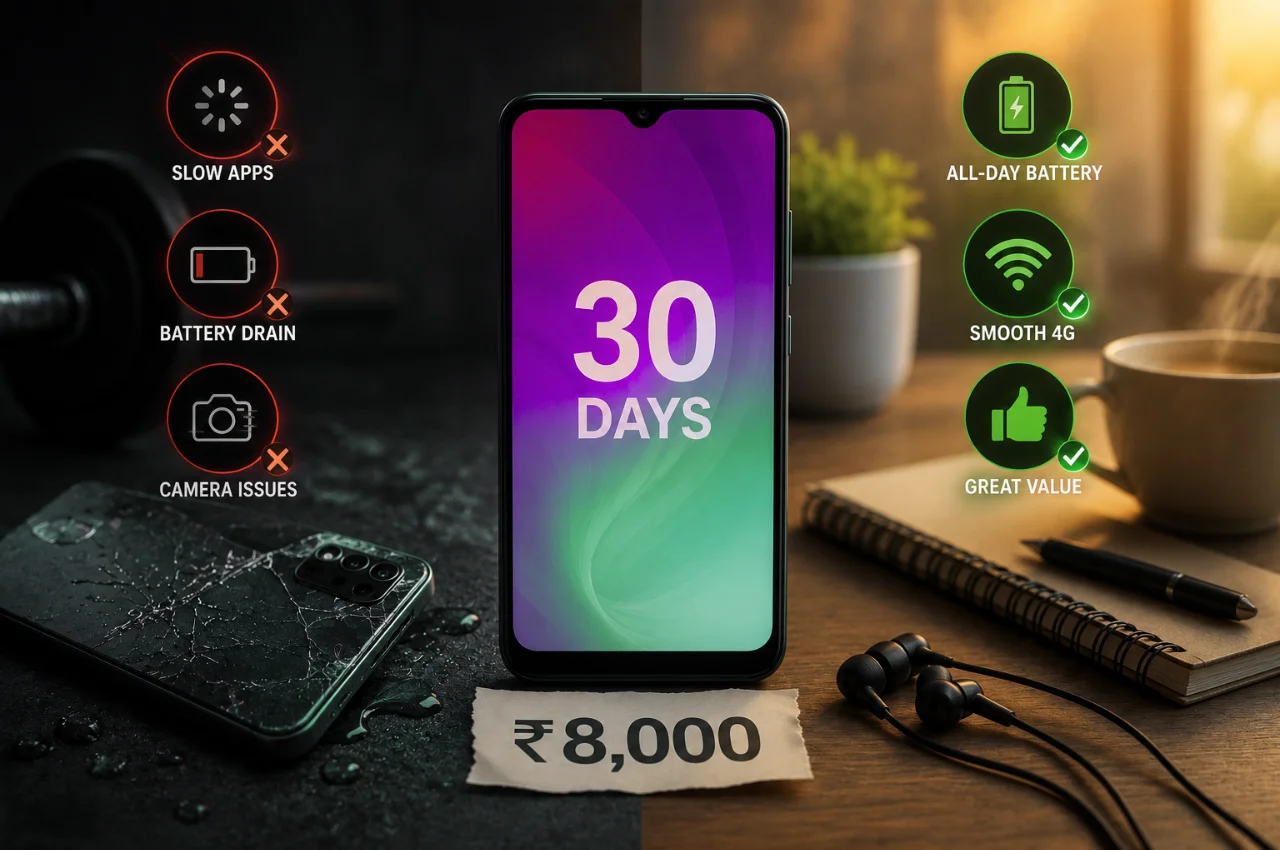
Let me be upfront about why I did this.
I was tired of reading smartphone reviews where someone spends two days with a phone and then tells you it is “great for the price.” Two days tells you almost nothing. Two days is still honeymoon territory. You have not yet discovered the app that mysteriously crashes every third time you open it, or the way the battery percentage drops like a stone the moment you turn on GPS navigation, or the particular way the fingerprint sensor starts misbehaving after your hands get slightly sweaty in the afternoon heat.
So I decided to spend an entire month using nothing but a Redmi 14C — a phone that costs roughly ₹7,999 on Flipkart — as my only device. No switching back to my regular phone when things got frustrating. No exceptions. Thirty days, one phone, honest notes.
I want to be clear: this is not a sponsored review. Nobody asked me to do this. The Redmi 14C is simply one of the most bought phones in this price bracket in India right now, and I wanted to understand what life actually looks like when this is your only smartphone. Because for a significant number of people reading this, it already is.
Why the Redmi 14C and Not Something Else
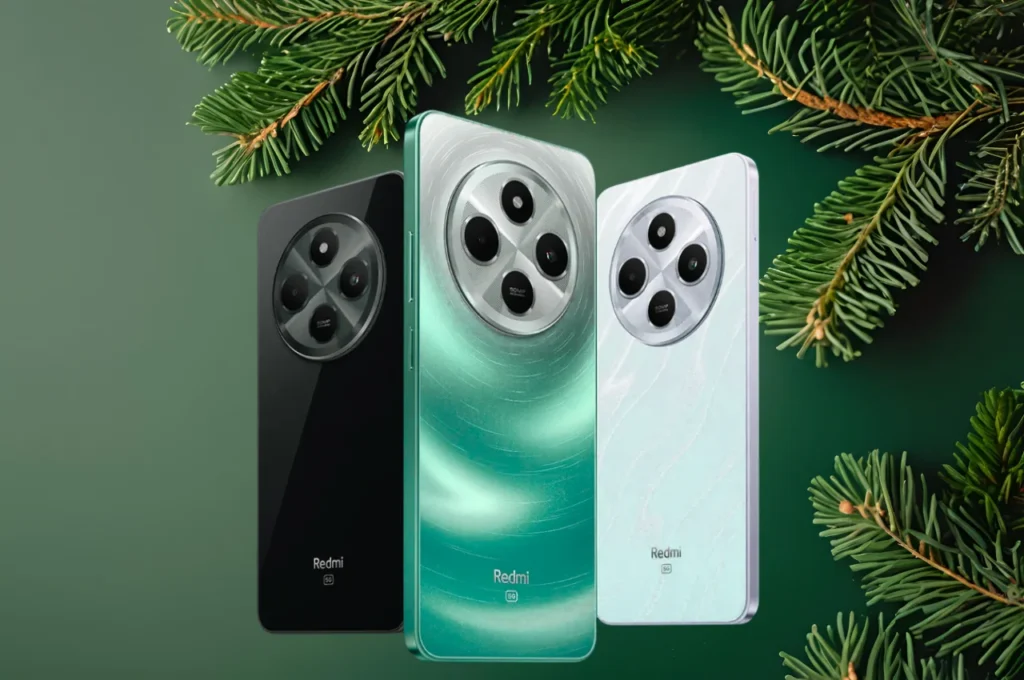
The Redmi 14C sits at around ₹7,999 for the 4GB plus 128GB variant, which is the sweet spot in the under-₹8,000 segment. It runs on a MediaTek Helio G81 Ultimate processor, comes with a 5,160 mAh battery, a 6.88-inch HD+ display, and a 50MP main camera with AI features. On paper, these numbers look respectable. The marketing photos look good too.
I picked it specifically because it is not a fringe product. It is not an obscure phone from a brand you have never heard of. This is a device that gets recommended to students, to people upgrading from a 2G or basic feature phone, to parents looking for a phone for their child, to workers who need a device primarily for calls and WhatsApp. I wanted to understand what those recommendations actually mean in practice.
I started the 30 days on the first of the month. These are my genuine notes, roughly as they happened.
The First Week — Better Than Expected, With One Immediate Catch
The first thing I noticed when I set up the phone was how big it felt. The 6.88-inch screen is genuinely large. Coming from a more compact phone, it took two or three days before it stopped feeling slightly unwieldy. I found myself reshuffling how I hold a phone while reading, because one-handed use was not comfortable.
But the display itself was fine. HD+ resolution on a screen this size does not look as sharp as FHD, and you can tell if you look closely at text. The pixels are slightly softer at the edges. Most people will not notice or care. I noticed it primarily when reading long WhatsApp messages or text-heavy websites in direct sunlight.
The battery in the first week was genuinely impressive. I am a fairly heavy user — multiple WhatsApp groups, two hours of YouTube in the evening, some Instagram, maps when commuting, and a couple of work calls per day. The Redmi 14C was lasting from 7 AM to 11 PM with around 15 to 20 percent remaining. That is excellent. I was honestly surprised. I had expected to be charging it by evening.
The immediate catch was the charger. The phone comes with a 10W brick in the box. In 2026, with 33W and 45W charging widely available on phones costing just a few thousand more, 10W feels genuinely slow. A full charge from near zero took close to two hours. I adapted by plugging it in overnight, which is not ideal for long-term battery health but is what most people at this price point end up doing anyway.
The fingerprint sensor on the side worked well in the first week. Responsive, accurate, no complaints.
Week Two — Where the Processor Started Showing Its Limits
By week two, I had more apps installed. My normal rotation: Gmail, Slack, Chrome with multiple tabs, Google Maps, Instagram, YouTube, Spotify in the background, WhatsApp. Nothing unusual for a working person in 2026.
This is where I started to feel the MediaTek Helio G81 more clearly. It is not a bad processor — it handles everyday tasks fine. But it struggles with what I would call the “simultaneous” moments. Switching from a YouTube video to WhatsApp while Spotify is running and Chrome has four open tabs loaded — there would be a half-second to full-second delay as things loaded back into memory.
Also Read: RAM and how it affects performance
Not a crash. Not a freeze. Just a visible pause that reminded you this phone is managing its resources carefully.
BGMI ran. It did. But I would not call the experience good. On medium graphics settings, the game was playable but inconsistent — smooth for stretches, then stuttery during heavy combat. On high settings, it became noticeably worse. I do not play BGMI seriously, so this did not personally bother me. But if gaming is a priority for you, this phone is not built for it.
The camera in week two was a genuinely mixed story. Outdoors, in good light, the 50MP camera produced photos I was happy with. Some of them were legitimately good — sharp, decent colour, enough detail to zoom in and still look clean. I sent a few of these photos to my family and nobody asked what camera I had used.
The problem was anything indoors or in the evening. The moment natural light dropped, photos became noticeably noisy and soft. Night mode helped somewhat but introduced a different problem: the processing time was long enough that anything with movement — a person talking, a ceiling fan — came out blurred. I stopped trying to take photos in restaurants after week one because the results were consistently disappointing.
One thing that actually surprised me positively: call quality. Voices came through clearly, the earpiece was loud, and I had no dropped calls in 30 days. For a phone this price, the call quality is excellent. This matters more than most tech reviewers acknowledge, because for a large number of users in India, making and receiving calls clearly is still the primary job of a smartphone.
Week Three — The Ads and the Software Reality
By week three I was living comfortably with the phone, but I had developed a particular frustration I want to talk about honestly: the software experience.
MIUI on Redmi phones at this price comes with ads. I am not talking about occasional suggestions. I am talking about ads in the Security app, in the File Manager, sometimes in the Settings notifications. A promotional banner occasionally appeared when I opened the Phone app for a split second before it dismissed itself. This is not unique to Redmi — Realme does similar things — but it is a real part of daily life with this phone that reviews in the first two days will not catch.
I spent about an hour in week two going through settings and disabling what I could. Most of the more aggressive notifications can be turned off in the app settings under “notifications” and “recommendations.” The process is not difficult but it requires knowing that the problem exists and then spending time finding each individual toggle. A first-time smartphone user — which is a significant part of this phone’s target audience — would likely not know to do this, and would just live with it.
The fingerprint sensor also started behaving slightly differently in week three. Not broken, but less consistently fast. I noticed this particularly in the morning when my hands were slightly dry. The success rate dropped to maybe 80 percent on the first attempt, compared to close to 95 percent in week one. I adjusted by registering my fingerprint twice, which helped.
Storage management became a minor consideration. The 128GB variant gives you roughly 112GB of usable space after the OS. With photos, apps, and a few downloaded videos, I was at 68GB by week three. Not a crisis, but worth noting if you download a lot of music or movies locally.
The display glass, which is not Gorilla Glass, picked up two small scratches in week three from ordinary pocket use alongside keys. They are only visible at certain angles, but they are there. A screen protector from day one would have prevented this. At this price point, I recommend treating the screen protection as a mandatory purchase, not optional.
Week Four — What I Had Actually Adapted To and What Still Bothered Me
By week four, something interesting had happened: I had largely stopped noticing most of the phone’s limitations. Not because they had disappeared, but because I had built habits around them.
I stopped trying to take photos indoors. I cleared my app cache every few days. I kept background apps to a minimum. I plugged in overnight. I learned to pause for a second when switching between heavy apps rather than immediately expecting an instant response.
This is worth acknowledging, because it points to something real about budget phones that reviews often miss: they are not bad phones, but they require a slightly different relationship with technology. You adapt to the device rather than the device adapting to you. Whether that is acceptable depends entirely on you, your daily needs, and what your alternatives are.
What continued to bother me in week four, despite adaptation, was the camera in anything less than ideal light. I have people in my life who are important to me, and I want to take decent photos of them in the normal conditions of daily life — indoors at home in the evening, at a restaurant, at a family function with mixed lighting. On this phone, that is reliably unreliable. Some shots are fine. Many are not. You never know which you are going to get until you look at the result afterward.
The performance slowdowns also did not improve with time. If anything, with more apps installed and more data on the phone, they became marginally more frequent. Nothing dramatic. But the half-second pauses were a consistent texture of using the phone that never fully disappeared.
What genuinely impressed me across the full 30 days: the battery life held up. By week four I was still ending most days with 15 to 25 percent remaining, even with heavy use. Whatever Xiaomi has done with power management on this device, it works. For a ₹8,000 phone, this is the standout strength. Not the camera. Not the performance. The battery.
The build quality was fine. No creaks, no flex, no assembly issues. The phone felt the same in week four as it had on day one, scratched screen aside.
What This Month Actually Taught Me About Budget Phones in India
A month of living with a ₹8,000 phone gave me a perspective I did not have before.
Budget phones in 2026 are genuinely capable of being your only phone — with caveats. The caveats are not about whether the phone works. It works. The caveats are about which specific parts of your smartphone use actually matter to you.
If your daily life involves calls, WhatsApp, YouTube, and basic photography outdoors, a ₹8,000 phone handles all of it adequately. Battery life at this price point is often better than on ₹20,000 phones because there is no large processor demanding power. Call quality is solid across all budget brands I have used. Basic app performance for the apps most Indians use daily is fine.
If your daily life involves photography in variable light conditions, sustained gaming, camera-heavy work like shooting Reels or content for any platform, or professional use that demands quick app switching without pauses — this price bracket will consistently frustrate you. The processor and camera hardware have real limits that no software update can overcome.
The other thing I learned is how much the software experience matters and how invisible it is in spec comparisons. Two phones with identical specs can feel dramatically different based on how much the manufacturer has added to the base Android experience. Ads, bloatware, slow system animations, notification spam — these accumulate over days into a texture of low-grade friction that is very real but impossible to describe in a spec sheet.
My recommendation to anyone considering a phone in this range: go to a store and use it for ten minutes before buying. Actually use it. Open WhatsApp, take a photo, switch apps, look at the display in the store light. The specs tell you one story. The feel of the phone tells you another, and the second story is the one you will live with every day.
The Numbers That Surprised Me Most
Before I close, here are the specific observations from 30 days that I would not have predicted from reading specs alone.
Average screen-on time per day: 5 hours 20 minutes. The battery handled this without requiring a midday charge on any day in the first three weeks.
Photos taken: approximately 340. Of these, I would say around 180 were genuinely good enough to share or keep. The remaining 160 were deleted — largely indoor shots, evening shots, and anything where the subject moved slightly.
Dropped calls in 30 days: zero. I made and received calls in Kanpur city, on highways, in areas with patchy signal, and in a basement office. Signal holding and call quality were consistently good.
Number of times I wished I had a better phone: honestly, more than I expected. Primarily during photography situations at family events. Once during a 40-minute navigation session where the phone warmed up noticeably and the GPS was slightly laggy. And during every attempt to play any graphically demanding game.
Number of times the battery anxiety common to smartphone users hit me: almost never. That was genuinely refreshing.
Frequently Asked Questions
Is a ₹8,000 phone good enough as a primary smartphone in 2026?
For most everyday use cases, yes — but with specific expectations. Calls, WhatsApp, YouTube, social media browsing, maps, UPI payments, basic photography in good light — these all work fine. Where you will feel the limitation is indoor photography, sustained gaming, and demanding multitasking. If your use falls primarily in the first group, a ₹8,000 phone is absolutely adequate as your primary device.
Which phone is the best under ₹8,000 in India right now?
As of mid-2026, the Redmi 14C and the realme Narzo 80 Lite are the most capable options in this segment. The Redmi 14C has better overall performance and a more capable camera. The realme Narzo 80 Lite wins on battery life with its 6,300 mAh cell. Both are solid choices. If you are buying for a student or for someone using a smartphone for the first time, both are appropriate — with the understanding that the software experience on both requires some initial setup to remove intrusive notifications.
How do budget phones under ₹8,000 handle 5G in India?
Most phones under ₹8,000 are 4G only as of 2026. True 5G capability in this segment typically starts around ₹9,000 to ₹10,000. If 5G connectivity is important to you — and it increasingly should be, given how rapidly India’s 5G network is expanding — you will need to stretch your budget slightly to the ₹10,000 to ₹12,000 range to get a reliable 5G-capable device.
What should I buy alongside a budget phone to make it last longer?
Three things that genuinely extend the life and experience of a budget phone: a tempered glass screen protector applied from day one (budget phones typically do not use premium glass), a slim case to protect the plastic body from drops and scuffs, and a slightly faster third-party charger if you find the included charger too slow. Combined, these accessories typically cost ₹300 to ₹700 and meaningfully improve daily life with the phone.
Is the camera on a ₹8,000 phone good enough for Instagram and YouTube Shorts?
For outdoor and well-lit content, yes — the 50MP cameras on current budget phones produce photos and videos that work perfectly well for casual social media use. For indoor content, low-light shooting, or anything that requires consistent quality regardless of lighting conditions, a budget phone camera will be unreliable. Content creators who shoot regularly in varied conditions should consider saving up to the ₹12,000 to ₹15,000 range for a noticeably better camera system.
Does the performance get worse over time on budget phones?
In my experience, yes — gradually. Budget processors have limited RAM management capability, and as you install more apps and accumulate data over months, the half-second pauses during app switching become slightly more frequent. This is not unique to one brand — it is a function of the hardware. The standard advice to clear cache periodically and uninstall unused apps genuinely helps, but does not fully reverse the trend. Most budget phones in this segment feel meaningfully slower by the 18-month mark than they did on day one.
Final Thoughts
Thirty days with a ₹8,000 phone did not make me think these devices are bad. It made me think more carefully about what we actually need from a smartphone versus what we have been conditioned to want.
The Redmi 14C is a capable, honest device for the money. Its battery life is excellent. Call quality is strong. Basic daily tasks work fine. It is not a phone for photographers, gamers, or power users — and it does not pretend to be.
What it is good for is giving someone their first real smartphone experience, or serving as a reliable secondary device, or meeting the daily needs of someone whose priority is simply having a phone that works and does not die before dinner.
If you are buying this phone for yourself knowing its limits, you will probably be happy with it. If you are buying it hoping it will perform like a ₹20,000 phone, you will be disappointed. That is the most honest summary I can offer after thirty days of actually living with it.
One last thought: the single biggest upgrade available in this price segment is not the processor or the camera. It is your own expectation management. Know what you are getting, build your habits around the phone’s strengths, and you will find that ₹8,000 buys you something genuinely useful in 2026.