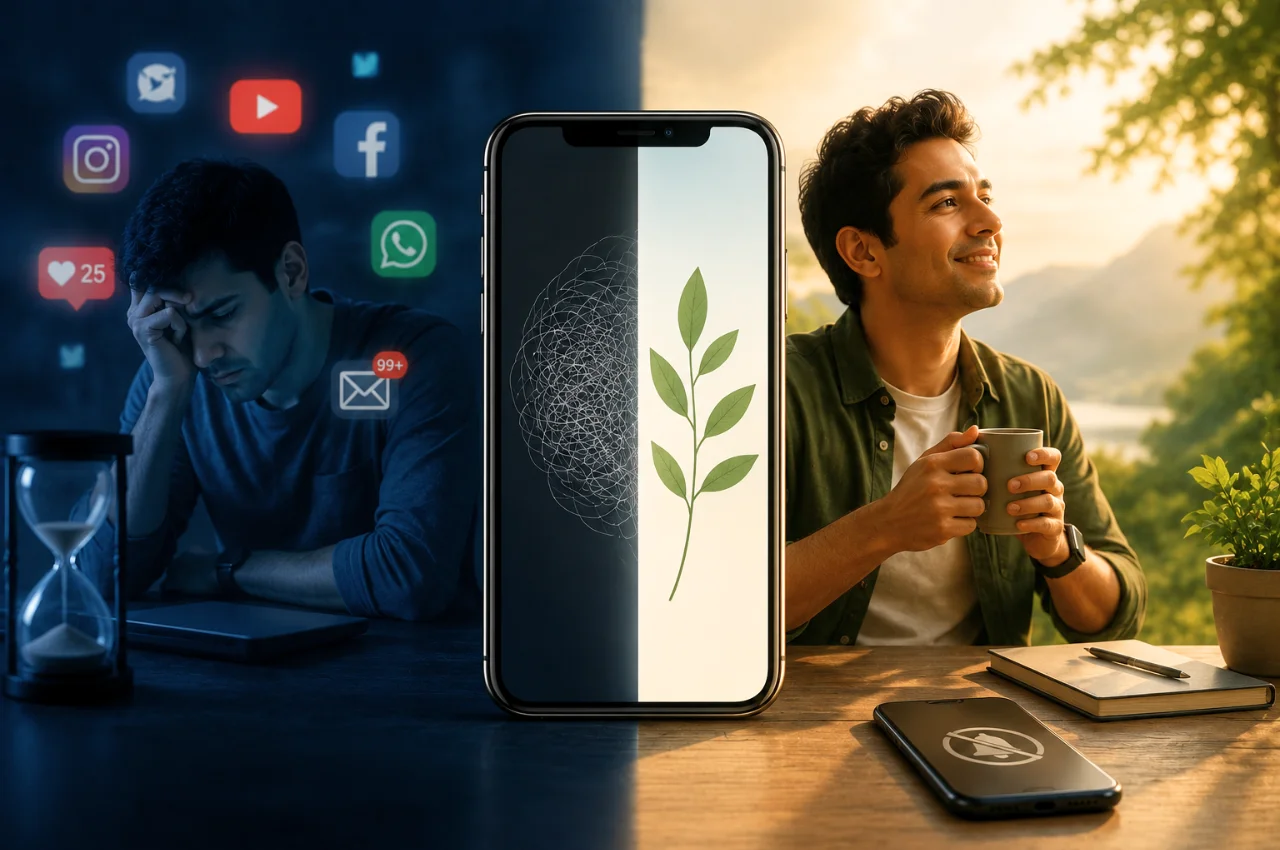
There is a good chance you picked up your phone at least once before you finished reading this sentence.
Do not feel bad about it. You are not alone, and you are not weak. You are dealing with something that has been deliberately engineered to be as difficult to resist as possible. But here is the thing — more people in India are starting to talk honestly about this, and the conversation has finally reached the highest levels of government.
India’s Economic Survey 2026, tabled in Parliament in January, officially flagged digital addiction as a public health concern. It recommended stricter screen-time limits for children, the creation of phone-free zones in schools and workplaces, and expanding India’s Tele-MANAS mental health helpline to specifically support people dealing with digital dependency. This is not a fringe wellness trend anymore. It is a policy priority.
The numbers behind that policy priority are uncomfortable. India leads the world in smartphone addiction rates, with 32 percent of users classified as addicted according to a WHO-linked analysis. The average Indian spends well over five hours a day on their phone. We check our devices over 100 times every single day. And despite knowing that this is probably too much, most of us have no idea how to actually change it.
This article is about that — how to actually change it. Not through willpower alone, which rarely works, but through practical, specific, realistic strategies that fit the way most Indians actually live and work in 2026.
What Is a Digital Detox, Really?
The phrase “digital detox” has been around for years and, thanks to some aggressive wellness marketing, it has picked up some unhelpful associations. Most people picture a week at an ashram in Rishikesh with no phone signal. Or a luxury retreat in Kerala. Or some dramatic all-or-nothing break from technology.
That is not what this article is about.
A digital detox in any practical sense simply means a deliberate, structured reduction in your screen time — done with clear intention, and with specific habits replacing the mindless scrolling. It does not mean throwing your phone in a river. It means building a healthier relationship with a device that is genuinely useful but currently running too much of your life.
The goal is not to use your phone less in some abstract philosophical sense. The goal is to use it intentionally — to be the one deciding when and how you use it, rather than being pulled toward it compulsively dozens of times a day without really choosing to.
That distinction — intentional use versus compulsive use — is the heart of everything that follows.
Why Your Brain Is Working Against You
Understanding why screen time is so hard to control makes it easier to address without self-blame.
Your smartphone is designed by some of the most sophisticated behavioural engineers in the world. Every like, comment notification, new reel, and unread message triggers a small release of dopamine — the same neurotransmitter involved in responses to food, physical affection, and in more extreme cases, addictive substances. Your brain learns very quickly that picking up the phone produces a small reward, and it begins craving that reward with increasing frequency.
This is not a metaphor. Research shows that the dopaminergic pathways activated by social media notifications are structurally similar to those activated by gambling. The variable reward system — sometimes you open Instagram and there is something exciting, sometimes there is nothing new — is particularly powerful, for the same reason that slot machines are more compelling than predictable vending machines. You keep checking because you never know what you might find.
Average human attention span has dropped significantly over the past two decades, declining from around 12 seconds in the year 2000 to somewhere between 6 and 8 seconds in 2026. Every notification breaks your concentration, and research suggests that recovering full focus after an interruption can take up to 23 minutes. If you receive dozens of notifications a day — which most smartphone users do — genuine deep focus becomes almost impossible without deliberate intervention.
The point of explaining this is not to make you feel helpless. It is the opposite. Once you understand that your phone use is driven by engineered triggers rather than personal weakness, you can design your environment to work around those triggers instead of just trying harder to resist them.
Also Read: make your phone last longer
The India-Specific Context
Digital overuse looks slightly different in India than in other parts of the world, and the solutions need to reflect that.
A significant portion of screen time in India is driven by genuinely functional use — UPI payments, government portals, work WhatsApp groups, online classes, and professional communication all happen primarily on the phone for most Indians. Many people in tier-2 and tier-3 cities use their smartphone as their only computing device. The phone is not just entertainment. It is also their bank, their office, their classroom, and their connection to family members who live in different cities.
This means that the approach to digital detox in the Indian context has to be nuanced. You cannot simply advise someone to “put your phone away” when their boss sends critical work updates on WhatsApp at 9 PM, or when their child’s school uses an app for homework submissions. The goal is not to fight against the phone’s functional role in your life. It is to separate intentional use from compulsive use.
The Economic Survey 2026 acknowledged this complexity. Rather than recommending wholesale disconnection, it suggested digital wellness curricula in schools, awareness programmes in colleges and workplaces, and phone-free zones — specifically defined spaces and times — rather than blanket restrictions.
That framework — defined boundaries rather than total disconnection — is the right one for most Indian adults as well.
Step One: Know Your Actual Numbers
You cannot fix what you have not measured. The first and most important thing you can do is spend one week simply looking at your actual screen time data before trying to change anything.
Both Android and iOS have built-in screen time tracking. On Android, go to Settings, then Digital Wellbeing and Parental Controls. On iPhone, go to Settings, then Screen Time. These sections show you exactly how many hours you spent on your phone each day last week, which apps you used most, how many times you picked up your phone, and what time of day you were most active.
Most people are genuinely shocked by what they find. The number is almost always higher than what they estimated. It is very common for people who believe they use their phone “a couple of hours a day” to discover they are actually at four or five hours. And once you see the specific breakdown — 90 minutes on Instagram, 45 minutes on YouTube, 30 minutes on WhatsApp beyond any actual conversations — the problem becomes much less abstract.
Do not judge yourself when you look at these numbers. Just look at them. Write them down. Keep them somewhere visible. These are your baseline.
Set a realistic target for the next month. If you are currently at five hours per day, aiming for two hours immediately is not realistic and will make you feel like a failure. Aiming for three and a half hours is achievable and meaningful. Small, sustained reductions compound over time.
Step Two: Redesign Your Phone’s First Screen
The apps on your home screen are not neutral. They are traps. Every app with a bright coloured icon and a notification badge on your home screen is a visual cue that triggers the impulse to open it. Removing those cues removes a significant portion of compulsive checking without requiring any willpower at all.
This is one of the most effective interventions supported by behavioural research, and it takes about ten minutes.
Move all social media apps — Instagram, YouTube, Facebook, Snapchat, Twitter/X, LinkedIn — off your home screen entirely. Do not delete them. Just move them to a folder on a second or third screen, or into the app drawer. Out of immediate sight means out of immediate mind, more often than you might expect.
Turn off all non-essential notifications. This is genuinely one of the highest-impact changes you can make. The average smartphone user receives dozens of notifications a day, the vast majority of which are not time-sensitive. App update reminders, promotional alerts, news tickers, social media activity — none of these require immediate attention. Go through your notification settings app by app and turn off anything that is not genuinely urgent. Keep notifications on for phone calls, messages from actual contacts, and payment alerts. Turn everything else off.
Switch your display to greyscale mode (hidden smartphone features most users ignore). This is a lesser-known tip that has strong supporting evidence. Colour is a significant part of what makes social media apps visually stimulating. Instagram in greyscale is dramatically less compelling than Instagram in full colour. Most Android phones have greyscale in the accessibility settings or digital wellbeing settings. Try it for a week and observe whether the compulsion to open apps feels weaker.
Step Three: Create Time Boundaries, Not Willpower Rules
Saying “I will use my phone less” is a willpower rule. Willpower rules fail under stress, fatigue, and boredom — which is precisely when compulsive phone use is most likely. Time boundaries are structural. They are much more reliable.
The two most impactful time boundaries for most people are a morning window and a night window.
The morning window means not picking up your phone for the first 30 to 60 minutes after you wake up. This is harder than it sounds for most people because checking the phone has become the first thing they do before getting out of bed. But the first hour of your day sets the tone for your mental state and focus for hours afterward. Starting it with notifications, news, and social media puts your brain immediately into reactive mode — responding to other people’s agendas rather than your own. Starting it with tea, a walk, prayer, exercise, or simply quiet sets a different foundation entirely.
The night window means stopping phone use 30 to 60 minutes before you sleep. Blue light from screens suppresses melatonin production and delays the body’s natural sleep signal. This is well-documented science, not marketing. Research consistently shows that screen exposure within two hours of bedtime reduces both sleep quality and total sleep duration. Poor sleep, in turn, increases anxiety and reduces the mental resources you have available to resist compulsive behaviour the next day. The cycle is self-reinforcing. Breaking it at night is one of the highest-return investments you can make in your overall wellbeing.
Keep your phone out of your bedroom if possible. Charge it in another room overnight. If you use your phone as an alarm clock, buy a basic alarm clock — they cost less than ₹500 and solve the problem completely.
Step Four: Build Phone-Free Moments Into Your Day
Beyond the morning and night windows, identify two or three moments in your day that can become reliably phone-free.
Meals are the most natural and highest-impact choice. Eating while scrolling is bad for digestion — the distraction genuinely interferes with satiety signals, which is one reason why screen-time-while-eating correlates with overeating — and it is also a significant source of disconnection in families. A meal where everyone is present and actually talking is not a nostalgia fantasy. It is something most families can recover with a simple, agreed-upon rule.
Commuting is another opportunity. If you commute by train, metro, or bus, that time is currently being consumed almost entirely by your phone for most people. Consider spending two or three commutes a week listening to music without scrolling, observing your surroundings, or simply thinking. These are not wasted minutes. Unstructured thinking time is where your best ideas tend to emerge.
Any waiting time — doctor’s waiting room, a queue, a few minutes between meetings — has been colonised almost entirely by the phone. Try waiting without it occasionally. The discomfort you feel in the first 30 seconds is your brain asking for its dopamine fix. It passes. What replaces it, with practice, is a quieter and more comfortable relationship with your own thoughts.
Step Five: Replace, Do Not Just Remove
This is the most important principle in sustaining any reduction in phone use, and it is the one most people skip.
If you reduce your phone time without replacing it with anything, you create an uncomfortable void. Discomfort and boredom are among the most powerful triggers for compulsive phone checking. If you do not have something to do with the time you recover, you will spend that time reaching for your phone anyway.
Think about what you actually want to be doing with your time. Physical activity — even a 20-minute walk — produces real changes in mood and focus that no app can replicate. Reading books, even 20 pages a day, compounds dramatically over a year. Conversations with people you care about, face-to-face or on a proper phone call rather than a WhatsApp thread, are more satisfying than passive scrolling in ways that are not obvious until you try.
Hobbies that require physical materials — cooking, drawing, gardening, playing an instrument, knitting, woodworking — are particularly powerful as phone replacements because they occupy your hands. You literally cannot scroll while doing them.
The goal is not to create a miserable, phone-free existence. It is to fill your life with things that are genuinely more satisfying than Instagram, so that the phone becomes less appealing by comparison rather than something you are fighting to avoid.
What Actually Does Not Work
No honest article about digital detox can avoid this section.
Cold turkey rarely works for most adults with genuine functional obligations. If your boss WhatsApps at all hours and your income depends on responding, simply putting your phone away for three days is not a realistic solution. Dramatic all-or-nothing breaks are also prone to the rebound effect — people who feel they have failed their detox often overcorrect back to even heavier use.
App timers and screen time limits that can be dismissed with a single tap are largely ineffective for people with serious compulsive use patterns. The same willpower required to avoid the phone is required to resist tapping “ignore limit” when it appears. If you find yourself ignoring your own screen time limits consistently, a softer limit is not the solution — you need to address the underlying triggers driving the compulsion.
Blaming your phone or specific apps is less useful than examining your own triggers. Most people check their phone compulsively in specific emotional states — boredom, anxiety, loneliness, procrastination avoidance, or the particular restlessness that comes from not wanting to think about something difficult. Learning to identify your specific triggers — the emotional states that make you reach for your phone — is more powerful than any technical restriction.
Simply setting goals without changing your environment almost always fails. The environment — what is on your home screen, where your phone is kept, what notifications arrive — shapes behaviour far more powerfully than intentions do.
Frequently Asked Questions
How many hours of screen time per day is considered healthy for adults?
There is no single number that applies to everyone, and the research does not support one. Context matters: video calling your parents is different from mindlessly scrolling Instagram for the same amount of time. As a rough benchmark, most digital wellness researchers suggest keeping recreational screen time — excluding work and functional use — to two hours or less per day for adults. If you are currently well above that and feel that your phone use is affecting your sleep, relationships, concentration, or mood, that is a more reliable indicator than any specific number.
Will reducing screen time make me less productive since so much work happens on my phone?
For most people, the opposite is true. The compulsive checking behaviour — picking up the phone dozens of times a day for no specific reason — is one of the biggest destroyers of focused work time. Turning off non-essential notifications and confining phone use to defined windows typically improves work quality and output rather than reducing it. The goal is not to reduce work-related phone use. It is to reduce the compulsive, purposeless checking that interrupts work constantly.
What is the best built-in tool for tracking screen time on Android phones?
Go to Settings and look for Digital Wellbeing and Parental Controls. This section shows your daily and weekly screen time broken down by app, how many times you unlocked your phone, and how many notifications you received. It also lets you set app timers, activate Focus Mode to temporarily pause distracting apps, and enable Bedtime Mode which dims the screen and switches to greyscale after a set hour. These tools are available on most Android phones running Android 9 or newer.
Is digital detox just for people who are seriously addicted to their phones?
No. The same principles that help someone with serious compulsive use also improve quality of life for people with moderate, manageable phone use. You do not need to be in crisis to benefit from more intentional phone habits. Even if your current phone use is not causing obvious problems, most people who deliberately reduce mindless scrolling and increase time for other activities report feeling less anxious, sleeping better, and enjoying their actual phone use more — because it is purposeful rather than habitual.
How do I handle social pressure when others around me are always on their phones?
This is a genuine challenge, particularly in social settings in India where group WhatsApp conversations, shared reels, and real-time reactions to content are woven into how many friendships and families operate. The most practical approach is to be transparent about your intentions without being preachy. You do not need to lecture anyone or make others feel judged. You can simply mention that you are trying to spend less time on your phone, keep your own phone away during shared time, and let your behaviour speak for itself. Most people around you will not notice or object if you are present and engaged in the conversation.
Does the Economic Survey 2026 recommendation apply only to children, or to adults too?
The Economic Survey 2026 addressed digital addiction across age groups, though its strongest recommendations — school curricula, parental controls, physical activity requirements — were directed at children and young people because they are most vulnerable during developmental years. However, the Survey also recommended workplace awareness programmes and phone-free zone policies for adults, and it specifically called for expanding mental health support through Tele-MANAS for people of all ages dealing with digital dependency. The concern is not limited to children.
Final Thoughts
The goal of a digital detox in 2026 is not to live without your phone. Your phone is genuinely useful, often necessary, and in many ways a remarkable tool. The goal is to stop living for your phone — to stop letting it dictate your attention, your mood, your sleep, and your time in ways you never consciously chose.
India’s Economic Survey flagging this as a public health concern is significant, but you do not need government policy to make changes in your own life. You need to look honestly at your screen time numbers, make a few structural changes to your environment, create a small number of non-negotiable phone-free times, and replace the time you recover with things you actually care about.
Start smaller than you think you need to. One phone-free morning per week. Notifications turned off for one category of app. Your phone charging outside your bedroom for one month. See what changes.
The irony of a digital detox is that most people who try it — even partially — do not miss what they gave up. What they notice instead is how much they were missing while they were scrolling.