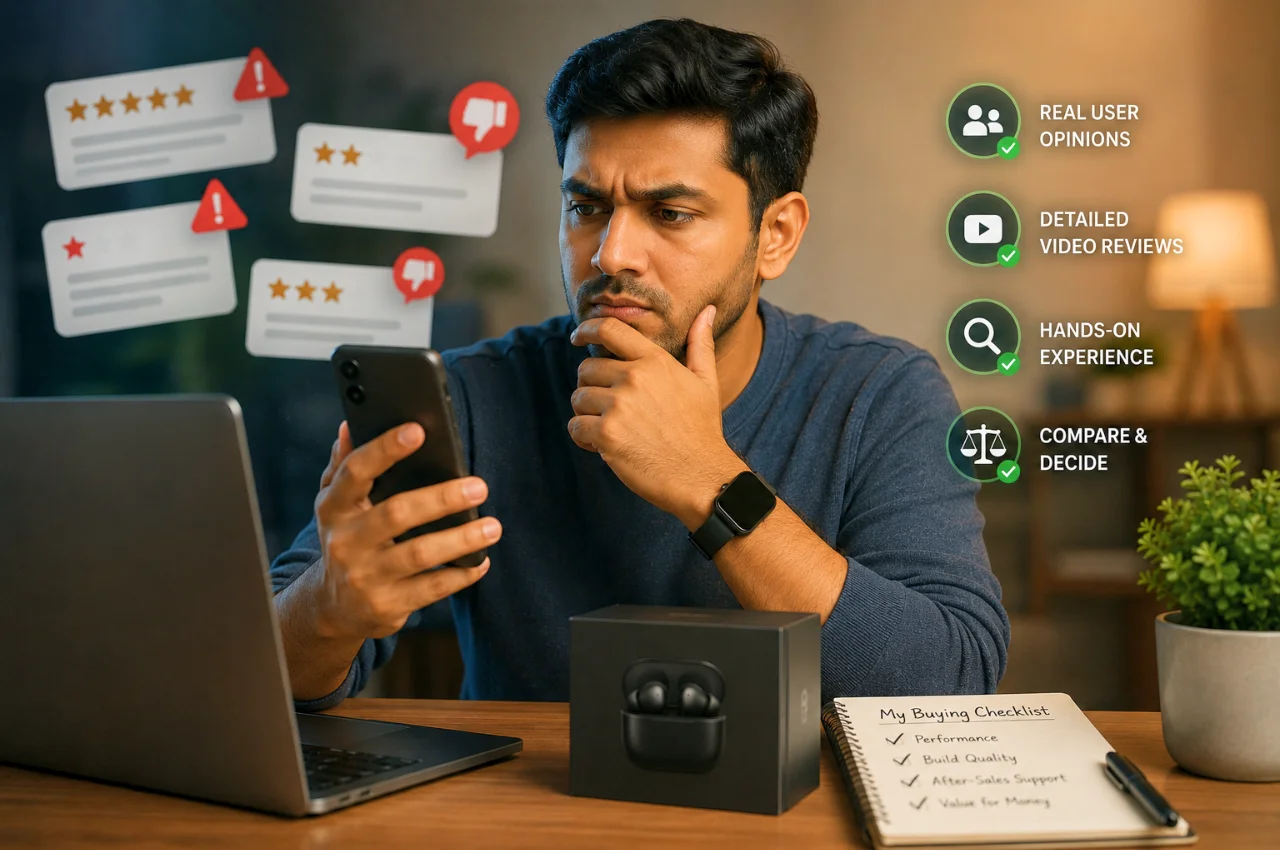
The moment I realised something was seriously wrong happened about two years ago.
I had spent three evenings reading reviews before buying a pair of wireless earphones on Flipkart. The product had 4.4 stars, over 2,000 reviews, dozens of people saying the bass was excellent and the call quality was crystal clear. The top review had 340 helpful votes. I was convinced. I bought it.
The earphones arrived. One of them cut out intermittently from day one. The bass was boomy in a hollow, cheap way that no review had described. The mic on calls made me sound like I was speaking from a tin container — multiple people told me this unprompted. I checked the reviews again after receiving the product, now reading them differently. And suddenly I could see what I had missed the first time: almost no negative reviews mentioned any specific problem. The positive reviews all used similar language. Several reviewers had only ever reviewed this one product, and nothing else.
I had been reading manufactured consent, not real opinions.
That experience changed how I research every tech purchase since then. This article is my honest account of what I discovered about the Indian online review ecosystem, what the red flags actually look like, and the specific process I now use before spending money on any tech product.
How Bad Is the Fake Review Problem in India, Really?
Worse than most people realise. And the data backs this up.
India’s National Consumer Helpline received over 4,44,000 e-commerce related complaints in 2023. That number has grown further in 2025 and 2026. The government’s Department of Consumer Affairs has been working on a regulatory framework specifically targeting paid and fake reviews, with the Indian government pushing e-commerce platforms toward BIS Standard IS 19000:2022 — India’s own standard for how online reviews should be collected, verified, and published. The fact that a government standard for review integrity now exists tells you something about how large the problem became.
Globally, studies suggest that somewhere between 30 to 42 percent of reviews on major e-commerce platforms like Amazon are either fake or incentivised — meaning the reviewer received a free product, a discount, or a direct payment in exchange for a positive review. There is no reason to believe India’s numbers are better. If anything, the combination of intense seller competition, low detection enforcement, and large price-sensitive buyer base makes India a particularly fertile environment for review manipulation.
The methods are more sophisticated than most buyers expect. It is not just a few sellers typing fake reviews themselves. There are organised WhatsApp and Telegram groups where sellers offer free products or Amazon Pay cashback in exchange for a verified purchase review with five stars. There are review farms — services you can pay to generate hundreds of reviews from real-looking accounts. There are also competitor attacks: one-star review bombing campaigns where a seller’s rival organises negative reviews to tank their listing. All of this happens continuously, on a scale that platform moderation cannot keep up with.
And then there is the problem that exists even beyond outright fake reviews: paid YouTube videos, sponsored blog articles, and influencer content that never discloses compensation. The review looks independent. It is not.
Also Read: how online manipulation tactics work
What Fake Reviews Actually Look Like — The Patterns I Learned to Spot
Once I started paying attention, the patterns became visible in almost every product category. Here is what I now look for before trusting any review.
The timing cluster is the most reliable signal. When a product launches and receives 200 reviews in its first two weeks — all or mostly five stars — that is almost never organic. Real buyers trickle in over months, with ratings that vary as different types of users encounter different experiences. A surge of early five-star reviews is a manufactured launch boost, not a genuine signal of quality.
Look at the reviewer’s profile, not just the review. Click on any reviewer’s name on Amazon or Flipkart and look at their review history. A real user typically reviews a handful of things they actually bought — a phone case, a cooking pot, a shirt. A fake or incentivised reviewer often has a trail of five-star reviews for completely unrelated product categories, posted within days of each other. Or they have reviewed only one product ever — the exact one you are looking at. Neither of these profiles is zero-information, but both are red flags worth noting.
The language of a fake review is specific in its vagueness. Phrases like “amazing product,” “totally worth it,” “works perfectly,” and “fast delivery, happy customer” contain no information. They describe satisfaction without describing experience. A real review says something like: “I use this in a small bedroom, the bass was overwhelming at first but I adjusted the EQ in the app and now it sounds decent. Battery life is as advertised.” That review contains observation. Generic praise contains nothing.
Watch for the identical quirk. Sometimes paid review campaigns distribute a template and reviewers do not deviate much from it. You will see the same phrase — “bang for the buck” or “highly recommend to everyone” — appear in multiple reviews with different names. This is visible if you read more than the top three reviews and look for language patterns.
One-star reviews are worth more than five-star reviews. I now read the one and two star reviews first. Not because they are always accurate — competitor attacks exist, and some negative reviewers are unreasonably harsh — but because specific, detailed negative reviews that describe a real problem are almost impossible to fake. If five different people with different writing styles all mention that the product’s charging cable stopped working after two months, that is credible. If all the negative reviews are vague (“bad product,” “waste of money”) while positive reviews are detailed, that asymmetry itself is suspicious.
The verified purchase tag means less than you think. This is the most important misunderstanding to correct. Verified purchase means Amazon or Flipkart confirmed that this account bought this product. It does not mean the reviewer was not paid. The entire model of WhatsApp-based incentivised review groups is built around buying the product, leaving a positive verified review, and then receiving a full refund plus cashback. The review is verified. It is also incentivised.
Also Read: how to check if your phone is original or fake
The YouTube Review Problem Nobody Talks About Enough
I want to spend some time on YouTube specifically because it is where most Indian tech buyers go for “honest” reviews, and it is where I feel the problem is most invisible.
There are Indian tech YouTube channels with millions of subscribers that have not published a single unpaid, editorially independent product review in years. Every review involves a unit sent by the brand. Some disclose this. Many do not, or bury the disclosure in a description nobody reads. A creator who receives free products, early access, and sometimes direct payment from brands is not a neutral evaluator. They have a relationship to maintain. A negative review risks losing future access.
This does not mean every YouTube reviewer is dishonest. Some of them are genuinely rigorous and maintain editorial independence even with loaner units. But viewers have no way to tell the difference without understanding the ecosystem they are operating in.
The tells I have learned to look for in YouTube reviews: Does the creator mention any specific negative aspect of the product? If a 15-minute review of any phone mentions zero problems — no overheating, no software bugs, no camera weaknesses — that is not a thorough review. Every product has tradeoffs. A reviewer who mentions none is either inexperienced or incentivised. Does the creator compare this product honestly against competitors? If the comparison section only mentions how the product beats alternatives but not where it loses, the review is incomplete. Does the creator update the video or add a comment after extended use? Long-term follow-up is one of the most reliable signals of genuine engagement with a product.
The Sponsored Blog Problem Is Equally Real
The same issue exists in written reviews, perhaps more invisibly.
A significant number of tech review articles on Indian websites — including sites that look professional, rank well on Google, and write in confident authoritative language — are either written entirely from press releases and spec sheets, or are based on loaner units with an implicit or explicit positive expectation attached. Articles titled “Best Smartphones Under ₹20,000 in India 2026” that appear in Google’s top results often contain affiliate links where the site earns a commission on every sale. This is not inherently dishonest, but it creates a structural incentive to recommend products that sell rather than products that are genuinely best.
Some of these articles have never tested any product at all. The writer summarises the spec sheet, lifts pull quotes from the brand’s press release, mentions that it is “great for the price,” and adds a buy link. The article looks like a review. It contains no actual evaluation.
I learned to notice this pattern when I started looking for specific, failure-mode details in written reviews. Does the article mention how the phone performs after 30 minutes of gaming when it throttles? Does it say anything about the camera in indoor light at night? Does it mention how the software performs six months after purchase? Articles that contain real answers to these questions were probably written by someone who actually used the product. Articles that do not contain any of this have probably never touched it.
What I Actually Do Now — My Full Process Before Buying Any Tech Product
Here is the specific process I use before buying any tech product today. I am sharing it not as a definitive method but as a framework that has worked for me and that anyone can adapt.
Step one: I start with the one-star reviews and read at least ten of them. I am looking for recurring specific problems mentioned by different reviewers in different words. One person complaining about battery life could be an outlier. Five people mentioning the same specific issue — the GPS stops working after ten minutes of navigation, the screen develops a yellow tint — is a real signal.
Step two: I check the reviewer profiles of five to ten positive reviewers at random. I am specifically looking for accounts that have reviewed only this product, or accounts with suspicious review histories of unrelated products in bulk. If I find three or more such profiles in a quick check, I discount the overall positive rating significantly.
Step three: I search YouTube specifically for long-term review or “after X months” videos. The initial unboxing and day-one review tells you almost nothing. A video titled “Redmi 14C after 6 months — the honest truth” from a creator with 50,000 subscribers who clearly uses the phone as their main device is worth ten times the launch-day review from a channel with a million subscribers who received the unit from the brand.
Step four: I go to Reddit. Specifically, I search the product name in subreddits like r/india, r/IndianGaming, r/hardware, and the product-specific subreddits. Reddit is not perfect — it has its own biases and occasional astroturfing — but it is significantly harder to manufacture consensus there at scale because the community polices suspicious behaviour. Real users describe real problems. The signal-to-noise ratio is not great, but the signal is genuine.
Step five: I use a review analysis tool to cross-check the rating. Two tools worth knowing about in 2026 are RateBud and Buydit. RateBud accepts an Amazon product URL and analyses review patterns using AI — timing clusters, reviewer history, language patterns — and gives you a trust score and adjusted rating. It works on Amazon India links and has a free Chrome extension. Buydit takes a different approach: rather than analysing reviews, it scours Reddit threads where real people have discussed and recommended products, then surfaces those results. Both are free. They are not perfect, but occasionally you find a product whose 4.6 displayed rating drops noticeably after analysis, which tells you something important before you spend money.
Step six: I specifically look for reviews that mention the problem I am most worried about. If I am buying earphones, I search for “mic quality” within the reviews. If I am buying a phone, I search for “overheating” and “battery after 6 months.” Searching within reviews for specific terms, rather than reading the top-displayed reviews, bypasses the platform’s algorithmic curation of which reviews appear first.
Step seven: If the product costs more than ₹5,000, I wait two to three months after launch before buying if possible. Review manipulation is heaviest in the first few weeks after a product launches, when brands and sellers invest most heavily in building social proof. After two to three months, genuine user reviews have accumulated, patterns become clearer, and any persistent quality problems have been documented. The product is also often slightly cheaper.
The Sources I Actually Trust Now
This is the part I wish someone had told me earlier, because it would have saved me hours of wading through questionable content.
For Indian tech product reviews, the channels and sources I have found to be consistently honest — where negative aspects are mentioned alongside positive ones and where the reviewer clearly uses the product extensively before publishing — are a small group. I will not name specific YouTube channels here because the landscape changes and my experience is my own. But the criteria are consistent: the reviewer mentions specific problems, makes unflattering comparisons, gives real-world usage examples rather than lab-style spec readouts, and does not have an obvious pattern of reviewing products exclusively from brands with active commercial relationships.
International review publications like Rtings for audio and display products, AnandTech for processor benchmarks, and GSMArena for specs verification are reliable for technical specifications because they use standardised tests. They are less useful for the real-world durability questions that matter most to Indian buyers — how does this phone hold up after 18 months of Indian weather, charging conditions, and the kind of intensive use that budget phone users in India typically put their devices through.
For Indian-specific durability and real-world experience, Reddit and long-form owner communities in WhatsApp groups and Telegram channels dedicated to specific product categories are the most reliable sources I have found — precisely because they are informal and unmonitored by brands.
Frequently Asked Questions
Are Amazon and Flipkart doing anything to fix the fake review problem?
Both platforms have systems in place — Amazon uses machine learning to detect unusual review patterns, and Flipkart has its own verification processes. But the scale of the problem consistently outpaces these efforts. In 2023, Google removed 170 million fake reviews from its own platforms. Amazon has not published comparable numbers for India specifically, but the volume of complaints reaching India’s National Consumer Helpline — over 4,44,000 in 2023 — suggests the problem remains significant. The Indian government’s push toward BIS Standard IS 19000:2022 for online review integrity may create more accountability for platforms, but enforcement is still developing.
Is the “Verified Purchase” tag on Amazon and Flipkart a reliable indicator of genuine reviews?
It is one indicator, not a guarantee. Verified purchase confirms that the account made a purchase of the product. It does not confirm that the reviewer was not incentivised through cashback groups, free product offers, or direct payment. The most common incentivised review schemes are specifically designed to generate verified purchases while rewarding the reviewer separately. Trust verified purchase tags more than unverified ones, but do not treat them as proof of independence.
Which is more reliable for tech reviews — YouTube or written blog articles?
Neither is inherently more reliable. Both are susceptible to the same pressures of brand relationships, loaner units, and affiliate incentives. The differentiator is not the format but the specific creator or publication. The questions to ask are the same regardless of format: does this reviewer mention specific problems? Is there evidence of extended personal use? Are comparisons honest, including where this product loses? Are financial relationships disclosed? Apply these questions to YouTube channels and written reviews equally.
How do I check if a YouTube tech reviewer is paid or sponsored?
Check the video description for a disclosure — some creators do disclose sponsorships and loaner units there. Watch the review for any mention of problems or comparison moments where the reviewed product comes up short. Search the channel for any video where the creator criticised a product from a brand they regularly review — independent creators do this; sponsored creators typically do not. Also notice whether the creator has ever been critical of a product from a company they have an affiliate relationship with. The pattern across a channel tells you more than any single video.
What tools can I use to check fake reviews before buying?
Two tools worth using in 2026 are RateBud and Buydit. Fakespot — which was the most popular tool for years — shut down permanently in July 2025 after Mozilla discontinued it. ReviewMeta also went offline in early 2026. RateBud is the most capable current replacement: it accepts an Amazon product URL, analyses review timing, reviewer behaviour, and language patterns, and returns a trust score and letter grade. It has a free Chrome extension. Buydit works differently — it finds products that real Reddit users have recommended in genuine discussions, which sidesteps the fake review problem entirely by going to a harder-to-manipulate source. Neither tool is a guarantee, but both add a useful layer of verification before a significant purchase.
Does this mean I should never trust online reviews?
No. The goal is not to distrust everything — it is to read reviews more critically. Genuine, detailed, specific reviews from real users exist alongside fake ones. Learning to distinguish between them is a skill that gets easier with practice. Specific details, honest negatives, consistent patterns across different platforms, and long-term usage reports are all markers of genuine reviews. The platform star rating alone has become unreliable, but the reviews themselves — read carefully and selectively — still contain real information if you know where to look for it.
Final Thoughts
I still read reviews before buying tech products. What I do not do anymore is let the star rating or the volume of positive reviews be the deciding factor.
The Indian online shopping ecosystem in 2026 is genuinely useful — the selection is vast, prices are competitive, and delivery has improved significantly. But the review system that was designed to give buyers honest information has been so thoroughly gamed that it now requires active effort to extract the signal from the noise.
The process I described in this article takes longer than glancing at a star rating. For a ₹2,000 purchase, maybe it is not worth the effort. For anything above ₹5,000 — a phone, earphones, a laptop, a smart TV — the twenty minutes of careful research have saved me money, frustration, and the particular feeling of sitting with a product that did not deliver on the promise of its reviews.
The earphones I mentioned at the beginning of this article — the ones that sounded like a tin container on calls — cost me ₹1,800. I kept them for six months because I felt foolish returning them. I have thought about those ₹1,800 every time I have done more careful research since then, and the careful research has always been worth it.