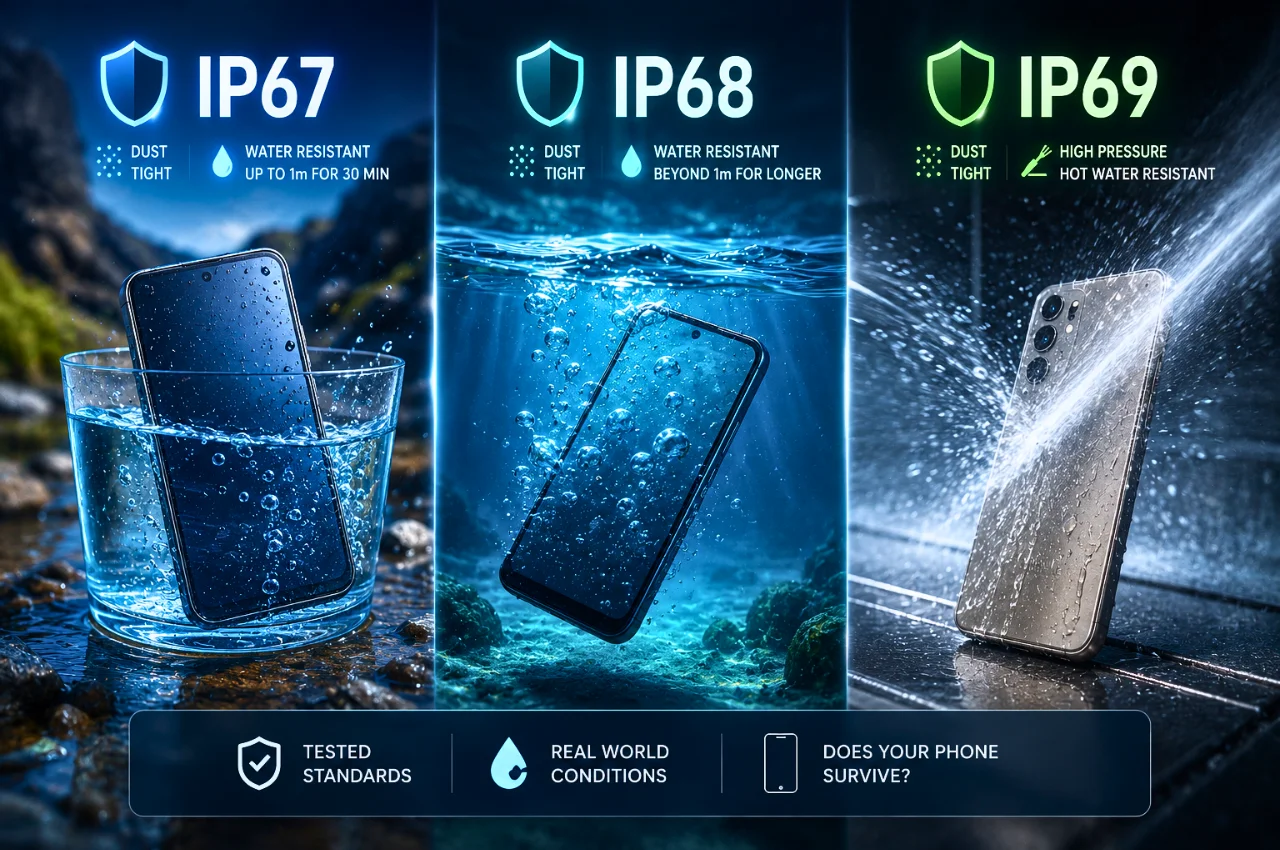
Your phone fell into a bucket of water during Holi. Or it slipped out of your pocket in the bathroom. Or you got caught in the monsoon without a cover.
First thought — “thank god it’s IP68.”
Second thought — wait, what does that actually mean?
Because here is the thing nobody tells you at the time of purchase: IP ratings are not a waterproof guarantee. They are a lab test result. And the difference between IP67, IP68, and IP69 is genuinely confusing — because a higher number does not always mean better protection for your specific situation.
This guide explains exactly what each rating means, what it does not mean, which phones carry which rating in India in 2026, and the one thing that will genuinely shock you about water damage and your warranty.
What Does IP Rating Actually Mean?
IP stands for Ingress Protection. It is an international standard defined by IEC 60529 — a set of tests that measure how well a device resists dust and liquid entering its body.
Every IP rating follows the same format: two digits after the letters IP. The first digit is about dust. The second digit is about water.
The first digit goes from 0 to 6. A 6 means the device is completely dustproof — no dust particles can enter under any conditions. Almost every phone rated IP67 or higher has a 6 as the first digit, so dust protection is generally not the differentiating factor between phone ratings.
The second digit is where everything interesting happens. It goes from 0 to 9 — and each step tests a completely different scenario. The jump from 7 to 8 is not just “a little more water resistant.” The jump from 8 to 9 is not just “even more water resistant.” They test entirely different things. Understanding this is the whole point.
IP67 — What It Actually Means
An IP67 phone can be submerged in still fresh water up to 1 metre deep for 30 minutes under lab conditions.
In Indian daily use, IP67 means your phone is safe in the monsoon, safe if dropped in a sink or bucket, safe in light rain, and safe for brief bathroom use. It is solid protection for the most common accidents that happen to most people.
What IP67 does not cover: swimming pools, rivers, beaches, heavy shower spray, or any water deeper than your knee. The rating was tested in perfectly still fresh water in a controlled environment — not in a running tap, not in a moving stream, not in chlorinated or salt water.
In India in 2026, several phones in the ₹15,000 to ₹25,000 range carry IP67 ratings. Select Samsung Galaxy M series models and certain Redmi Note models fall in this category — bringing genuine water protection to a price segment that previously had none.
IP68 — The Standard That Actually Matters
IP68 is the rating that makes the most meaningful difference for everyday Indian users. An IP68 phone can be submerged in fresh water beyond 1 metre — typically 1.5 metres for most Android phones, and up to 6 metres for the iPhone 17 series — for 30 minutes under controlled conditions.
The jump from IP67 to IP68 is significant in real-world use. IP68 gives genuine confidence in and around water — not just protection against accidental splashes. You can use it in a pool at shallow depth, take photos in the rain without anxiety, and not panic when you drop it in water.
In India in 2026, IP68 has quietly stopped being an exclusively flagship feature. The POCO X7 Pro, Realme 14 Pro 5G, Samsung Galaxy A56 5G, OnePlus Nord 6, and Google Pixel 10 series all carry IP68 ratings. Premium flagships like the Samsung Galaxy S26 series and iPhone 17 series also carry IP68 — with Apple going further and testing to 6 metres depth, which is significantly more than the standard.
IP69 — Industrial Protection That Gets Misunderstood
IP69 is the most misunderstood rating in the smartphone market. People assume IP69 means “even more waterproof than IP68.” It does not work that way.
An IP69 rating specifically means the device can withstand high-pressure hot water jets — water at up to 80 degrees Celsius, at 100 bar of pressure, sprayed from 10 to 15 centimetres away. This test was originally designed for industrial machinery that needs to be sanitised with steam cleaners. Agricultural equipment, food processing machines, factory floors.
Here is the critical detail: IP69 does not automatically mean the device is better for swimming or deeper submersion than IP68. The “9” rating only certifies that it passed the high-pressure jet test — not a submersion test. A phone can theoretically pass IP69 and fail at deeper water immersion.
That is why serious phones today carry multiple ratings simultaneously. The OnePlus 13, for example, carries IP68 and IP69 together — IP68 certifies it for submersion, IP69 certifies it for pressure resistance. One certification without the other gives you an incomplete picture.
For Indian buyers, IP69 matters primarily if you use your phone in environments involving direct water pressure — heavy shower spray, kitchen use near running water, outdoor work in the rain. For general use, IP68 is sufficient and more practically relevant.
The Big Difference Nobody Talks About
IP67 tests at 1 metre of still fresh water for 30 minutes. IP68 tests at 1.5 metres or more of still fresh water for 30 minutes. IP69 tests against high-pressure hot water jets at close range.
Notice what all three have in common: still fresh water, controlled lab conditions, tested once when the phone is brand new.
Real-world water is different. Saltwater contains minerals that corrode seals. Chlorinated pool water attacks rubber gaskets. Running tap water creates pressure that still water does not. Moving river water pushes harder than a stationary test chamber.
The seals that create water resistance also wear down over time. Every drop the phone takes, every time you open a charging port, every thermal expansion and contraction cycle in Indian summer heat — all of it gradually degrades the seals. A phone rated IP68 when it left the factory may not hold that same rating after 18 to 24 months of regular use.
This is confirmed by Google themselves. When the Pixel 10 series launched, Google published a support page explicitly stating that the IP68 rating reflects factory conditions but is not permanent — and that water resistance degrades with normal wear and tear. Several other manufacturers have similar fine print buried in their documentation.
The Warranty Reality That Will Genuinely Surprise You
This is the part most phone advertisements skip entirely.
Water damage is not covered under warranty on virtually any IP-rated phone in India — including phones rated IP68 and IP69
refurbished phones often have degraded IP seals — relevant angle
Samsung, Apple, OnePlus, Google — all of them explicitly exclude liquid damage from their standard warranty terms. The IP rating is a marketing feature and a lab certification. It is not an insurance policy.
Inside every modern phone is a small component called a Liquid Contact Indicator — a tiny sensor that turns red when it detects moisture. If you bring a water-damaged IP68 phone to a service center, the technician checks the LCI. If it has turned red, the warranty is considered void. You pay for repairs out of pocket.
The logic manufacturers use is technically sound: they cannot prove how or when the phone encountered water, or whether the conditions exceeded the rated limits. If water got inside, something exceeded the test parameters — and that is treated as accidental damage rather than a product defect.
This is not a small print technicality. It is a meaningful financial risk. An IP68 rating should give you reasonable confidence for everyday accidents — but it should not give you the confidence to take your phone into a swimming pool and expect full replacement coverage if something goes wrong.
Which Rating Do You Actually Need?
For most Indian users, IP68 is the target. It covers the realistic accident scenarios — monsoon, bathroom drop, kitchen splash, pool edge. The added cost of choosing an IP68 phone over an unrated one is minimal in 2026, since many mid-range phones now carry this certification.
IP67 is acceptable for users who are genuinely careful with their phones and primarily want protection against rain and accidental spills. For the ₹15,000 to ₹25,000 price segment, IP67 is often the best available option and provides meaningful protection.
IP69 is worth seeking out if you work outdoors in heavy rain, use your phone in a kitchen environment with running water, or want the added confidence of pressure resistance on top of submersion protection. For office workers and general users, IP69 adds limited practical benefit over IP68 in daily life.
No IP rating is sufficient justification for using your phone while swimming, snorkelling, or in any environment involving sustained water exposure beyond the rated depth and time. The certification tests for accidents, not for deliberate aquatic use.
IP Ratings on Indian Phones in 2026 — Quick Reference
Under ₹20,000: IP67 is now available on select Samsung Galaxy M series and Redmi Note models. This is a meaningful improvement in a price segment that previously offered no certified water protection.
₹20,000 to ₹35,000: IP68 is increasingly standard. The Samsung Galaxy A56 5G, POCO X7 Pro, and Realme 14 Pro 5G all carry IP68 at this price point — making serious water protection accessible to mainstream Indian buyers for the first time.
₹35,000 to ₹60,000: IP68 is standard across the segment. OnePlus Nord 6, iQOO Neo 10, and Motorola Edge 60 Pro all carry IP68. Some phones in this range also include IP69 certification.
Above ₹80,000: IP68 is universal. Apple’s testing to 6 metres remains the deepest submersion certification in the consumer smartphone market. The Samsung Galaxy S26 Ultra and iPhone 17 Pro Max both carry IP68 with manufacturer-tested depths well beyond the standard minimum.
What Degrades Water Resistance Over Time
Understanding what damages water resistance seals helps you make a phone last longer.
Physical drops are the biggest threat. Every impact can slightly misalign or crack the rubber seals around the display edge and buttons. A phone that survives a 1-metre water test when new may leak after taking a concrete corner hit.
Heat cycles matter too. Indian summers — 40 to 45 degrees Celsius outside, air-conditioned interiors — create repeated thermal expansion and contraction in the phone’s materials. Over time, this loosens seals.
Third-party repairs are the most immediate risk. If you open the phone for a screen replacement or battery change at an unauthorised service center, the original seals are almost certainly not reinstalled correctly. The IP rating after an unofficial repair is essentially meaningless.
Charging port use adds wear. Plugging and unplugging cables repeatedly creates micro-stress on the port seal. Wireless charging partially addresses this — which is one reason why flagship phones that offer wireless charging tend to maintain better water resistance over time.
The Honest Bottom Line
IP ratings are a genuinely useful feature. An IP68 phone is meaningfully more protected than an unrated phone in the same situation. The monsoon is less anxiety-inducing. The bathroom drop is recoverable. The rainy bike ride is manageable.
But “water resistant” is not “waterproof.” The certification is a lab result, not a lifetime guarantee. It degrades over time. It does not cover saltwater, pool water, or sustained pressure. And if something goes wrong, the warranty will not protect you.
Buy a phone with IP68 if it is available at your price point — in 2026 it often is, even in the mid-range. Use it with reasonable confidence. Just do not take it snorkelling and expect a replacement.
Frequently Asked Questions
What is the difference between IP67 and IP68 in simple terms?
IP67 means the phone can survive being submerged in still fresh water up to 1 metre deep for 30 minutes in lab conditions. IP68 means it can survive deeper submersion — typically 1.5 metres for most Android phones, up to 6 metres for Apple — for the same 30-minute duration. For everyday Indian use including monsoon and bathroom accidents, both provide solid protection. IP68 gives additional confidence near pools or in heavier rain.
Does IP69 mean a phone is more waterproof than IP68?
Not necessarily. IP69 certifies resistance to high-pressure hot water jets — a test designed for industrial equipment that gets steam-cleaned. It does not automatically mean the phone can be submerged deeper or longer than IP68. Phones with both IP68 and IP69 certifications provide the most comprehensive protection. IP69 alone without IP68 would actually be less useful for submersion scenarios.
Is water damage covered under warranty on IP68 phones in India?
No. Virtually all major manufacturers — Samsung, Apple, OnePlus, Google — explicitly exclude water damage from standard warranty terms. The IP rating is a lab certification, not an insurance policy. Inside your phone is a Liquid Contact Indicator that turns red when moisture enters. Service centers use this to identify water damage and typically deny warranty coverage when it has triggered.
Can I swim with my IP68 phone?
You can swim at shallow depths in fresh water for short durations — IP68 is typically rated for 1.5 metres for 30 minutes. However, manufacturers do not recommend it, and swimming creates water pressure and movement that exceeds the still-water lab conditions of the test. Saltwater and chlorinated pool water are not covered by the IP rating and can damage seals more quickly. Treat IP68 as protection for accidents, not for deliberate aquatic activity.
Does water resistance degrade over time?
Yes. The rubber and adhesive seals that create water resistance wear down with use, drops, heat cycles, and especially with third-party repairs. A phone that passes IP68 testing when new may have reduced protection after 18 to 24 months. Google has explicitly confirmed this for the Pixel 10 series — and the same applies to all IP-rated phones regardless of brand.
Which IP-rated phone is best for Indian monsoon use?
Any phone with IP67 or higher provides genuine monsoon protection. For under ₹25,000, the Samsung Galaxy A56 5G (IP67 in some variants) offers certified protection at a mainstream price. For the ₹25,000 to ₹40,000 range, the POCO X7 Pro and Realme 14 Pro 5G both carry full IP68. For premium buyers, the OnePlus 13 carries both IP68 and IP69, making it the most comprehensively certified mainstream smartphone in India in 2026.
Why do budget phones not have IP ratings even if they feel water resistant?
IP certification requires formal third-party laboratory testing and carries a cost. Budget phone manufacturers often skip the certification process to reduce costs — even if the physical build quality is reasonably water resistant in practice. Without the certification, there is no standardised test result to reference and no accountability for performance claims. Always look for an explicit IP rating rather than marketing language like “splash resistant” or “water protected” that is not backed by a certification number.
Final Thoughts
The IP rating system is one of the most useful pieces of information on a phone spec sheet — and one of the most commonly misunderstood. IP67 is solid everyday protection. IP68 is the target for most Indian buyers. IP69 adds pressure resistance that matters in specific environments. None of them make your phone waterproof, and none of them guarantee warranty coverage if water gets inside.
In 2026, IP68 has trickled down to mid-range phones that cost ₹25,000 to ₹35,000 — which means there is little reason to buy a phone without certified water resistance at any mainstream price point. It is one of those features you will never regret having, and will deeply regret not having, at the worst possible moment.