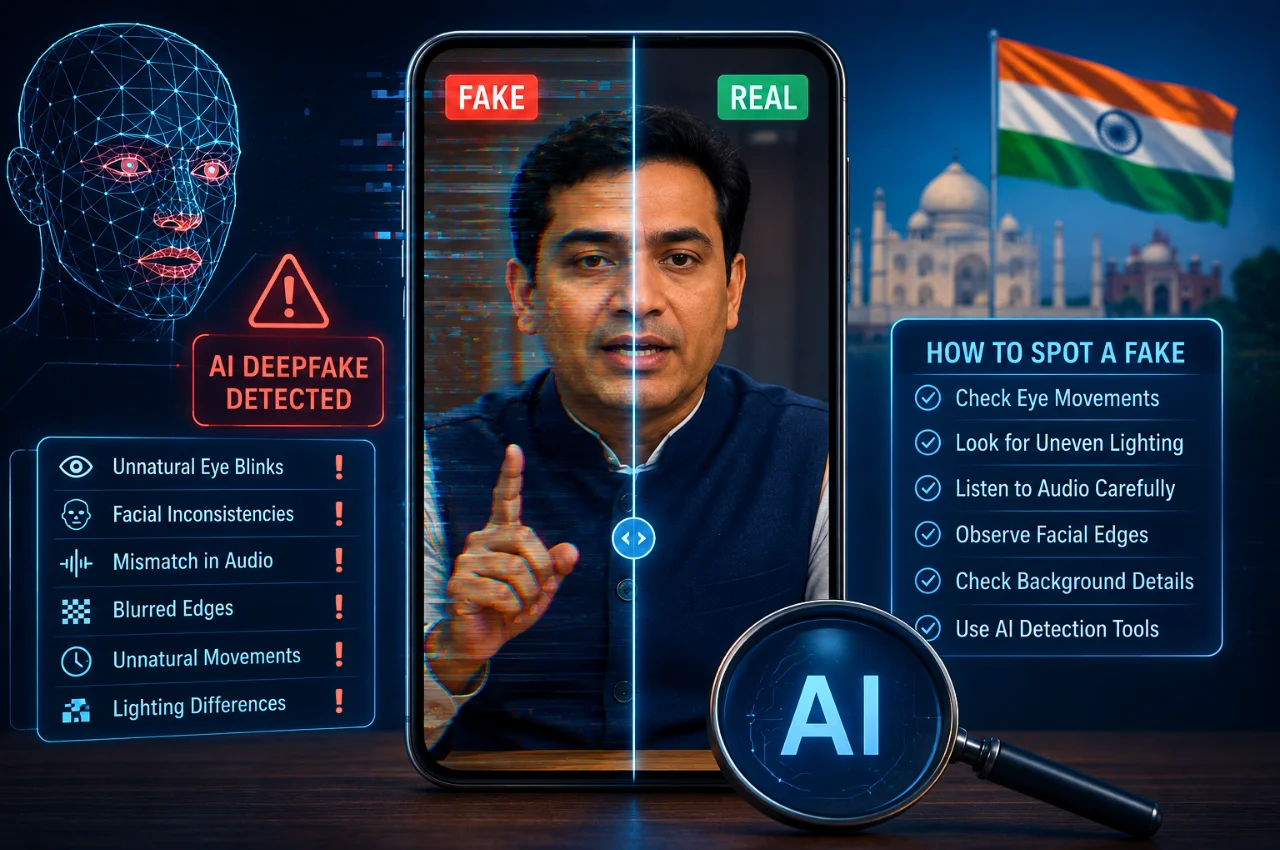
A video message arrives on WhatsApp. It looks like your brother. It sounds like your brother. He says he is in trouble and needs ₹50,000 transferred immediately.
Except it is not your brother. It is an AI-generated voice clone built from three seconds of audio scraped from a public Instagram story.
This is not a hypothetical scenario. AI-driven WhatsApp scams using voice cloning and deepfakes are actively targeting Indians, costing victims crores of rupees. According to Haryana Cyber Cell, over 2,300 voice cloning fraud cases were reported in India in Q4 2025 alone — a 450% increase from the previous year.
India lost over ₹22,000 crore to cybercrime in 2025 alone. Deepfake incidents grew 900% year-over-year, making India one of the most targeted countries in the world for AI-powered digital fraud.
Understanding what deepfakes are, how they work, and how to spot them is no longer optional knowledge for Indian internet users. It is a basic digital survival skill in 2026.
What is a Deepfake?
A deepfake is a piece of media — a video, photo, or audio clip — that has been artificially generated or manipulated by AI to show something that never actually happened, or to make a real person appear to say or do something they never said or did.
The word comes from “deep learning” — the AI technique used to create them — combined with “fake.” The technology works by training AI models on large amounts of real images, videos, and audio of a specific person, then using that training to generate convincing synthetic versions.
Early deepfakes required expensive hardware and significant technical expertise. A realistic video swap in 2018 took days of processing time and a team of specialists. Today, a decent gaming PC can generate 4K deepfakes at 50 frames per second with synchronized audio. The barrier to entry has completely collapsed.
In 2026, AI needs only 3 to 5 seconds of audio to produce a consumer-grade voice clone. That is shorter than most Instagram Reels. Anyone with a public social media presence is a potential target.
How Deepfakes Are Being Used to Harm Indians Right Now
The Family Emergency Scam
This is the most common deepfake fraud targeting ordinary Indians in 2026. Fraudsters use AI-generated voices to impersonate relatives or trusted contacts on WhatsApp calls and voice notes. Victims are made to believe the caller is someone they know and pressured into sending money quickly. The voice is cloned from publicly available audio — a video call recording, a YouTube upload, a TikTok clip — without the real person ever knowing it happened.
Fake Celebrity Investment Promotions
Other reported incidents involve fake investment promotions where manipulated videos or synthetic endorsements are used to create false trust. You have likely seen these circulating on YouTube and Facebook — videos of Mukesh Ambani, Ratan Tata, or well-known cricketers “endorsing” crypto platforms or stock trading apps they have never heard of. The faces and voices are real. The words are entirely fabricated.
The “Digital Arrest” Scam
A deepfake video of someone who appears to be a police officer or government official calls and tells you that you are under investigation. The face is convincing enough. The uniform is convincing enough. The official-sounding accusations create genuine fear. You pay a “settlement” to make it go away. Many of India’s cybercrime cases are now AI-enhanced, with voice clones and deepfakes used specifically to increase the credibility of the threat.
Corporate Fraud
This is not just a problem for individuals. Global losses from CEO fraud — where scammers clone the voice of a company’s CEO or CFO and call the finance team with urgent payment instructions — exceeded $2.4 billion in 2025, with India accounting for 8% of cases. In one high-profile international case, an entire video conference call with multiple participants turned out to be fully AI-generated — and a real employee transferred a large sum of money before discovering the truth.
Why Spotting Deepfakes Has Gotten So Hard
Here is the honest, uncomfortable truth that most “how to spot a deepfake” articles skip: the old visual tricks no longer work reliably.
Research from iProov’s 2025 Threat Intelligence Report found that just 0.1% of participants could reliably distinguish real from AI-generated content. The advice about watching for unnatural blinking or weird teeth made sense when deepfakes were crude, in 2019. Modern AI has largely solved those obvious problems.
At the India AI Impact Summit in February 2026, Tarun Wig, co-founder of Innefu Labs, stated: “As of now, there is not a single AI model that can detect a really good deepfake-generated video and tell you this is fake.” He also warned that this technology is heading toward becoming a national security issue by the 2029 elections.
The gap between how good deepfakes have gotten and how good detection tools are is real. Visual inspection alone is no longer sufficient. What you need is a layered approach — a combination of visual checks, behavioral awareness, and verification habits.
How to Spot a Deepfake Video — What Still Works
Despite how advanced the technology has become, there are still tells that modern deepfakes struggle to hide. Knowing what to look for changes how you watch suspicious content.
Watch the edges of the face
Modern deepfakes fail at the edges of things. Hair, earrings, and the boundary where the face meets the neck are consistently difficult for AI to render perfectly. Look for blurring, flickering, or an unnaturally smooth transition between the face and the surrounding area. If a strand of hair seems to pass through an ear, or if the hairline looks slightly plastic — it is a warning sign.
Observe the eyes and blinking
Real humans blink spontaneously every 2 to 10 seconds. AI-generated faces often stare without blinking for unnaturally long periods, or blink in an oddly mechanical way. Watch a 30-second clip and count the blinks. If something feels robotic about the eye movement, trust that instinct.
Check the mouth and teeth
Teeth remain one of the hardest elements for AI to generate consistently. Look for teeth that seem too uniform, too perfect, or that shift slightly between frames. Watch the inside of the mouth during speech — the tongue and the back of the throat are often rendered inconsistently.
Look at lighting consistency
Real lighting hits a face from a specific direction and creates consistent shadows. In deepfakes, the lighting on the face sometimes differs subtly from the lighting on the neck, ears, or background. A face that seems slightly brighter or differently lit than the rest of the scene is worth scrutinizing.
Watch for audio-video sync issues
Look for inconsistencies in the subject’s speech rhythm and micro-expressions. In deepfakes, the lip movement sometimes lags slightly behind the audio, or the emotional expression on the face does not match the emotional content of the words. A slight delay between what you hear and what you see, particularly on fast speech, is a classic deepfake artifact.
Pause on still frames
Play the video and manually pause on random frames. Deepfake artifacts are often invisible in motion but visible in freeze frames. Look for blurring around the face boundary, mismatched skin texture between the face and neck, or strange distortion in the background near the head.
How to Spot a Deepfake Audio or Voice Clone
Voice deepfakes are increasingly common in India because they require even less source material than video deepfakes and are harder to verify quickly over a WhatsApp call.
Real humans modulate their voice in response to interruption, surprise, or emotion. AI-generated voices struggle with truly unscripted real-time responses. The most powerful test against a live voice deepfake is asking something completely unexpected — an inside joke, a reference to a shared memory, a question about something only the real person would know. Scripted deepfakes cannot handle genuine improvisation.
Listen for these audio signs. Unnaturally consistent volume throughout — real voices fluctuate. Breathing that sounds wrong — either absent or oddly placed. Emotional delivery that feels flat or slightly off in timing. Words that sound perfectly pronounced but lack the natural imperfections of real speech.
In 2026, voice models are approximately 95% accurate — even trained experts struggle. Do not rely on audio quality alone to make a judgment. Use the behavioral test of asking unexpected questions instead.
How to Spot a Deepfake Photo

AI Generated image
Background inconsistencies: Look at what is behind the person. AI often renders the subject perfectly while creating subtle errors in the background — objects that repeat, walls that curve slightly, furniture that does not cast shadows correctly.
Jewelry and accessories: Earrings, necklaces, and glasses remain difficult for AI to render consistently. Earrings that are slightly different from each other, glasses frames that do not sit evenly on both sides of the face, or jewelry that seems to merge with the skin are all deepfake tells.
Skin texture uniformity: Real skin has pores, texture variation, and subtle imperfections. AI-generated skin often looks unnaturally smooth or plasticky in areas, even while appearing realistic at first glance.
Symmetry that is too perfect: Real human faces are slightly asymmetrical. AI models often generate faces that are more symmetrical than any real person’s face. A face where both sides look almost mirror-perfect is a sign worth investigating.
Text in the background: AI still struggles with generating readable text. If there is text on signs, screens, books, or clothing in the background of an image, look at it closely. Garbled, blurred, or nonsensical text is a strong deepfake indicator.
Free Tools to Verify Suspicious Content
When visual inspection is not enough, these tools can help — though no tool is definitive against modern deepfakes.
Deepware Scanner (deepware.ai) — a web-based tool that uses neural networks to analyze uploaded videos for deepfake indicators. It offers a free tier with no installation required and works on any device. Upload a suspicious video and receive an analysis within minutes.
Google Reverse Image Search — for photos, drag and drop a suspicious image into Google Images search. If the same face appears in multiple different contexts with different names attached, or if the image traces back to a stock photo database or known deepfake collection, it is likely fabricated.
InVID / WeVerify — a browser extension used by journalists and fact-checkers worldwide to analyze video provenance, keyframe extraction, and metadata. Free and available for Chrome and Firefox.
FotoForensics (fotoforensics.com) — analyzes images for manipulation artifacts using Error Level Analysis, which highlights areas of an image that have been digitally altered or inserted.
Remember that these tools are aids, not authorities. Even AI-based detection models have limitations — modern deepfakes can fool purpose-built classifiers trained specifically to detect them. Use tools as one layer of verification, not as a final verdict.
The Safe Habits That Protect You
Technical detection skills are useful. But building consistent habits is more reliable than trying to out-analyze every suspicious piece of media.
Establish a code word with family members. Before any financial emergency happens, agree on a word or phrase that only your family knows. If someone claiming to be a relative calls urgently asking for money, ask for the code word. No code word — no transfer. This single habit defeats the family emergency voice clone scam entirely.
Never transfer money based on a phone call or video call alone. Call back independently on a number you already have stored for that person. Fraudsters will tell you not to hang up — which is itself a red flag.
Be suspicious of urgency. Deepfake scammers rely on urgency to prevent you from thinking clearly or verifying. Any request that creates high pressure to act immediately — especially involving money — should trigger verification, not immediate action.
Audit your public social media audio. Videos and voice notes you post publicly are source material for voice cloning. If you have years of public video content on YouTube or Instagram, be aware that your voice is accessible to anyone with the intention to misuse it.
Do not forward unverified videos. India’s misinformation spreads overwhelmingly through WhatsApp forwards. With 535 million Indian users on WhatsApp — the largest user base of any country globally — the platform is the primary channel through which fake content reaches ordinary people. If you cannot verify a video, do not forward it.
What Indian Law Says About Deepfakes in 2026
India took a significant regulatory step in early 2026. On February 10, 2026, MeitY notified the Information Technology (Intermediary Guidelines and Digital Media Ethics Code) Amendment Rules, 2026. Effective from February 20, 2026, these rules mark India’s first comprehensive statutory framework for synthetically generated information.
Under these rules, all synthetically generated information — including deepfakes and AI-cloned audio — must carry disclaimers and permanent provenance metadata. Platforms must deploy automated detection tools.
Significant social media intermediaries are now required to remove flagged deepfake content within 3 hours, and non-consensual intimate content within 2 hours. Platforms that miss these windows risk losing safe harbour protection under Section 79 of the IT Act.
The amendment introduces strict liability for social media platforms to label AI content, verify user posts, and act on grievances faster than before. Platforms must now inform users that creating harmful synthetic content — such as non-consensual intimate imagery or fraud — can lead to imprisonment under the Bharatiya Nyaya Sanhita, 2023.
If you are a victim of deepfake fraud in India, file a complaint at the National Cyber Crime Reporting Portal (cybercrime.gov.in) or call the National Cyber Crime Helpline at 1930.
Frequently Asked Questions
What exactly is a deepfake and how is it made?
A deepfake is AI-generated or AI-manipulated media — video, photo, or audio — designed to make a real person appear to say or do something they never actually did. It is created using deep learning models trained on real images and videos of the target person. The AI learns to replicate the person’s face, voice, or both, and then generates new content in their likeness. The process that once required weeks of specialist work now takes minutes on consumer hardware.
Can a deepfake be made from a single photo?
Yes. Modern AI tools can generate realistic video from a single reference photo combined with a separate audio source. You do not need extensive footage of a person to create a convincing deepfake — one clear facial image is sufficient for some applications. This makes everyone with a public profile a potential target.
How do I report a deepfake video in India?
If you encounter a deepfake video being used for fraud or non-consensual content, report it to the platform immediately using its content reporting tools. Simultaneously, file a complaint at cybercrime.gov.in or call 1930. Under India’s IT Amendment Rules 2026, platforms are required to take down flagged deepfake content within 3 hours of a valid complaint.
Is sharing a deepfake video illegal in India?
It depends on the intent and content. Sharing a deepfake video for fraud, to damage someone’s reputation, or that contains non-consensual intimate imagery is illegal under multiple provisions of Indian law including the Bharatiya Nyaya Sanhita, 2023, and the IT Act. Sharing satirical or clearly labelled AI content for educational or entertainment purposes exists in a greyer area. When in doubt, do not share content you cannot verify.
Can I trust a video call as proof that someone is real?
No — not entirely. Enterprise risks now include voice cloning and video deepfakes in live calls. Attackers impersonate executives in video calls to authorize fraudulent wire transfers. A convincing video call appearance is no longer sufficient verification that you are speaking with the real person, particularly in high-stakes financial situations. Always verify through independent channels before acting on any request made via video call.
What is the best free tool to detect a deepfake?
No single tool is definitive against modern deepfakes. The most accessible combination for Indian users is Google Reverse Image Search for photos, Deepware Scanner for videos, and the InVID/WeVerify browser extension for cross-platform content verification. Use these as one layer of a broader verification habit, not as a final authority.
Final Thoughts
The deepfake problem in India is not going to get easier. The technology will continue to improve. The cost of generating convincing fake content will continue to fall. The tools to detect it will continue to lag behind the tools to create it.
Experts at India’s AI Impact Summit warned that deepfakes are heading toward becoming a national security issue, potentially as soon as the 2029 elections.
What you can control is your own habits and awareness. The visual tells still exist — use them. The behavioral verification tricks — code words, call-backs, questions only the real person could answer — are more reliable than any AI detector. The safe money habit of never transferring funds based on a single call is simple and effective.
India now has its first legal framework specifically addressing deepfakes. That is a meaningful step. But laws and platforms cannot protect you faster than a suspicious, thinking person can protect themselves.
When something feels wrong about a video, a voice, a photo — trust that instinct. Then verify before you act.