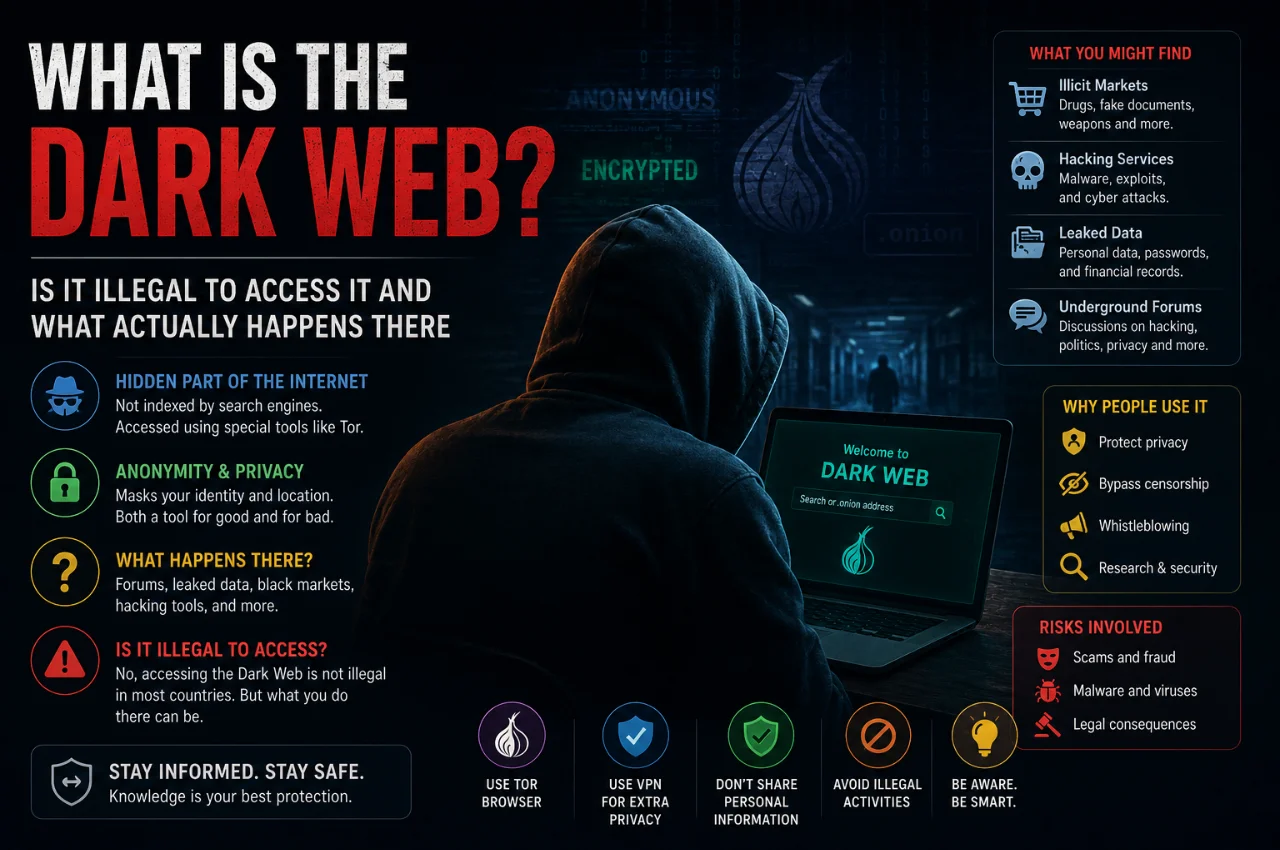
If you have ever heard the term “dark web” and felt a mixture of curiosity and unease — you are not alone. The dark web has a reputation built mostly on fear, sensationalism, and Hollywood-style exaggeration. People imagine it as a shadowy corner of the internet where only hackers, criminals, and government spies operate.
The reality is more nuanced, more interesting, and more relevant to ordinary people than most sensational headlines suggest.
This guide explains exactly what the dark web is, how it differs from the regular internet, what actually happens there, whether it is legal to access, what the real risks are, and — most importantly — how it can affect you even if you never visit it once in your life.
No exaggeration. No scare tactics. Just the facts.
The Internet Has Three Layers — Most People Only See One
Before explaining the dark web, you need to understand that the internet you use every day is only a small fraction of the total internet. The entire internet is divided into three distinct layers, and most people only ever interact with the outermost one.
The Surface Web is the part of the internet that you access every single day. It includes every website that appears in Google search results — news websites, YouTube, Instagram, Amazon, Wikipedia, government websites, and every other publicly accessible page. Despite feeling enormous, the surface web represents only about 4 to 5 percent of the total content on the internet. Everything on the surface web is indexed by search engines, meaning Google and other search engines have catalogued it and can direct you to it through a normal browser like Chrome, Firefox, or Safari.
The Deep Web is the largest layer of the internet, making up approximately 90 to 95 percent of all internet content. Contrary to what many people assume, the deep web is not mysterious or dangerous at all. It simply consists of all internet content that is not indexed by search engines — meaning Google cannot find it or show it in search results. This includes your personal email inbox, your bank account portal, private company databases, medical records systems, university research databases, subscription streaming content, password-protected corporate intranets, and any other content that requires authentication to access. You use the deep web every single day every time you log into Gmail, check your bank balance, or access any private online account.
The Dark Web is a small, intentionally hidden portion of the internet that exists within the deep web but is deliberately concealed — requiring specialized software to access. Unlike the deep web, which is simply private or non-indexed, the dark web is specifically designed for anonymity. It cannot be accessed through a regular browser. It does not appear in any search engine. And its websites use special domain extensions — typically ending in .onion — that are only resolvable through the specific software required to access the dark web.
The dark web is estimated to make up less than 0.01 percent of the total internet.
What is the Dark Web? — The Technical Explanation Made Simple
The dark web is a collection of websites and online services that operate on encrypted overlay networks — most commonly the Tor network — that are specifically designed to hide the identity and location of both the websites themselves and the people visiting them.
The key technology that makes the dark web possible is called onion routing — and the name gives you the best way to understand it.
Imagine peeling an onion. When you access a regular website, your request travels from your device to your internet service provider and then to the destination website — and every step of this journey reveals your identity and location.
Onion routing works differently. Your request is encrypted in multiple layers — like the layers of an onion. It then travels through a series of volunteer-operated relay computers around the world, called nodes. At each node, one layer of encryption is removed — and the node only knows where the request came from and where to send it next, but nothing else. By the time the request reaches its destination, the original source has been completely hidden through these multiple layers of routing and encryption.
The result is that neither the website you are visiting nor any of the intermediate nodes can identify who you are or where you are connecting from. This anonymity is what makes the dark web unique — and what makes it attractive to both people with legitimate privacy needs and people with criminal intent.
The software most commonly used to access the dark web is the Tor Browser — a specially modified version of Firefox that routes all traffic through the Tor network automatically. The Tor Project, the nonprofit organization that develops Tor, originally created the technology for the US Naval Research Laboratory as a tool for secure government communications. It was later released publicly and is now used by millions of people worldwide for a wide range of purposes.
Is It Illegal to Access the Dark Web?
This is the question most people ask first, and the answer is important to get right.
In most countries — including the United States, the United Kingdom, most of Europe, and India — accessing the dark web itself is not illegal. The Tor Browser is legal to download and use. Simply visiting the dark web, out of curiosity or for legitimate research, does not violate any law in most jurisdictions.
The legality depends entirely on what you do there — not on the act of accessing it.
Accessing the dark web to read privacy-focused news, communicate anonymously, research cybersecurity threats, or use legitimate services is completely legal. Accessing the dark web to buy illegal drugs, purchase stolen data, obtain illegal weapons, view illegal content, or engage in any other criminal activity is illegal — just as those same activities would be illegal if conducted anywhere else online or offline. The dark web does not create a legal exemption for criminal behavior. Anonymity does not equal impunity.
Law enforcement agencies including the FBI, Interpol, and India’s CBI have successfully tracked down and prosecuted individuals conducting illegal activities on the dark web. In May 2025, a global operation called Operation RapTor resulted in 270 arrests and the seizure of over 200 million dollars worth of cryptocurrency and cash. The dark web’s anonymity is real but imperfect — and determined law enforcement has demonstrated repeatedly that it is not impenetrable.
Regarding India specifically: Accessing the dark web using Tor is not explicitly illegal under Indian law. However, any activity conducted on the dark web that violates Indian law — including the IT Act, NDPS Act, or any other legislation — is fully prosecutable regardless of where or how it was conducted online. Indian cybercrime authorities do monitor dark web activity related to Indian targets.
What Actually Happens on the Dark Web? — The Full Picture
The dark web contains both illegal and legitimate content — and understanding both is essential for an accurate picture.
The Illegal Side — What Makes Headlines
The dark web does host significant criminal activity, and it is important to acknowledge this honestly rather than pretend it does not exist.
Illegal marketplaces are the most well-known dark web feature. These are online stores that sell illegal drugs, stolen personal data, counterfeit documents, hacking tools, ransomware kits, and other illegal goods. They operate similarly to regular e-commerce platforms — with product listings, seller ratings, and customer reviews — but payment is made in cryptocurrency, primarily Monero and Bitcoin, to maintain anonymity. The most famous of these, Silk Road, was shut down by the FBI in 2013, but new marketplaces have continuously emerged to replace shut-down ones.
Stolen data markets are among the most active segments of the dark web economy. Every major data breach — when a company’s database of customer information is hacked — results in that stolen data appearing for sale on dark web forums. This includes email addresses, passwords, credit card numbers, Aadhaar numbers, bank account details, and complete identity packages. The dark web stolen data economy generates an estimated 1.5 billion dollars annually.
Cybercrime services are sold openly on the dark web. These include ransomware-as-a-service kits that allow criminals with no technical knowledge to launch ransomware attacks, phishing templates, DDoS attack services, and malware distribution tools.
Forums for hackers and cybercriminals provide communities where techniques, vulnerabilities, and stolen access credentials are traded. These forums discuss methods for breaching corporate systems, share newly discovered software vulnerabilities, and sell access to already-compromised corporate networks.
It is also important to acknowledge that the dark web hosts content that is deeply disturbing and illegal — including material that law enforcement agencies actively pursue and that there is no circumstance under which accessing would be legal or appropriate anywhere in the world.
The Legitimate Side — What Never Makes Headlines
What receives far less attention is the significant legitimate use of the dark web, which is real and important.
Journalists and whistleblowers use the dark web and Tor to communicate securely and share sensitive information. SecureDrop — a platform used by major news organizations including The Guardian, The Washington Post, and the BBC — operates on the dark web specifically so that sources can submit documents and tip information to journalists without fear of government surveillance or retaliation. Many of the most significant news stories of the past decade were enabled by this technology.
Activists and dissidents in authoritarian countries use the dark web to communicate freely, access uncensored news, and organize without government surveillance. In countries where social media is blocked, certain news sites are banned, and internet activity is heavily monitored — the dark web and Tor provide a genuine lifeline for free expression.
Privacy-conscious individuals who are not engaged in any illegal activity use Tor and the dark web to prevent surveillance by corporations, ISPs, and governments. In an era of pervasive tracking and data collection, some people value anonymity as a matter of principle.
Researchers and cybersecurity professionals access the dark web to study emerging cyber threats, monitor criminal marketplaces for stolen corporate data, identify new malware being sold, and gather threat intelligence that helps protect organizations from attacks.
Ordinary people in countries with heavy internet censorship use Tor to access the normal surface web — news sites, social media platforms, and educational resources that are blocked by their government. Tor is not just a dark web browser — it also allows users to bypass censorship and access the regular internet anonymously.
How Does Your Personal Data End Up on the Dark Web?
This is the most directly relevant part of the dark web for ordinary Indian internet users — because your personal data may already be on the dark web without you ever having visited it.
Every major data breach results in stolen information being sold on dark web marketplaces. When a company’s database is hacked and millions of customer records are stolen, those records — including email addresses, passwords, phone numbers, credit card details, and sometimes Aadhaar numbers — are sold to the highest bidder on dark web forums within days of the breach.
India has experienced several significant data breaches in recent years. The 2023 ICMR data breach reportedly exposed the personal data of 815 million Indian citizens. Various other breaches of e-commerce platforms, fintech apps, and government databases have resulted in Indian user data appearing on dark web markets.
The implication is important: your personal information may be on the dark web right now as a result of a breach at a company you trusted with your data — through no fault of your own. You did nothing wrong. A company failed to secure your data adequately, and the result is that your information is for sale to anyone willing to pay.
How to Check If Your Data is on the Dark Web
There are legitimate tools that monitor dark web marketplaces for stolen data and alert you if your information appears there.
Have I Been Pwned at haveibeenpwned.com is a free, trustworthy service that allows you to enter your email address and see whether it has appeared in any known data breaches. If your email appears, the site tells you which breach it came from and what type of data was exposed. This is a completely safe tool created by a respected security researcher and is used by millions of people worldwide.
Google’s dark web report feature, available to Google One subscribers, monitors the dark web for your personal information including email addresses, phone numbers, and names and sends you alerts if they appear.
Many antivirus and security software packages — including Bitdefender, Norton, and McAfee — now include dark web monitoring as a standard feature in their paid plans.
If a service tells you your email or other data has appeared in a breach, the recommended actions are: change the password for that account immediately, change the password for any other account where you used the same password, enable two-factor authentication on all important accounts, and monitor your bank and credit card statements carefully for unauthorized transactions.
What Are the Real Risks If You Visit the Dark Web?
Even if someone visits the dark web purely out of curiosity and with no intention of engaging in any illegal activity, there are genuine risks worth understanding.
Malware exposure is the most immediate risk. Many dark web websites are designed to install malware on visitor devices. Without the right security setup, simply visiting certain dark web pages can result in keyloggers, ransomware, or other malicious software being installed on your device.
Scams are extremely common on the dark web. Because there is no legal recourse and no consumer protection, dark web marketplaces are full of scammers who take payment and deliver nothing. Trusting anyone on the dark web with financial information of any kind is extraordinarily risky.
Exposure to disturbing content is a real risk. The dark web contains content that is deeply disturbing, traumatizing, and in some cases illegal to view. Stumbling across such content — even accidentally — can have serious psychological effects.
Legal risk from association is subtle but real. Even if you are not personally engaged in illegal activity, being present in spaces where illegal activity is openly discussed or conducted can create legal complications in some jurisdictions. Law enforcement monitoring of dark web spaces means that presence in certain communities may attract scrutiny.
Identity exposure through misconfiguration is a technical risk. Improperly configured dark web access — such as not using the Tor Browser correctly, allowing JavaScript on dark web sites, or logging into personal accounts while using Tor — can inadvertently reveal your actual identity.
Is the Dark Web the Same as the Deep Web?
No — and this confusion is extremely common. These two terms are frequently used interchangeably but they refer to very different things.
The deep web is simply all internet content that is not indexed by search engines. Your email inbox is deep web. Your online banking portal is deep web. Your Netflix account is deep web. All private, password-protected content is deep web. The deep web is enormous — making up roughly 90 percent of the internet — and almost entirely benign.
The dark web is a small, specific subset of the deep web that requires special software to access and is deliberately designed for anonymity. The dark web is much smaller than the deep web and is the portion that contains both the legitimate privacy tools and the criminal marketplaces described in this article.
Every dark web site is also deep web — but the vast majority of the deep web has nothing to do with the dark web.
Key Facts About the Dark Web in 2026
The dark web makes up less than 0.01 percent of the total internet. The Tor Browser has over 3 million daily users worldwide. Approximately 57 percent of dark web content is estimated to be linked to illegal activity, meaning roughly 43 percent is not. The illicit dark web economy generates an estimated 1.5 billion dollars annually from stolen data and goods. Major law enforcement operations have successfully shut down hundreds of dark web criminal marketplaces, though new ones continually emerge. Operation RapTor in May 2025 alone resulted in 270 arrests globally. The most commonly traded items on illegal dark web markets are stolen personal data, login credentials, and drug listings. Transactions on dark web marketplaces almost exclusively use cryptocurrency — primarily Monero for anonymity and Bitcoin for broader acceptance.
Protecting Yourself From Dark Web Threats — Without Ever Visiting It
The most important thing for most ordinary users to understand is this: you do not need to visit the dark web to be affected by it. Your data can end up there through breaches at companies you trusted. Here is how to protect yourself.
Use unique passwords for every account. If one password is leaked in a breach, it cannot be used to access your other accounts. A password manager makes this manageable.
Enable two-factor authentication on all important accounts — email, banking, social media, and financial apps. Even if your password is stolen and sold on the dark web, two-factor authentication prevents anyone from using it to log in.
Monitor your accounts regularly. Check bank and credit card statements at least weekly for unauthorized transactions. Set up transaction alerts through your bank’s app.
Check haveibeenpwned.com periodically. Enter your email addresses to see if they have appeared in known data breaches and act accordingly.
Be careful what personal information you share online. The less data companies have about you, the less can be stolen and sold if they are breached.
Change passwords for any account where a breach is announced. Do this immediately when you hear news of a major data breach at any company you use.
Key Takeaway
The dark web is not the all-encompassing den of evil that sensational media portrays it as — but it is not harmless either. It is a technology that enables genuine anonymity online, which serves both legitimate privacy needs and criminal purposes simultaneously.
For the vast majority of ordinary internet users, the dark web is most relevant not as a place you visit but as a destination where your stolen personal data might end up after a company breach. Understanding this — and taking the protective steps outlined above — is the most practically useful thing you can do with the knowledge in this guide.
The dark web exists. It contains real criminal activity. It also serves real legitimate purposes. The internet is complex, and honest understanding serves everyone better than exaggeration in either direction.
Frequently Asked Questions
Is the dark web illegal in India?
Accessing the dark web using Tor is not explicitly illegal under Indian law. However, any activity conducted on the dark web that violates Indian law — drug trafficking, trading stolen data, cybercrime — is fully prosecutable under the IT Act and other relevant legislation regardless of the anonymity used. Indian cybercrime authorities actively monitor dark web activity involving Indian targets.
Can police track dark web users?
The Tor network provides strong anonymity but it is not perfect. Law enforcement agencies in multiple countries have successfully de-anonymized and arrested dark web users through a combination of technical methods, operational security mistakes by criminals, and infiltration of dark web communities. Hundreds of arrests result from dark web investigations every year globally.
What is the Tor Browser?
Tor Browser is a free, open-source browser developed by the Tor Project — a nonprofit organization. It routes your internet traffic through the Tor anonymity network, hiding your IP address and making your browsing difficult to trace. It is the primary tool used to access dark web .onion sites. The Tor Browser is legal to download and use in most countries.
Can I accidentally access the dark web?
No — accessing the dark web requires deliberately downloading specialized software like the Tor Browser and specifically navigating to .onion websites. You cannot stumble onto the dark web through a regular browser by accident. Your normal browsing is entirely on the surface web.
If my data is on the dark web, what should I do?
Change the password for the affected account immediately. Change passwords for any other accounts where you used the same password. Enable two-factor authentication everywhere possible. Monitor your financial accounts for unauthorized activity. File a cybercrime complaint at cybercrime.gov.in if you believe you have suffered financial fraud as a result. You cannot remove your data from the dark web once it is there, but you can minimize the damage by acting quickly.
Is the dark web the same as Tor?
No — Tor is a network and browser that provides anonymity. The dark web is the collection of hidden websites accessible through Tor and similar networks. Tor can also be used to browse the normal surface web anonymously — many people use it specifically for that purpose, never visiting any dark web content at all.
Final Thoughts
The dark web is one of the most misunderstood technologies in mainstream conversation. It is not a fictional hacker playground from a thriller movie. It is a real technology with real criminal misuse and real legitimate applications — existing simultaneously as a tool for activists, journalists, and privacy advocates, and as a marketplace for cybercriminals.
For most Indian internet users, the practical takeaway is straightforward. You do not need to visit the dark web. Your biggest concern is protecting your personal data from ending up there through company breaches — and the protective steps in this guide address exactly that.
Understanding the dark web accurately — without the sensationalism or the dismissiveness — is part of being an informed, protected digital citizen in 2026.