Every student in India has heard about ChatGPT and Gemini by now. Many have opened them at least once. But most use them in the least effective way possible — they type a question, get an answer, copy it, and move on. Then they wonder why their marks did not improve.
The students who are genuinely benefiting from AI in 2026 are not using it as a shortcut to skip thinking. They are using it as a study partner — something that explains, challenges, quizzes, and helps them understand rather than something that does the work for them. That distinction makes all the difference.
This guide covers ten specific, practical ways to use ChatGPT and Gemini for studying, exam preparation, and assignments — with exact prompts you can use today, completely free.
Before Anything Else — The Right Mindset
There is one thing worth saying directly before jumping into the ten methods, because it shapes everything else.
AI tools are not a replacement for understanding. A student who uses AI to generate an essay they do not understand gains nothing academically and risks serious consequences if their institution has AI policies. A student who uses AI to understand a concept they were struggling with, then writes the essay themselves, genuinely learns more than they would have with just a textbook.
The students who are winning academically with AI are using it to accelerate learning, not to bypass it. Keep that in mind as you read through these methods. The goal is not to do less work — it is to make your work more effective.
Way 1 — Use AI as a 24-Hour Personal Tutor

This is the most fundamental and valuable use of AI for any student, and it works for every subject from Class 8 to postgraduate level.
When you encounter a concept you do not understand — in your textbook, in lecture notes, or in a past paper solution — type it into ChatGPT or Gemini and ask for an explanation. But do not just ask “what is photosynthesis.” Ask in a way that gets you a genuinely useful response.
Try this prompt: “Explain photosynthesis to me as if I have never studied biology. Use a simple analogy to make it clear, and then give me one example from everyday life.”
Or for a more advanced topic: “I am studying for my Class 12 physics exam and I do not understand how electromagnetic induction works. Explain the concept step by step, starting from the basics, and tell me what common mistakes students make in exams on this topic.”
The key difference from using a search engine is that you can ask follow-up questions. If the first explanation is still confusing, say “I still do not understand the part about the magnetic field. Can you explain that part differently using a different example?” AI will keep rephrasing and adjusting until it clicks — which no textbook or YouTube video can do.
For Indian students specifically, Gemini is worth using for topics that require current information — government schemes, economic data, international events for UPSC preparation, or recent scientific discoveries. Gemini searches the web in real time and provides current answers with sources.
Way 2 — Generate Practice Questions on Demand
One of the most time-consuming parts of exam preparation is finding enough practice questions. Past papers are limited. Coaching institute materials are expensive. AI solves both problems instantly.
Try this prompt for any topic: “I am preparing for my Class 12 chemistry board exam. Give me 10 multiple choice questions on organic chemistry reactions at board exam difficulty level. After I answer them, tell me which ones I got wrong and explain why the correct answer is right.”
For competitive exams: “Give me 5 JEE-level problems on rotational mechanics. Make them progressively harder — start with a straightforward application and end with a multi-concept problem. Show full solutions after I attempt them.”
For UPSC preparation: “Give me 10 previous-year-style questions on Indian polity focusing on fundamental rights. Include questions that test conceptual understanding, not just definitions.”
What makes this genuinely useful is the ability to request questions at exactly the difficulty level you need. Too easy? Ask for harder ones. Not covering the right subtopic? Ask specifically. This level of customization would cost thousands of rupees at a coaching centre.
ChatGPT’s Study Mode — available in the free version — is specifically designed for this. When you turn it on, ChatGPT stops giving you answers and instead guides you toward them through questions, which is a significantly better learning method than being given solutions directly.
Way 3 — Simplify Difficult Textbook Language
NCERT books, reference books, and university-level texts often use language that is technically accurate but genuinely difficult to absorb on first reading. AI is exceptionally good at translating dense academic language into plain, readable explanations.
The method: open your textbook to the page that is confusing you. Copy the paragraph or the concept that is unclear. Paste it into ChatGPT or Gemini with this instruction: “Explain this in simple language that a student can understand. Use everyday examples relevant to India if possible.”
For science subjects, add: “Break down each part of this explanation and tell me what each term means.”
For social science and humanities, add: “What is the main idea here? What is the author trying to say in plain language?”
This works particularly well for subjects like economics, law, political science, and advanced science where the vocabulary is specialized. A paragraph that takes twenty minutes to decode from a textbook often takes thirty seconds to understand when explained by AI in simpler terms.
Way 4 — Create Personalized Study Plans
Exams are stressful partly because students often do not know where to start or how to divide their preparation time. AI can help structure your study plan based on your specific situation.
Try this prompt: “I have 45 days until my Class 12 board exams. I need to cover physics, chemistry, maths, and biology. I am strongest in chemistry and weakest in physics. I can study for 5 hours on weekdays and 8 hours on weekends. Create a detailed day-by-day study schedule that gives more time to my weak subjects and includes revision and practice test time in the final two weeks.”
Or for competitive exams: “I am preparing for NEET 2027 and I have 14 months. I am currently at a beginner level in all three subjects. Design a month-by-month study roadmap covering what topics to study each month, which books to use for each subject, and when to start solving previous year papers.”
AI will generate a structured plan based on your specific inputs. You can then ask it to modify any part — change the study hours, add buffer days, adjust the weightage for specific topics. The plan is a starting point that you own and adapt, not a rigid prescription.
Way 5 — Summarize Long Study Material
Reading entire chapters the night before an exam is not a realistic strategy. AI-powered summarization can condense long chapters, dense notes, or lengthy PDFs into manageable revision material.
Copy the text of a chapter section and paste it into ChatGPT or Gemini with this prompt: “Summarize this in bullet points covering only the most important concepts, definitions, and facts that are likely to appear in an exam.”
For chapters you have already studied: “I have studied this chapter but want a quick revision summary. Give me the top 15 most important points from this content in simple language.”
Google’s NotebookLM — available free at notebooklm.google.com — is particularly powerful for this use case. Upload your study notes, textbook PDFs, or any document, and NotebookLM creates interactive summaries, answers specific questions about the content, and can even generate a podcast-style audio summary of the material. Indian students are using it extensively for NEET, JEE, and UPSC preparation according to Google’s own 2026 data.
Way 6 — Get Instant Doubt Clearing at Any Hour
Coaching centres close at 9 PM. Teachers are not available at midnight when you are studying. Your friends may not know the answer either. AI is available at three in the morning when a concept is not making sense and the exam is tomorrow.
This sounds simple but it is genuinely one of the most practically valuable things AI offers students. The gap between having a doubt and getting it resolved used to be hours or days. With ChatGPT or Gemini, it is seconds.
The most effective way to get doubt cleared: describe exactly what you understand and exactly where you get confused. Do not just ask “explain kinetic theory of gases.” Instead say: “I understand that gas molecules move randomly. What I do not understand is why increasing temperature increases pressure. I thought temperature and pressure were different things. Can you explain the connection step by step?”
Specific, contextualized questions produce dramatically better explanations than vague ones. The more you tell the AI about where you are starting from, the more targeted its explanation will be.
Way 7 — Practice Answer Writing and Get Feedback
For board exams, UPSC, and any exam requiring written answers, the quality of your answer writing is as important as knowing the content. AI can evaluate your written answers and give specific feedback — something that would otherwise require a teacher’s time.
Write your answer to a practice question. Then paste it into ChatGPT or Gemini with this prompt: “This is my answer to a Class 12 board exam question. Please evaluate it on structure, completeness, clarity, and whether I have covered the key points. Tell me specifically what I should add or improve, and rate it out of 10.”
For UPSC answer writing: “I am preparing for UPSC Mains. This is my answer to a GS Paper 2 question. Evaluate it based on UPSC marking criteria — structure, analytical depth, factual accuracy, and word limit adherence. Give specific suggestions for improvement.”
This feedback loop — write, get evaluated, improve, write again — is one of the most effective methods for improving exam performance. Having AI available as an evaluator means you can do this for every practice question rather than waiting for weekly feedback from a mentor.
Way 8 — Create Flashcards and Memory Aids
Flashcards are one of the most research-backed memory techniques available. AI makes creating them from any study material instant.
Try this prompt: “Convert the following notes on the Indian independence movement into 20 flashcards in question-answer format. The front of the card should have the question and the back should have a concise answer. Focus on dates, people, events, and their significance.”
For science: “Create flashcards for the important formulae and their applications in this chapter. Format each card as: Formula name on front, formula with units and a brief explanation of when to use it on back.”
For vocabulary in language exams or medical entrance preparation: “Create 15 flashcards for these medical terms. Front: the term. Back: definition plus one example of its use in a clinical context.”
Once you have the flashcard content, you can paste it into free apps like Anki — which uses spaced repetition to show you cards at the optimal time for memory retention — or simply use them as a text-based self-quiz.
Way 9 — Improve Your Essay and Assignment Writing
This is the method where it is most important to use AI correctly — as an editor and advisor rather than as a ghostwriter.
The right approach: write your essay or assignment yourself first, as completely as you can. Then paste it into ChatGPT or Gemini with this prompt: “Review this essay and give me specific feedback on structure, argument clarity, grammar, and whether my points are well supported. Do not rewrite it for me — just tell me what to improve and where.”
After implementing the feedback yourself, you can ask: “Is this specific paragraph clear? Does my argument here make logical sense?” And get targeted responses to specific sections.
For students preparing research papers or project reports: “Check this introduction for clarity and tell me if the thesis statement is strong. What is missing?”
Using AI as an editor who gives you feedback that you then act on yourself produces both better writing and genuine skill development. Simply having AI write the essay for you produces neither.
For Gemini users with Google Docs: the Gemini sidebar in Google Docs lets you get feedback on your document without copy-pasting. Highlight a section, open the sidebar, and ask for a specific type of feedback — grammar, clarity, argument strength, or structure.
Way 10 — Prepare for Viva and Oral Exams
Many students spend weeks preparing the written content of an exam and almost no time preparing for oral questioning. This is a significant gap because viva voce exams, project presentations, and interview rounds require you to explain concepts clearly under pressure — which is different from writing them in an exam hall.
Use ChatGPT or Gemini to simulate your viva examination. Try this prompt: “Act as a strict professor conducting a viva examination on the topic of cellular respiration. Ask me questions one at a time, starting with basic questions and moving to more challenging application-based questions. After each of my answers, tell me whether I explained it correctly and what I should add.”
This simulated questioning reveals gaps in understanding that written practice does not. When you have to explain something out loud — even by typing it — you quickly discover which concepts you genuinely understand versus which ones you can recognize on paper but cannot explain.
For project presentations: “I am about to present my project on water conservation methods in rural India. Act as a tough examiner and ask me questions a panel would typically ask after a 10-minute presentation. Challenge my assumptions and ask about limitations.”
How ChatGPT and Gemini Compare for Studying
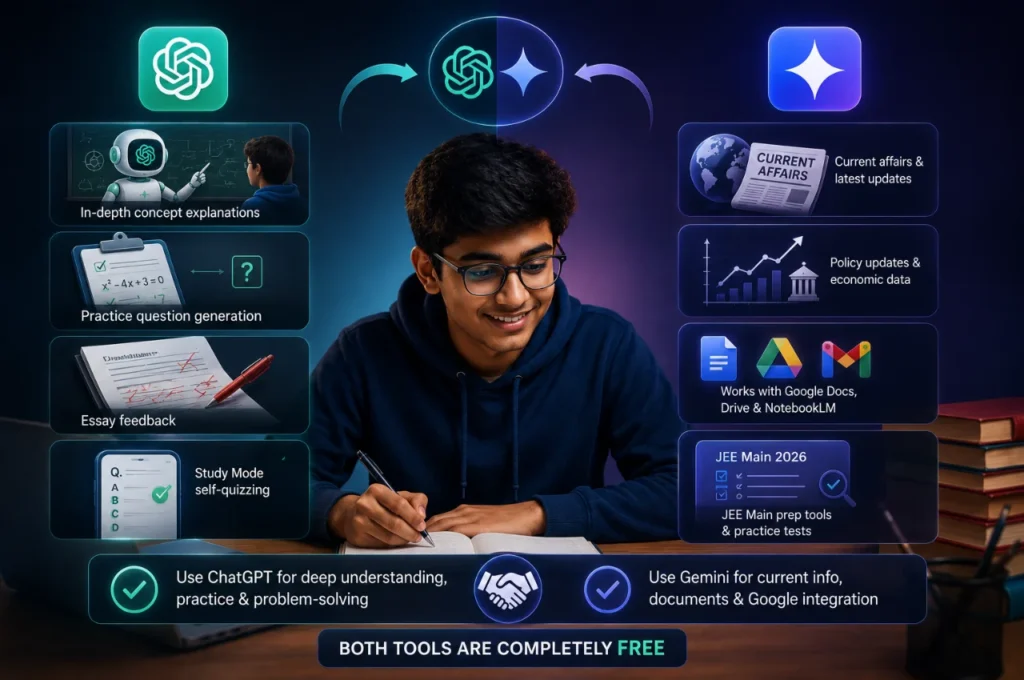
Both tools are free and both are useful. They have different strengths that make each more appropriate for certain study tasks.
ChatGPT is stronger for in-depth concept explanations, practice question generation, essay feedback, and Study Mode for self-quizzing. Its reasoning ability makes it particularly useful for complex problem-solving in mathematics and science.
Gemini is stronger for anything requiring current information — current affairs for UPSC, recent scientific developments, policy updates, and economic data. It also integrates directly with Google Docs, Google Drive, and NotebookLM, which makes it more convenient if you store your study material in Google’s ecosystem. Google has specifically launched JEE Main preparation tools within Gemini for Indian students in 2026, including practice tests with explanations.
The most effective approach is to use both. Use Gemini for current events, document-based work, and Google ecosystem integration. Use ChatGPT for detailed conceptual explanations, practice question generation, and Study Mode preparation.
Both are completely free for the features described in this guide.
What AI Cannot Do for Students
Honesty matters here, because the hype around AI can create unrealistic expectations.
AI cannot replace consistent effort. A student who uses AI cleverly but studies for two hours a day will not outperform a student who studies seriously for six hours without AI. The tools accelerate learning — they do not substitute for it.
AI makes mistakes. ChatGPT and Gemini can produce incorrect information, especially for highly specific or niche academic content. Always cross-check important facts against your textbook or a verified source. Never use an AI-generated fact in an exam answer unless you have verified it.
AI does not know your specific exam pattern. It can generate practice questions that are similar to board or competitive exam questions, but it does not have access to your school’s specific internal marking scheme or your professor’s preferences. Use it as supplementary practice, not as a substitute for past papers.
Many institutions have AI policies. Some schools and universities have specific rules about how AI can be used in assignments and assessments. Read your institution’s policy carefully. Using AI appropriately — for understanding, practice, and feedback — is almost universally permitted. Submitting AI-generated content as your own work typically is not.
Frequently Asked Questions
Is using ChatGPT or Gemini for studying considered cheating?
Using AI to understand concepts, generate practice questions, get feedback on your writing, or prepare for exams is not cheating — it is a study tool, the same as using a textbook or attending a tutoring session. Using AI to generate assignment content you submit as your own original work without disclosure may violate your institution’s academic integrity policies. Check your school or university’s specific AI use policy to understand what is and is not permitted.
Is the free version of ChatGPT and Gemini good enough for students?
Yes — both free tiers provide more than enough capability for the study methods described in this guide. ChatGPT’s free tier includes GPT-5.3 and Study Mode. Gemini’s free tier includes real-time web search and Google ecosystem integration. Students do not need to pay for anything to use these tools effectively for exam preparation and assignments.
Which AI tool is best for JEE and NEET preparation?
For JEE, ChatGPT is stronger for detailed mathematical problem-solving and physics concept explanations. Gemini has JEE-specific practice test features launched in early 2026. For NEET, both tools work well for biology and chemistry concept explanations. NotebookLM is particularly useful for converting NCERT chapters into quizzes and summaries. Most serious competitive exam students use a combination of two or three tools for different purposes.
Can AI help with Hindi medium students?
Yes — both ChatGPT and Gemini respond in Hindi if you ask in Hindi or specify the language. Gemini’s multilingual capability covers several Indian languages. You can ask for explanations in Hindi, Hinglish, or any other Indian language and receive a coherent response.
Will using AI make me dependent and hurt my learning?
Only if you use it incorrectly — by having it generate answers you never think about. Using AI as described in this guide — for explanations you engage with, practice questions you attempt before seeing answers, and feedback you actively implement — develops your understanding rather than replacing it. The students who have used AI most effectively for studying report higher confidence and better retention, not reduced capability.
Final Thoughts
The students who will benefit most from AI in 2026 are the ones who treat it as a serious study tool rather than a shortcut. Used correctly, ChatGPT and Gemini are genuinely transformative — they provide personalized explanations at any hour, unlimited practice questions at any difficulty level, instant feedback on your writing, and exam simulation that would otherwise cost thousands of rupees.
Start with one or two of the methods described here rather than trying all ten at once. Use AI to understand the concept you have been stuck on for two weeks. Use it to generate ten practice questions on your weakest topic this weekend. Use it to get feedback on one assignment before submitting it.
Small, consistent uses of these tools, combined with genuine study effort, compound into real academic improvement over weeks and months. That is the honest, unglamorous truth about how AI actually helps students — and it is more powerful than any shortcut could ever be.