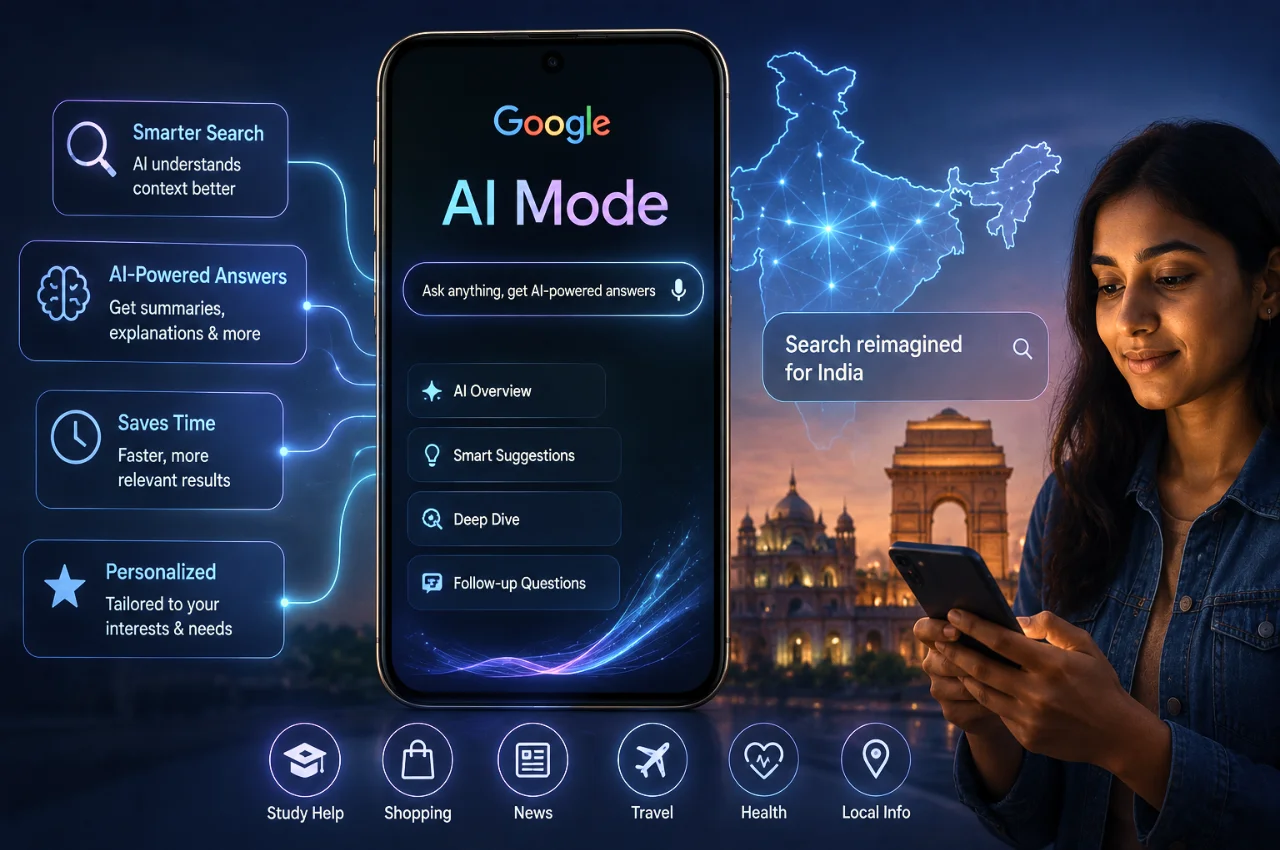
Open Google on your phone right now. If you are in India, you will notice something that was not there a year ago — a tab that says “AI Mode” sitting alongside the familiar Images, Videos, and News tabs. Tap on it, and the search experience you have known for two decades looks and feels completely different.
This is not a small update. Google AI Mode is the most significant change to how Google Search works since the company first introduced it in 1998. It replaces the familiar blue links with something far more conversational, more intelligent, and — depending on how you use it — genuinely more useful. For Indian users specifically, this shift carries extra weight, because India was not just an afterthought in this rollout. It was a priority.
This article explains what Google AI Mode actually is, how it works, what makes it different for Indian users, and honestly — where it still falls short.
A Brief History of How We Got Here
To understand why AI Mode matters, it helps to understand what regular Google Search has been for the past two decades.
Traditional Google Search operates on a simple principle: you type a few keywords, Google finds web pages that contain those keywords, ranks them by relevance and authority, and shows you a list of blue links. This model was revolutionary in 1998. In 2026, it is starting to show its age.
The problem is that most real-world questions are not keyword-shaped. When a college student in Kanpur wants to understand the difference between NEET and JEE preparation strategies, or when a homemaker in Chennai needs to know whether the rash on her child’s arm looks like it needs a doctor, or when a small business owner in Surat is trying to figure out if a trademark is already registered — none of these questions fit neatly into a keyword search box.
Google began addressing this with AI Overviews in 2024, which added AI-generated summaries at the top of some search results. The response in India was strong. Google reported that AI features in Search drove over 10 percent more usage for the types of queries where they appeared. People were searching more, not less. That success accelerated the push toward something deeper: AI Mode.
What Is Google AI Mode, Exactly?
Google AI Mode is a dedicated search interface powered by Gemini — Google’s most advanced AI model. It is not a chatbot separate from Google Search. It is built directly into the Google Search experience, available as a tab that any user in India can access today without any subscription or sign-up.
The core difference between AI Mode and regular search is in how questions are processed and answered. Traditional search takes your query, matches it to indexed pages, and returns links. AI Mode takes your question, breaks it down into multiple sub-questions using a technique Google calls “query fan-out,” searches across Google’s entire index simultaneously, synthesises all of that into a coherent answer, and presents it with citations that link to the original sources.
The result is something that feels more like asking a very well-informed friend a question than typing keywords into a box. You get a direct answer, context, relevant follow-up points — and you can keep the conversation going with additional questions.
Practically speaking, instead of asking “best laptop for engineering students under 50000” and then clicking through five different review sites, you can ask AI Mode “I am a first-year computer science student at a tier-2 college, I need a laptop under ₹50,000 primarily for coding and occasional video editing, which should I buy and why?” — and get a synthesised, directly useful answer.
How AI Mode Works Under the Hood
You do not need to understand the engineering to use AI Mode effectively. But knowing the basics helps you ask better questions and understand the answers better.
The query fan-out process is the heart of how AI Mode works. When you type or speak a complex question, the system does not treat it as a single query. It automatically breaks it down. A question like “Is it better to take a personal loan or a credit card for a ₹50,000 emergency in India?” gets decomposed into sub-queries about personal loan interest rates, credit card interest rates, processing fees, repayment timelines, RBI regulations, and short-term financial advice — all searched simultaneously and synthesised into one coherent answer.
Deep Search is a more intensive version of this process. You can activate it for especially complex research tasks. Deep Search runs hundreds of simultaneous queries, cross-references sources, and produces a detailed, cited response that might take several minutes to generate but is significantly more thorough than a standard AI Mode answer. It is useful for competitive exam preparation, market research, or understanding complex policy documents.
Search Live is a newer feature that arrived in India in late 2025, making India only the second country in the world after the United States to receive it. It uses your phone’s live camera feed alongside voice to answer questions about the physical world in real time. You point your camera at a broken appliance, describe the problem, and get step-by-step repair guidance. You hold your phone up to a medicine bottle and ask about interactions or dosage. You look at a document in a language you do not fully understand and ask for a translation and summary. The technology behind Search Live is built on Google’s Project Astra research, which aims to create AI that can perceive and reason about the world through a camera in real time.
Multimodal input runs through all of these features. You can interact with AI Mode through typed text, voice, uploaded photos, or live camera. This is not cosmetic — it fundamentally changes the kinds of questions you can ask.
Why India Was a First-Mover Market
One of the most interesting aspects of this story is the role India played in Google’s AI Mode rollout.
India was one of the very first countries outside the United States to receive AI Mode without requiring a Search Labs sign-up. In July 2025, Google rolled out AI Mode to all Indian users directly in the main Google Search interface. When Search Live launched, India was again the second market after the US to receive it. When Google expanded AI Mode to new languages, Hindi was among the first batch alongside Indonesian, Japanese, Korean, and Spanish.
This was not accidental. India leads the world in voice search and visual search usage. Indians ask more voice queries and take more Google Lens searches than users in any other country. India is also among the top three countries globally for Gemini usage, and India leads the world in daily Gemini usage specifically for learning. A Google-Kantar study found that 95 percent of Gemini student users in India reported feeling more confident in their academic work after using the tool.
Google has also invested $15 billion in AI infrastructure in India and has partnered with organisations like PhysicsWallah and Careers360 to integrate JEE Main practice tests and exam-preparation tools directly into Gemini and AI Mode. The message is clear: India is not just a large market to serve. It is an active partner in shaping how this technology develops.
How AI Mode Is Changing Search Behaviour in India
The changes in how Indians actually use search because of AI Mode are already visible, even if the full scale is still emerging.
The length of search queries has grown dramatically. Globally, Google has reported that people using AI Mode ask questions nearly three times longer than traditional search queries. In India, this pattern is even more pronounced because of how many users were already comfortable with voice search — it is much easier to speak a detailed question than to type one.
Education has emerged as the dominant use case in India. Students preparing for JEE, NEET, UPSC, and state-level competitive exams are using AI Mode as a study companion — asking complex conceptual questions, requesting worked examples, and following up with clarifying questions. Google specifically designed features for this: JEE Main practice tests within Gemini and AI Mode, AI-generated study guides, and quiz tools built directly into Search. The initiative aims to reach 75 million students and 1.8 million educators in India by December 2027.
Shopping research has also shifted. Rather than visiting Flipkart, then Amazon, then a review blog, then a YouTube channel — a process that could take 30 minutes — users are asking AI Mode directly to compare products, explain trade-offs, and make recommendations based on their specific budget and requirements. The multi-step research process collapses into a conversation.
Regional language accessibility has opened AI Mode to users who were previously excluded from deeper search interactions. As of late 2025, AI Mode supports Hindi, Bengali, Tamil, Telugu, Kannada, Malayalam, Gujarati, Marathi, and Punjabi alongside English. For a first-generation internet user in a small town in Uttar Pradesh or Bihar, being able to ask complex questions in their native language and receive coherent, cited answers is a qualitative leap in what the internet means to them.
Practical Ways to Use Google AI Mode
Knowing the features is useful. Knowing how to get the most out of them is more useful.
For students, the most powerful approach is multi-turn research. Do not just ask one question and stop. Ask a question, read the answer, then ask a follow-up. Ask for examples. Ask for comparisons. Ask AI Mode to explain a concept from a different angle if the first explanation did not land. The system is designed for conversation, not one-shot queries.
For professional research, use Deep Search for anything that genuinely requires synthesis across many sources. Legal questions, financial comparisons, policy analyses, market research — these are the tasks where Deep Search produces answers that would take hours of traditional browsing to assemble.
For practical daily tasks, voice is often the fastest input method. If you are cooking and need to know a substitution for an ingredient, or you are navigating a city and need information about a local landmark, speaking your question naturally is faster and more accurate than typing.
For visual tasks, Search Live is the feature most people have not yet fully explored. The ability to point your camera at anything and ask questions about it in real time sounds like science fiction but is a practical tool available right now. It is particularly useful for identifying plants and insects, understanding product labels and ingredients, getting help with physical repairs, and reading documents in unfamiliar scripts or languages.
What Google AI Mode Does Not Do Well
Any honest assessment has to include the limitations. AI Mode is impressive, but it is not without problems.
The accuracy of responses is not guaranteed. AI Mode draws from Google’s search index and uses Gemini to synthesise answers, but it can still produce confident-sounding responses that contain errors, outdated information, or misinterpretations of complex topics. Always check the cited sources, particularly for anything involving medicine, law, finance, or government policy. The citations are there for a reason — use them.
Response latency can be noticeable, particularly in areas with weaker network connectivity. Deep Search in particular can take several minutes to generate a full response. In low-network conditions, even standard AI Mode responses may load slowly. Google has acknowledged this and is working to optimise performance for bandwidth-constrained environments, but in 2026 it remains a real limitation for users outside major cities.
Privacy considerations deserve attention. AI Mode, particularly the Personal Intelligence features that connect Gmail and Google Photos to AI responses, processes personal data to generate personalised answers. Users should review their Google account data settings and understand what information is being used before enabling these features. The convenience is real, but so is the data usage.
The impact on content creators and publishers is a genuine concern. Because AI Mode synthesises answers directly in the search interface, users often get the information they need without clicking through to the original website. This reduces web traffic for the blogs, news sites, and independent creators who produce the content AI Mode draws from. This tension is unresolved in 2026 and is a subject of active debate in India’s digital journalism community.
Ads are not currently shown within AI Mode responses in India, though Google has indicated that monetisation will be introduced gradually. How ads are integrated into conversational AI search — and how obviously they are labelled — will be worth watching.
AI Mode vs. Traditional Search: Which Should You Use?
The honest answer is: both, depending on the task.
Traditional search with blue links is still better for finding a specific website you already know, getting the very latest news on a fast-moving story, finding local business listings, or any task where you want direct control over which sources you visit.
AI Mode is better for research and learning that requires synthesis across multiple sources, for complex multi-part questions that no single web page answers well, for shopping comparisons and decision-making, for study and exam preparation, and for visual identification and real-world tasks using your camera.
Think of it less as “AI Mode versus search” and more as an expanded toolkit. The old way of searching has not disappeared — it is still there. AI Mode adds a new and genuinely different capability on top of it.
Frequently Asked Questions
How do I turn on AI Mode in Google Search in India?
Open the Google app or visit google.com on your phone or computer. You should see an “AI Mode” tab near the top of the search bar alongside Images and Videos. Tap or click it to switch to AI Mode. If you do not see it yet, your account may not have received the update — try updating the Google app to the latest version. No special subscription is required for Indian users.
Is Google AI Mode free to use in India?
Yes. AI Mode is available at no charge to all Google users in India. The core features including text, voice, image search, and Search Live do not require a Google One subscription or any paid plan. Some advanced features tied to Personal Intelligence — such as connecting your Gmail and Google Photos to AI responses — may require a Google One AI Premium subscription.
Does AI Mode work in Hindi and other Indian languages?
Yes. AI Mode supports Hindi, and as of late 2025 it has expanded to Bengali, Tamil, Telugu, Kannada, Malayalam, Gujarati, Marathi, and Punjabi. The system is designed to understand the nuances of these languages — not just translate from English — though the quality of responses in regional languages is still improving compared to English.
Is the information in AI Mode responses accurate and reliable?
AI Mode is generally reliable for well-established factual topics. Every response includes citations linking to the original sources, which you should check for anything important. Do not rely on AI Mode responses without verification for medical decisions, legal advice, financial planning, or government procedures. The system can generate confident-sounding answers that are occasionally wrong or outdated.
How is Google AI Mode different from ChatGPT or other AI chatbots?
The key difference is integration with live search. ChatGPT, Gemini standalone, and most other AI assistants have a knowledge cutoff — they were trained on data up to a certain date and do not have access to current information unless separately enabled. Google AI Mode is connected to Google’s live search index, which means it retrieves current information from the web as part of generating every response. It also cites its sources inline, which standalone chatbots often do not.
Can AI Mode help Indian students preparing for competitive exams?
Yes, and this is one of its strongest use cases in India. Google has specifically partnered with PhysicsWallah and Careers360 to add JEE Main practice tests and exam preparation tools to Gemini and AI Mode. Beyond these structured tools, students can use AI Mode to ask conceptual questions, get step-by-step problem walkthroughs, request explanations in different formats, and quiz themselves on any topic. The multi-turn conversation feature makes it particularly effective for the kind of deep-dive studying that competitive exam preparation requires.
Final Thoughts
Google AI Mode is not a gimmick and it is not just a new coat of paint over old technology. It is a genuine rethinking of how search works — and for India, it arrives at a moment when the country’s relationship with the internet is deepening and broadening faster than almost anywhere else in the world.
The transition from searching for links to having a conversation with search is not complete. Traditional Google Search is not going away. But the direction is clear, and the pace is fast. AI Mode today handles tasks that would have required multiple browser tabs, a dedicated research session, and significant time just a couple of years ago.
For students using it to prepare for exams, for professionals conducting research, for first-time internet users accessing information in their own language, for shoppers comparing products, and for curious people who simply want better answers to complex questions — Google AI Mode is changing what is possible.
The best way to understand it is to use it. Open the AI Mode tab, ask a question you have always struggled to get a good answer for through regular search, and see what happens. The shift in what search can do is more tangible that way than any explanation can convey.