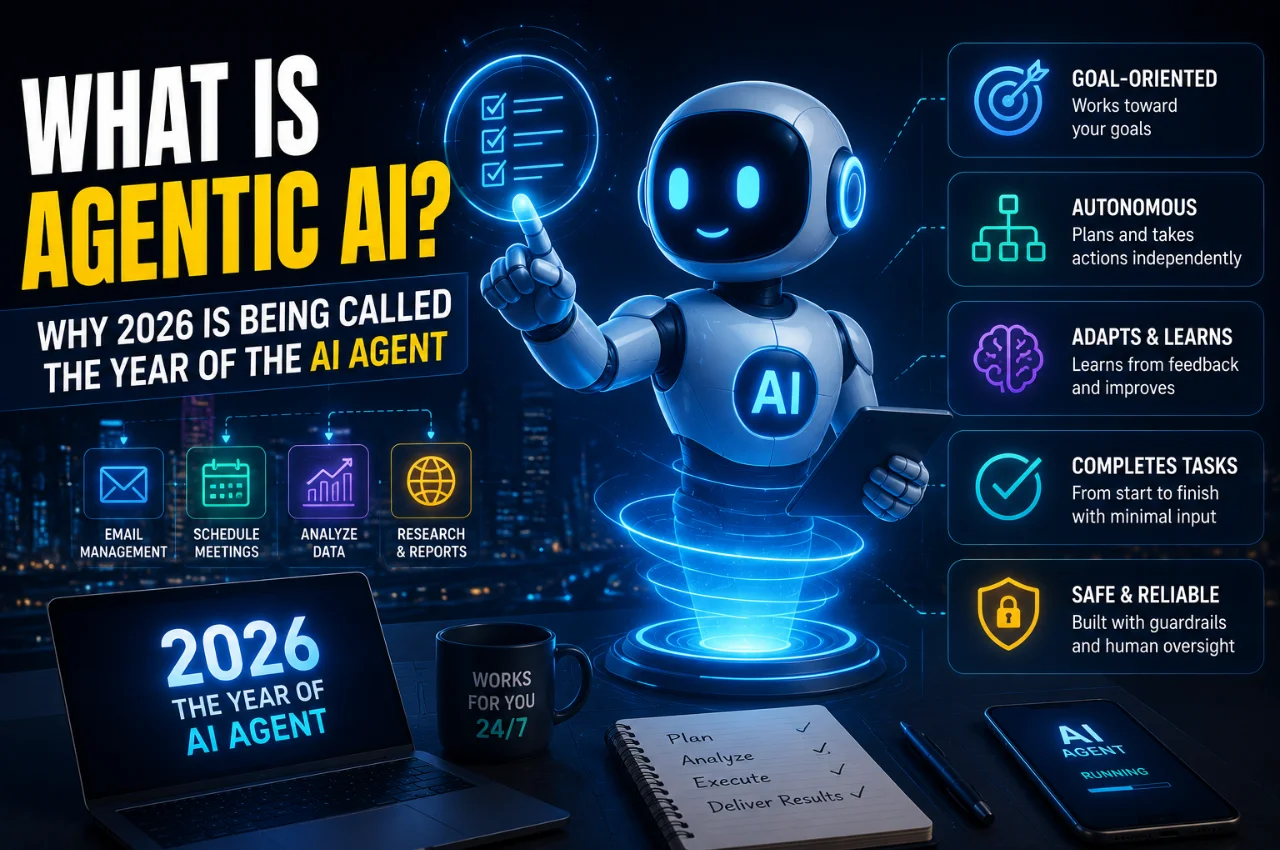
Something shifted in how AI works in 2026 — and most people have not noticed yet.
For the past few years, using AI meant having a conversation. You typed a question. The AI gave an answer. You took that answer and did something with it. Useful, certainly. But ultimately, you were still the one doing things. The AI was a very capable assistant that could not actually touch anything.
That model is changing rapidly. Microsoft, Google, Salesforce, and IBM have all publicly described 2026 as the year of the AI agent — and they mean something specific by it. Gartner reports that 40 percent of enterprise applications now include AI agent capabilities, up from under 5 percent in 2024. Meta spent two to three billion dollars acquiring a startup called Manus that builds general-purpose autonomous AI agents. The dedicated AI agent market hit 11.79 billion dollars this year.
The question worth asking is: what exactly is changing, what is an agentic AI, and does any of this actually affect ordinary people?
This guide answers all of that — clearly, in plain language, without assuming you have a technical background.
What is Agentic AI? The Simple Explanation
Agentic AI is an AI system that can take actions in the real world to complete goals — not just generate text or answer questions, but actually do things.
The word agentic comes from agency — the capacity to act independently to achieve an objective. An agentic AI does not wait for you to guide it step by step. You give it a goal, and it figures out how to reach that goal by planning the steps, using tools, checking whether its actions worked, and adjusting if they did not.
Here is the clearest way to understand the difference. A regular AI chatbot works like this: you ask, it answers, interaction over. An agentic AI works like this: you state a goal, it plans the steps to reach that goal, it uses tools and external systems to execute those steps, it observes whether each action worked, and it keeps going until the goal is achieved or it needs your input.
One real example that illustrates this perfectly: a colleague of a product manager at a tech company recently noted that their AI agent autonomously flagged a policy violation in an expense report, generated an audit trail, sent a notification to the relevant manager, and initiated corrective procurement workflows — all without a single human click or review. No one told it to do each of those things. It received the goal of monitoring expense compliance, determined what needed doing, and did it.
That is agentic AI in action.
How Agentic AI is Different From Regular AI
The distinction matters because it describes a genuine change in what AI can do — not a marketing rebranding of the same thing.
Regular generative AI — the kind you use when you talk to ChatGPT or Gemini in a standard conversation — is what researchers call read-only. It reads information, understands it, and generates output based on it. But it cannot write anything to external systems, take actions in software, send emails, modify files, make purchases, or interact with anything outside the conversation window. It is passive by design.
Agentic AI is read-write. It can observe its environment, decide what to do, take an action in a real system, observe the result of that action, and use what it learned to decide the next step. It operates in a continuous loop — observe, reason, act, observe results, adjust — until it completes the task or reaches a decision point where it needs human input.
The technical description of this loop in AI research is the ReAct loop — Reasoning and Acting — and it is the core of how every serious AI agent in 2026 works.
What makes agentic AI possible in 2026 specifically is the combination of three things that are now mature enough to work together reliably. Powerful language models that can reason about complex tasks and generate plans. Tool connectivity that allows AI models to call external software — search the web, read and write files, send emails, query databases, execute code, interact with APIs. And memory systems that allow agents to maintain context across many steps of a complex task rather than forgetting everything after each interaction.
The Four Components Every Agentic AI System Has
Understanding the building blocks makes the whole concept much clearer.
Planning is the first component. When you give an agentic AI a goal, the first thing it does is break that goal into a series of concrete steps. This is not random — it uses the reasoning capabilities of the underlying language model to think through dependencies, sequence, and what information or tools each step requires. The quality of this planning is one of the main things that separates capable agentic systems from ones that only work in demo videos.
Tool use is the second component. An AI agent is only as useful as the tools it can access. These tools are the connection points to the real world — web search for finding current information, code execution for running scripts and programs, file access for reading and writing documents, email and calendar integration for communication and scheduling, API connections for interacting with external services, and browser control for navigating websites. Without tools, an AI has no way to act. The range and reliability of available tools determines what kinds of tasks an agent can complete.
Memory is the third component. Short-term memory — the context window — holds everything the agent has observed and done during the current task, allowing it to build on previous steps rather than treating each action in isolation. Long-term memory stores knowledge about the user, past tasks, preferences, and accumulated experience that makes the agent more effective over time. The combination of these two memory types is what allows agents to handle tasks that unfold over hours or days rather than only simple single-step queries.
Judgment is the fourth component — and the most nuanced one. An agentic AI needs to know when to keep going independently, when to check back with a human before taking an action, and when a situation is outside its competence and needs to escalate. In 2026, only about 4 percent of organizations allow agents to act without any human approval. Most use what researchers call graduated trust models — automating low-risk actions while requiring human sign-off for high-stakes decisions. Getting this judgment calibration right is one of the central engineering challenges of building reliable agentic systems.
Why 2026 Specifically? What Changed
Agentic AI has been discussed theoretically for years. The reason 2026 is being called the year of the agent — rather than 2024 or 2023 — is that several things came together at the right time.
The language models got capable enough. Early attempts at agentic systems — tools like AutoGPT and BabyAGI in 2023 — attracted enormous attention but frequently failed in practice. The underlying models did not reason reliably enough over long chains of decisions. Errors compounded quickly, and agents regularly went off in wrong directions with no ability to recover. The models available in 2026 — GPT-5, Claude 4, Gemini 2.0 and their successors — are dramatically more capable at the multi-step reasoning that agentic tasks require.
The infrastructure arrived. The Model Context Protocol — MCP — standardized how AI models connect to external tools, making it possible to build agent systems that work across different platforms without custom integration work for each combination. Agent-to-Agent protocols allow multiple specialized agents to coordinate with each other. Low-code platforms have made it feasible for non-developers to build and deploy agentic workflows. The plumbing that makes agents practical at scale became available through 2024 and 2025.
The enterprise adoption reached a tipping point. Gartner naming agentic AI the top technology trend for 2026, combined with major deployments at scale by companies like Salesforce, Microsoft, and Google, created a self-reinforcing momentum. Companies using agentic workflows report 1.7 times average return on investment — a compelling enough result that the business case for adoption became clear.
What Agentic AI is Actually Doing in 2026 — Real Examples
Moving from abstract descriptions to concrete examples makes the technology real.
Software development is the most mature application. Coding agents receive a feature specification or a bug report, write the code, run the tests, identify failures, fix them, and submit the result for human review. Engineering agents are approaching 87 percent success rates on complex software tasks — up from roughly 62 percent two years ago. Tools like Devin AI and GitHub Copilot Workspace represent this category. A single developer working with a capable coding agent can produce output that previously required a small team.
Customer service at scale is another deployed application. Companies are running customer service agents that handle ticket triage, knowledge base resolution, account verification, refund processing, and escalation routing — completing hundreds of thousands of conversations without human involvement for the routine cases, and escalating to human agents exactly when the situation requires it. The example that opened this article — an agent autonomously detecting an expense policy violation, generating documentation, notifying stakeholders, and initiating corrective workflows — is this category applied to internal business operations.
Research and information synthesis is being used in healthcare, finance, and academic contexts. Agents that can search across thousands of documents, identify relevant information, synthesize it into structured reports, and flag inconsistencies or gaps are being deployed for drug discovery research, financial analysis, regulatory compliance monitoring, and due diligence workflows.
Personal productivity assistance is the consumer-facing application most people will encounter first. AI assistants that can manage your email by drafting responses, flagging priorities, and organizing threads. Calendar management agents that schedule meetings by checking availability across multiple people’s calendars. Research agents that gather information on a topic, synthesize it, and deliver a structured briefing. These capabilities are being integrated into Microsoft 365 Copilot, Google Workspace with Gemini, and Apple Intelligence on iPhone.
In India specifically, the IT services industry — which employs millions of people on structured, process-driven knowledge work — is the sector most actively deploying and being affected by agentic AI. Software testing, code review, documentation, customer support, and business process automation are all areas where Indian IT companies are both deploying agents for clients and evaluating the impact on their own operations.
Agentic AI vs Generative AI — The Most Important Distinction
This distinction is worth spending a moment on because it defines what is genuinely new about the current moment.
Generative AI — the technology that powers standard ChatGPT conversations, AI image generation, and AI writing tools — creates new content based on patterns learned from training data. It is passive and reactive. You initiate, it generates, you take over. The flow of control always returns to you.
Agentic AI initiates, executes, and persists. The flow of control stays with the agent until the task is complete or it encounters a decision point. The shift is from a tool you pick up and put down to a system that works independently toward a goal you set.
One research team has described the transition as moving from Generative AI — creative, passive, read-only — to Agentic AI — functional, active, read-write. We are moving from systems that describe the world to systems that change it.
This is a meaningful shift in kind, not just degree.
What Can Agentic AI Do and What Can It Not Do — The Honest Assessment
In the current hype environment around agentic AI, being accurate about real capabilities matters.
Agentic AI in 2026 works well for tasks that are well-defined enough that you could write a standard operating procedure for them in plain English. If a task has clear inputs, clear outputs, predictable steps, and bounded consequences when something goes wrong — a capable agent can likely handle it. Customer support resolution, code writing from specifications, document processing, data entry and validation, research compilation, and scheduling all fall into this category.
Agentic AI in 2026 still struggles with tasks requiring genuine judgment in ambiguous situations, tasks where the correct path depends on nuanced contextual understanding that the agent lacks, tasks that unfold over very long time periods requiring continuous independent decision-making, and tasks where the cost of errors is severe and potentially irreversible. The advice from practitioners is specific: deploy agents where the worst-case failure has a known, bounded cost. Not where they are empowered to take actions with unbounded downside.
Hallucination remains a real risk in agentic contexts — and the consequences are more serious than in a simple chatbot conversation. A chatbot that hallucinates gives you a wrong answer you can notice and discard. An agent that hallucinates in the middle of a multi-step task might take a series of wrong actions before the error becomes visible. This is why human checkpoints — points in a workflow where a human reviews and approves before the agent continues — remain important in most 2026 deployments.
Agentic AI and Jobs — The Honest Conversation
No discussion of agentic AI is complete without addressing what everyone is actually thinking about — the employment implications.
The honest assessment from researchers and practitioners in 2026 is that agentic AI is affecting jobs, but the pattern is more nuanced than either the optimistic or pessimistic framings suggest.
Roles involving highly structured, repetitive knowledge tasks — data entry and processing, standard customer service scripts, routine software testing, document review against fixed criteria — are being most directly affected. Not always eliminated, but changed significantly. Fewer people doing more volume, or the same number of people redirected to higher-judgment work that agents cannot handle.
Roles requiring genuine judgment, emotional intelligence, complex stakeholder management, creative thinking in ambiguous situations, and physical presence are proving much more resilient. Agentic AI is a powerful tool for amplifying what skilled people can accomplish — not yet a substitute for the full range of human capability in complex professional contexts.
For Indian IT professionals in particular, the practical implication is a shift in which skills are valuable. Understanding how to define tasks for agents, how to evaluate agent outputs, how to design agentic workflows, and how to identify where human judgment remains essential — these capabilities are becoming more valuable than the ability to execute the routine tasks that agents now handle.
Key Takeaway
Agentic AI is not a small iteration on chatbots. It is a genuinely different kind of AI — one that can plan, act, observe, and adapt to complete real tasks in the world, not just generate text in a conversation window.
The reason 2026 is being called the year of the AI agent is that the technology, the infrastructure, and the business adoption all crossed meaningful thresholds at roughly the same time. Gartner naming it the top trend. Forty percent of enterprise applications including agent capabilities. A market that hit nearly twelve billion dollars. Major tech companies deploying at production scale.
For most ordinary people, the immediate encounter with agentic AI will be through personal productivity tools — AI assistants in email, calendars, and document editors that handle more complete tasks rather than just drafting suggestions. The larger impact will unfold over the next several years as agentic systems become embedded in the businesses, services, and institutions that shape everyday life.
Understanding what agentic AI actually is — as distinct from the hype and the fear — puts you in a significantly stronger position to navigate that transition thoughtfully.
Frequently Asked Questions
What is the difference between agentic AI and a chatbot?
A chatbot responds to your input and stops. An agentic AI receives a goal and takes action to achieve it — planning steps, using tools, executing actions in real systems, checking results, and continuing until the task is complete. The fundamental difference is that a chatbot is passive and reactive, while an agentic AI is active and persistent. An agentic AI can send emails, modify files, run code, and interact with external services. A standard chatbot cannot.
Why is 2026 specifically called the year of the AI agent?
Several factors converged in 2026. Language models became capable enough for reliable multi-step reasoning. Infrastructure like the Model Context Protocol standardized tool connectivity. Enterprise deployments reached production scale. Gartner named agentic AI the top technology trend of the year. And major companies — Microsoft, Google, Salesforce — publicly committed to agentic AI as their primary product direction. The technology, infrastructure, and adoption all reached critical mass simultaneously.
Is agentic AI safe?
The safety of any specific agentic AI system depends on how it is built and deployed. Responsible agentic systems include permission controls that limit what actions the agent can take, human approval requirements for high-risk decisions, audit logs of all agent actions, and dry-run modes for testing before live deployment. The current consensus among practitioners is that agents should be deployed where the worst-case failure has a known, bounded cost — not in situations where an error could cause irreversible harm.
Can I use agentic AI today as an individual?
Yes. Microsoft 365 Copilot with agent capabilities is available to subscribers. Google’s Gemini with Extensions can perform multi-step tasks across Google Workspace. Claude with computer use can browse the web, read files, and take actions on your computer. Perplexity AI conducts multi-step research. Many of these have free or accessible tiers. The agentic capabilities in these consumer tools are less autonomous than enterprise deployments but represent genuine agent functionality available today.
Will agentic AI take over all jobs?
No — but it will change many of them. Structured, repetitive knowledge tasks are most affected. Complex judgment, emotional intelligence, creative thinking, and physical presence remain areas where human capability is essential. The more accurate framing is that agentic AI will handle increasing amounts of routine work, changing what human jobs involve rather than eliminating them wholesale. The transition will be uneven across industries and roles, and it is already underway.
What is multi-agent AI?
Multi-agent AI refers to systems where multiple specialized AI agents work together on complex tasks, each handling the part it is most suited for. One agent might research a topic, another might write a report based on that research, a third might check the report for accuracy, and a fourth might format and distribute it. This coordination between agents allows complex, multi-step workflows to be handled without any single agent needing to be capable of everything — similar to how a team of specialists produces better results than a single generalist.
Final Thoughts
Every few years, a technology shift happens that is real rather than merely hyped — that genuinely changes what is possible and begins to reshape how work, communication, and daily life function. Generative AI was one such shift. Agentic AI is the next one.
The shift from AI that responds to AI that acts is not subtle. It represents a fundamental change in the relationship between human intent and machine execution. For the first time, you can describe a goal and have a system pursue it — not just answer questions about it.
2026 is early in this transition. The technology is powerful but imperfect. The governance frameworks are still developing. The employment implications are unfolding rather than settled. But the direction is clear and the pace is fast.
The organizations and individuals who understand what agentic AI actually is — distinct from both the hype and the fear — are the ones best positioned to use it well, deploy it responsibly, and navigate the changes it brings.