You ask ChatGPT to write an email. It writes the email. You copy it, paste it into your inbox, fill in the recipient’s address, and hit send. ChatGPT did the writing. You did everything else.
Now imagine an AI that does not just write the email — it opens your email app, looks up the recipient’s address from your contacts, fills in the subject line, attaches the relevant document from your files, and sends it. All from a single instruction you gave it.
That second scenario is an AI agent. And in 2026, it is not a hypothetical — it is a technology being deployed at scale across businesses, apps, and personal productivity tools worldwide.
This guide explains exactly what AI agents are, how they work, how they are fundamentally different from the AI chatbots you already know, where they are being used right now, and what their rise means for ordinary people.
What is an AI Agent? — The Simple Definition
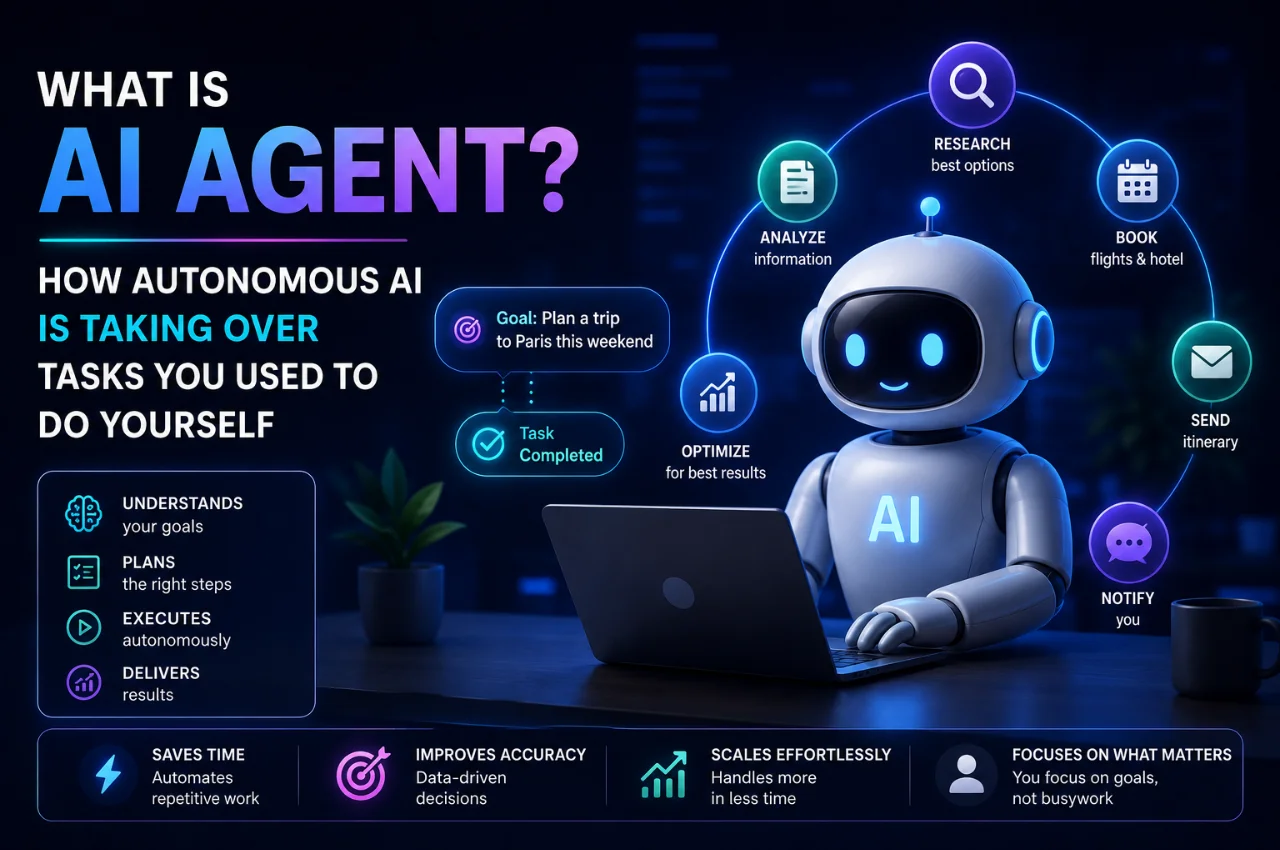
An AI agent is an autonomous AI system that can perceive its environment, make decisions, take real actions, and complete multi-step tasks toward a goal — without requiring human guidance at every step.
The key word is autonomous. A regular AI tool like ChatGPT or Gemini responds to your prompt and stops. You ask, it answers, and the interaction is over until you ask again. It generates output — text, code, an image — but it does not act on your behalf in the world.
An AI agent keeps going. It receives a goal, breaks it down into steps, executes those steps using whatever tools are available to it, checks whether its actions achieved the intended result, and adjusts its approach if something goes wrong — all without you guiding each individual step.
AI agents are autonomous artificial intelligence systems designed to achieve goals independently. Instead of handling a single command, an AI agent can break a goal into steps, use tools, and complete tasks end to end. This makes AI agents closer to digital workers than simple chatbots.
Think of the difference this way. A regular AI chatbot is like a very knowledgeable consultant who sits across a table and answers your questions. An AI agent is like an employee who takes your instructions and goes off to complete the work — making decisions, using tools, handling complications, and reporting back when the job is done.
How is an AI Agent Different From a Chatbot?
This is the most important distinction to understand, because most people’s experience with AI so far has been with chatbots — and AI agents are fundamentally different in several ways.
A chatbot responds. An AI agent acts.
When you use ChatGPT, Claude, or Gemini in a standard conversation, the interaction follows a simple pattern: you send a message, the AI generates a response, and the cycle repeats. The AI does not do anything in the external world. It does not open apps, send emails, book appointments, search databases, write and run code, or interact with any system outside the conversation window.
Regular AI responds to a prompt and stops. Agentic AI keeps going — it takes actions, uses tools, checks its own work, and completes multi-step tasks toward a goal without needing you to guide every move.
An AI agent breaks this pattern. It is connected to tools and systems — your email, your calendar, the web, databases, code execution environments, APIs, and other software. When given a goal, it uses these tools to take real actions in the world: sending actual emails, making actual bookings, running actual code, retrieving actual data from actual systems, and completing actual tasks from start to finish.
The gap between a chatbot and an AI agent is similar to the gap between a GPS that tells you where to turn and a self-driving car that actually drives you there.
How Does an AI Agent Actually Work? — The Four Core Components
Every AI agent, regardless of its specific application, is built around four fundamental components that work together to enable autonomous goal-directed behavior.
Perception — Understanding the Environment
The first component is perception — the agent’s ability to take in information about its current environment and the task it has been given. This includes reading your instruction or goal, accessing relevant data sources, reviewing previous actions and their results, and checking the current state of any connected systems.
A travel booking agent, for example, would perceive your instruction — “Book me a flight from Delhi to Mumbai on the 20th, cheapest available” — along with your travel preferences from your profile, your calendar to check for conflicts, and the current state of flight availability across booking platforms.
Reasoning and Planning — Deciding What to Do
Once the agent understands the situation, it uses an AI language model — typically a large language model like GPT-5 or Claude — to reason about the best approach. It breaks the overall goal into a sequence of specific steps, determines which tools to use for each step, identifies potential complications and how to handle them, and creates a plan of action.
This planning step is what makes AI agents fundamentally more powerful than simple automation. Traditional automation follows rigid, pre-programmed rules — if this happens, do that. AI agents reason through situations dynamically, adapting their plan when unexpected things happen, just as a human employee would.
Memory — Retaining Context
AI agents maintain memory at multiple levels. Short-term memory holds the context of the current task — everything that has happened in this particular session. Long-term memory stores information about the user, their preferences, past tasks, and accumulated knowledge that helps the agent perform better over time.
This memory is what allows an AI agent to build on previous work rather than starting from scratch each time. A customer service agent that has handled hundreds of similar queries builds up knowledge of common solutions. A personal assistant agent that has been working with you for months learns your communication style, your preferences, and how you like things done.
Action — Using Tools to Complete Tasks
The fourth and most distinctive component of an AI agent is its ability to take real actions using tools connected to external systems. These tools can include web search to find current information, code execution to write and run programs, email and calendar access to send messages and make bookings, file system access to read and write documents, API connections to interact with external services and platforms, browser control to navigate websites and fill in forms, and database access to query and update records.
AI agents operate in a continuous loop of plan, act, observe, and adapt until the task is complete. After each action, the agent checks whether the result moved it closer to the goal, decides what to do next, and continues until the task is finished — or until it encounters something it needs human input to resolve.
A Step-by-Step Example — What an AI Agent Actually Does
Abstract descriptions are useful — but a concrete example makes everything clearer. Here is what happens when you give an AI agent a realistic task.
You give your personal AI agent the following instruction: “Plan a team meeting with Rahul, Priya, and Ankit for next week to discuss the Q3 report. Find a time that works for everyone, create a meeting agenda, book a video call, and send them all the invite.”
Step one — the agent reads your instruction and accesses your calendar to understand your availability next week. It simultaneously accesses the calendars of Rahul, Priya, and Ankit to find times when all four people are free.
Step two — the agent identifies three possible time slots when everyone is available. It reasons that Tuesday at 2 PM is the best option based on your meeting preferences and creates a draft meeting agenda based on the Q3 report document it finds in your shared drive.
Step three — the agent creates a meeting event in your calendar, sets up a Google Meet or Teams link, writes a professional meeting invitation email that includes the agenda, and sends it to all three participants.
Step four — the agent confirms that the emails were delivered successfully, checks that the calendar event was created correctly for all participants, and reports back to you: “Meeting scheduled for Tuesday, 2 PM. Invite and agenda sent to Rahul, Priya, and Ankit.”
The entire process — which would have taken you ten to fifteen minutes of calendar checking, email drafting, and scheduling — was completed in seconds. You gave one instruction. The agent handled every step.
This is not science fiction. This is what AI agents can do right now in 2026.
The Different Types of AI Agents
Not all AI agents work the same way. They range from simple automated systems to highly sophisticated autonomous planners. Understanding the main types helps you recognize AI agents when you encounter them.
Simple reflex agents are the most basic type. They operate on if-then rules — if a certain condition is detected, take a predefined action. Email spam filters are a classic example. When an incoming message meets certain criteria, it is automatically moved to spam. These are technically agents but do not involve the complex reasoning and tool use of modern AI agents.
Goal-based agents plan multiple steps to achieve a specific objective. They receive a goal, reason about how to reach it, and execute a sequence of actions. Autonomous coding assistants like Devin AI are examples — you give them a programming specification and they plan and execute the development work step by step.
Learning agents improve over time through experience. They add new knowledge from each task to their existing knowledge base, becoming more effective the more they are used. Recommendation systems on streaming platforms and e-commerce sites are learning agents — they continuously improve their suggestions based on your behavior.
Multi-agent systems consist of multiple specialized AI agents working together on complex tasks. One agent might analyze data, another might generate reports, and another might trigger actions in CRM or ERP systems. Each agent handles its area of specialization while coordinating with the others — similar to a team of specialists working on different parts of a project simultaneously.
Where Are AI Agents Being Used Right Now?
AI agents have moved from research labs into real-world deployment at remarkable speed. Here are the most significant areas where they are being actively used in 2026.
In software development, AI coding agents have become one of the most transformative tools for developers. Agents like Devin AI and GitHub Copilot with agentic capabilities can receive a development specification, write code, run tests, identify bugs, fix them, and produce working software with minimal human intervention. Engineering agents approach 87 percent success rates solving complex GitHub issues, up from roughly 62 percent two years ago. This does not eliminate software developers — it dramatically amplifies what a developer can accomplish in a day.
In customer service, large companies are deploying AI agents that handle complete customer service workflows rather than simply answering questions. A billing agent can verify a customer’s identity, access their account history, identify the issue, apply a resolution, send a confirmation email, and update the account records — all without a human agent. The agent hands off to a human when escalation is needed, keeping humans in control of edge cases.
In sales and marketing, AI agents handle research-intensive pre-sales tasks. An agent can pull data on a target company, synthesize it into a briefing, draft personalized outreach emails, monitor for trigger events like funding announcements, and surface the right prospect to a salesperson at the right moment. The salesperson focuses on relationship and closing — the agent handles the research and preparation.
In healthcare, AI agents assist with appointment scheduling, medical record management, routine patient communications, insurance verification, and flagging abnormal test results for physician review. They surface relevant patient history during consultations and handle administrative documentation that previously consumed significant physician time.
In finance, agents monitor transactions for fraud patterns in real time, generate financial analysis reports, monitor regulatory compliance across large volumes of transactions, and provide personalized financial recommendations based on individual client data.
In personal productivity, AI agents are becoming digital personal assistants capable of managing email, scheduling, research, document preparation, and information retrieval. Rather than being a tool you go to when you need something, these agents proactively manage tasks on your behalf throughout the day.
The Scale of AI Agent Adoption in 2026
The speed at which AI agents have moved from concept to mainstream deployment is remarkable.
Gartner reports 40 percent of enterprise applications now include AI agents, up from under 5 percent in 2024. The dedicated AI agent market reached 11.79 billion dollars in 2026. Microsoft, Salesforce, and Google have all called 2026 the year of the agent, because companies using agentic workflows see 1.7 times average return on investment.
Early adoption data from 2026 indicates that users reclaim an average of 14 minutes per day through AI agents, totaling approximately 56 hours per user annually.
The multi-agent AI market is projected to grow at a 48.5 percent compound annual rate through 2030 — one of the fastest growth trajectories of any technology category in history.
In India specifically, AI agent adoption is growing rapidly in IT services, banking and financial services, e-commerce, and business process outsourcing — sectors where India has large workforces performing structured, repetitive knowledge work at scale.
The Difference Between AI Agents and Traditional Automation
A reasonable question at this point is: how are AI agents different from the automation tools that have existed for decades — bots, macros, workflow automation software, and robotic process automation?
Traditional automation is rigid. It follows exact, pre-programmed rules and breaks immediately when conditions change in unexpected ways. If a website redesigns its interface and the button a bot was clicking moves to a different location on the page, the bot fails. If the data format changes slightly, the script crashes. Traditional automation can only handle exactly the situations it was explicitly programmed for.
AI agents are adaptive. Autonomous AI agents understand context and intent rather than just following predefined rules. Traditional automation breaks when conditions change — like website redesigns, unexpected data formats, or edge cases not explicitly programmed. AI agents adapt by reasoning through new situations using their underlying language models and learned patterns.
This adaptability is the fundamental difference. AI agents can handle the messy variability of real-world tasks. They can read an error message they have never seen before and figure out how to resolve it. They can encounter an unexpected situation and reason about the best way to handle it. They can ask a clarifying question when instructions are ambiguous rather than failing silently.
The Risks and Challenges of AI Agents
The capabilities of AI agents are genuinely impressive — but responsible coverage requires being equally clear about their risks and limitations.
Control and oversight are the primary concern. As AI agents gain permissions to access different datasets and enterprise systems to automate tasks, the importance of building robust permission-based systems cannot be underestimated. Organizations need to clearly delineate who bears responsibility when agentic AI makes an error or causes harm, especially if the AI agent is autonomously performing workflows with minimal or no human supervision.
Errors can cascade in ways that simple chatbot mistakes cannot. A chatbot that hallucinates a fact is a minor problem — you see the wrong answer and can verify it. An AI agent that makes a wrong decision early in a multi-step process can trigger a chain of subsequent actions based on that error, resulting in consequences in the real world — sent emails, deleted files, financial transactions — before the mistake is caught.
Security risks increase significantly when AI agents have permissions to access real systems and data. An agent with access to email, files, and external services presents a much larger attack surface than a read-only chatbot. Malicious content that tricks an agent into taking harmful actions — a technique called prompt injection — is a genuine security concern that researchers and developers are actively working to address.
Privacy implications are significant. AI agents that handle your email, calendar, files, and communications have access to highly sensitive personal and professional information. Understanding what data these agents access, how it is stored, and who can see it is important for anyone considering deploying AI agents in personal or professional contexts.
Job displacement is a legitimate societal concern. While AI agents are currently augmenting human workers more than replacing them, the trajectory is toward taking over increasing amounts of knowledge work. The most significant short-term impact is on highly structured, repetitive knowledge tasks — data processing, document review, standard customer service, research, and routine analysis. The long-term employment implications are being actively studied and debated by economists and policymakers worldwide.
What AI Agents Can and Cannot Do in 2026
Being accurate about current capabilities is important for setting realistic expectations.
AI agents in 2026 can reliably handle well-defined, structured tasks with clear success criteria, multi-step workflows within connected digital systems, tasks that require gathering and synthesizing information from multiple sources, standard customer service workflows with defined escalation paths, software development tasks within specified parameters, and scheduling, research, and document preparation.
AI agents in 2026 still struggle with highly ambiguous goals that lack clear success criteria, tasks requiring genuine creative judgment or novel problem-solving, situations requiring nuanced human judgment and emotional intelligence, complex physical world interactions beyond digital systems, tasks where the consequences of errors are severe and irreversible, and anything requiring verified factual accuracy without human review — because AI agents can and do hallucinate.
Agents operate best within well-defined scopes, clear policies, and structured environments. What you can reliably build today are systems that execute workflows, coordinate tools, and make bounded decisions — not fully autonomous operators that handle every edge case.
Will AI Agents Replace Human Jobs?
This is the question most people are really asking when they read about AI agents, and it deserves a direct, honest answer.
AI agents will not eliminate all jobs, but they will change how people work. Routine tasks will increasingly be handled by AI agents.
The honest picture is nuanced. AI agents are already handling tasks that people used to do — scheduling, data entry, routine customer service, standard document review, basic research compilation. In organizations that have deployed AI agents effectively, the people who previously did those tasks are either doing higher-value work that requires judgment, creativity, and human relationship skills, or they are finding their roles reduced.
The skills most protected from AI agent displacement are those requiring genuine emotional intelligence and human connection, creative and strategic judgment in ambiguous situations, physical world dexterity and presence, deep expertise combined with contextual wisdom, and leadership and accountability for high-stakes decisions.
The skills most at risk are repetitive information processing, structured rule-following in predictable environments, standard document creation and management, routine customer communications, and data gathering and basic analysis.
The most practical advice for workers navigating this transition is to focus on developing skills that complement AI — supervising and directing AI agents, evaluating and verifying their outputs, handling the situations that agents escalate, and applying human judgment to the decisions that matter most.
Key Takeaway
AI agents represent the next evolution of artificial intelligence — moving from tools that respond to questions toward systems that autonomously complete work. The difference between a chatbot and an AI agent is the difference between advice and action.
In 2026, AI agents are real, deployed at scale, and delivering measurable results across software development, customer service, finance, healthcare, and personal productivity. They are not perfect, they have genuine risks, and they require careful oversight — but they are transforming how work gets done at a pace that very few technologies have matched in history.
Understanding what AI agents are, how they work, and what they can and cannot do puts you in a significantly stronger position — whether you are a professional navigating a changing workplace, a business leader evaluating how to use this technology, or simply a curious person trying to understand the AI-powered world taking shape around you.
Frequently Asked Questions
What is the difference between an AI agent and ChatGPT?
ChatGPT is an AI chatbot — you ask it questions and it generates responses. An AI agent is an autonomous system that uses ChatGPT-like intelligence as its reasoning core but combines it with the ability to use tools and take real actions in connected systems. ChatGPT tells you what to do. An AI agent goes and does it.
Can AI agents make mistakes?
Yes — AI agents can and do make mistakes, and the consequences can be more significant than chatbot errors because they take real actions. An agent that makes an incorrect decision can trigger real-world consequences — sent emails, deleted files, or completed transactions — before the error is caught. This is why robust human oversight, permission controls, and escalation mechanisms are essential in any AI agent deployment.
Are AI agents safe to use?
AI agents from reputable providers with proper security controls are generally safe for defined tasks. The key safety principles are granting agents only the minimum permissions they need for their specific task, maintaining logs of all agent actions, implementing human approval requirements for high-risk or irreversible actions, and regularly reviewing agent performance. Never grant an AI agent permissions to take irreversible actions without human oversight.
How is an AI agent different from automation?
Traditional automation follows rigid pre-programmed rules and breaks when conditions change unexpectedly. AI agents adapt to new situations by reasoning through them using an AI language model. Traditional automation can only handle exactly the scenarios it was programmed for. AI agents can handle variability, ambiguity, and unexpected situations — within limits.
What AI agents can I use today as an individual?
Several AI agent tools are available to individuals in 2026. Claude with computer use capabilities can browse the web, read files, and take actions on your computer. ChatGPT with operator and actions features can perform multi-step tasks through connected apps. Microsoft Copilot in Microsoft 365 can draft documents, analyze spreadsheets, and manage email workflows. Google Gemini with extensions integrates with Google Workspace. Perplexity AI conducts multi-step research and synthesis. Many of these have free tiers that provide genuine agentic capabilities.
Will AI agents replace my job?
Routine, structured, repetitive knowledge tasks are most at risk. Creative, strategic, relationship-based, and judgment-intensive work is most protected. For most knowledge workers, the near-term reality is that AI agents will handle increasing amounts of routine work, changing what your job involves rather than eliminating it. The professionals who will thrive are those who learn to work effectively alongside AI agents — directing, supervising, and complementing them rather than competing with them.
Final Thoughts
The shift from AI that responds to AI that acts is one of the most significant transitions in the history of computing. AI agents are not a distant future technology — they are here, they are working, and they are changing what is possible for individuals and organizations right now.
The right response to this technology is not fear and not blind enthusiasm — it is informed engagement. Understanding what AI agents are, what they can genuinely do, what they still cannot do reliably, and where the real risks lie puts you in the strongest possible position to benefit from this technology rather than be blindsided by it.
AI agents are becoming part of the infrastructure of digital work and daily life. Now you understand exactly what that means.