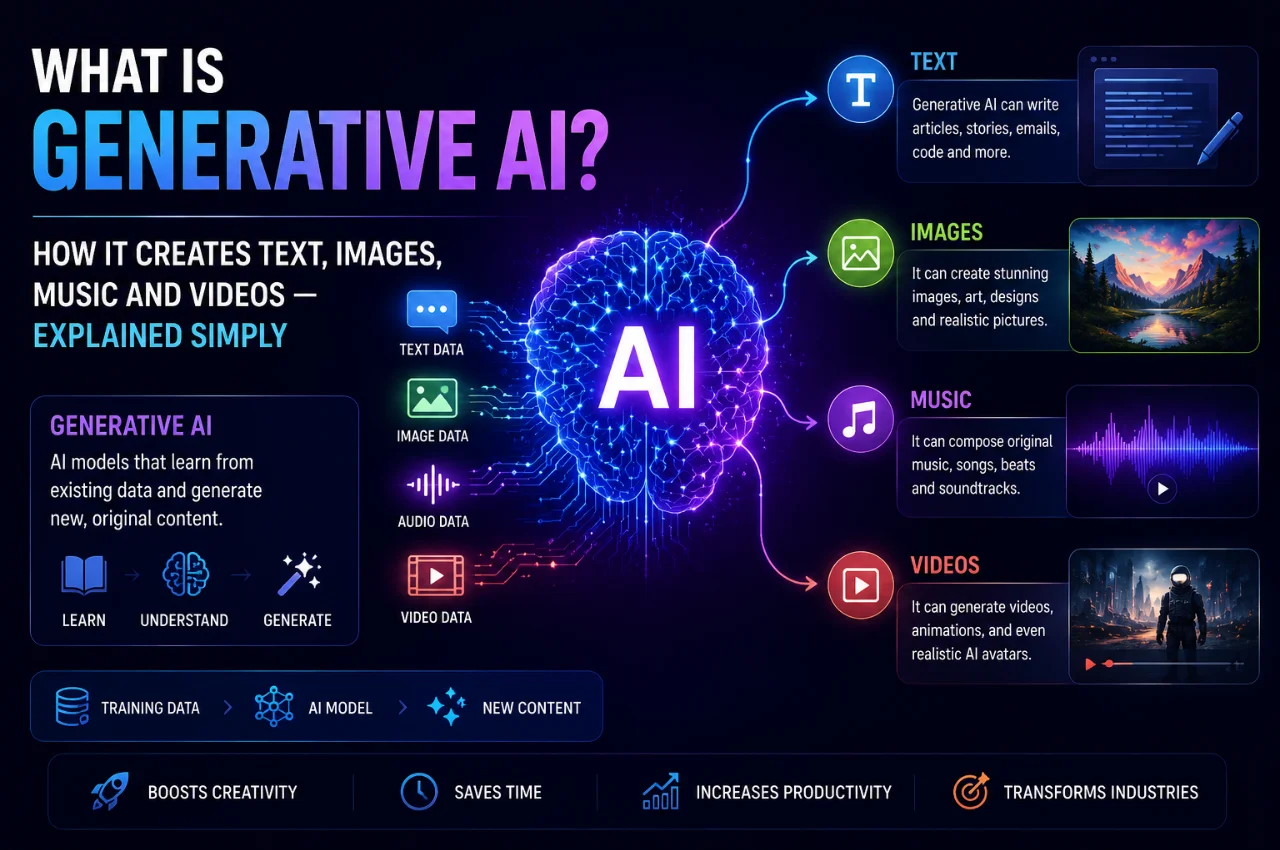
You have seen it everywhere in 2026. An AI tool writes a full blog post in seconds. Another generates a photorealistic image of a person who does not exist. A third composes an original song in the style of your favorite artist. And yet another creates a short video from nothing but a text description.
All of these things — the text, the image, the music, the video — are created by the same underlying technology: Generative AI.
But what exactly is Generative AI? How does it actually produce something that did not exist before? And why is it such a big deal right now?
This guide answers every one of those questions in plain, simple language — no technical background required. By the end, you will understand exactly what Generative AI is, how it works, what it can and cannot do, and how it is already changing your everyday life whether you realize it or not.
What is Generative AI? — The Simple Definition
Generative AI is a type of artificial intelligence that can create new content — text, images, music, video, code, and more — by learning patterns from large amounts of existing data and then using those patterns to generate something original.
The key word here is generate. Most traditional AI systems are built to recognize or classify things — they look at an image and tell you whether it contains a cat or a dog, or they analyze a customer review and tell you whether it is positive or negative. They take in data and produce a judgment.
Generative AI does something fundamentally different. It takes in a request — called a prompt — and produces brand new content in response. It does not copy something that already exists. It generates something new that follows the patterns, styles, and structures it learned during training.
Think of it this way. Imagine a student who reads ten thousand novels. After reading all of them, that student develops a deep intuition for how stories work — how sentences flow, how characters develop, how plots build tension and resolve. Now ask that student to write a new story, and they can produce something original that draws on everything they have absorbed — without copying any single book.
Generative AI works in exactly the same way — except instead of a student reading ten thousand novels, it is a computer system trained on billions of pieces of text, millions of images, thousands of hours of music, and vast libraries of video — learning the underlying patterns of each type of content, and then generating new examples on demand.
How is Generative AI Different From Regular AI?
This is a question that confuses many people, and the distinction is important.
Traditional AI — the kind that has existed for decades — is designed to perform specific, predefined tasks. A spam filter classifies emails as spam or not spam. A recommendation algorithm suggests products based on your purchase history. A facial recognition system identifies whether a face matches a database record. These systems take input, apply a fixed set of rules or learned classifications, and produce a structured output. They do not create anything new.
Generative AI goes beyond classification into creation. Rather than answering “which category does this belong to,” it answers “what should I make in response to this request?” It produces new text, new images, new audio, new video — content that did not exist before the prompt was entered.
Another way to think about the difference: traditional AI is like a skilled sorter who can organize a library. Generative AI is like an author who can write a new book for the library.
The History — How Did We Get Here?
Generative AI did not appear suddenly. Its current capabilities are the result of decades of research and several critical breakthroughs.
The earliest generative AI systems date back to the 1960s and 1970s, when researchers built simple text generators using statistical probability — predicting what word was likely to follow another based on patterns in text. These early systems could produce grammatically plausible sentences but had no real understanding of meaning or context.
The real transformation began with the rise of deep learning in the 2010s. Deep learning uses artificial neural networks — computational systems loosely inspired by the structure of the human brain — to learn complex patterns from enormous datasets. As computing power grew and datasets became larger, these neural networks became capable of learning far more sophisticated patterns than any previous AI approach.
In 2014, a significant breakthrough arrived with Generative Adversarial Networks, or GANs, introduced by researcher Ian Goodfellow. GANs used two competing neural networks — one that generates content and one that tries to determine whether the content is real or AI-generated — to produce increasingly realistic outputs. GANs were the technology behind many of the early AI-generated face images that spread across the internet.
In 2017, researchers at Google published a paper called Attention Is All You Need, introducing the Transformer architecture. This new approach to building neural networks dramatically improved AI’s ability to understand and generate language by allowing the model to consider the relationships between all words in a text simultaneously, rather than processing them one at a time. The Transformer became the foundation for all modern large language models.
The launch of ChatGPT in November 2022 was the moment Generative AI became a mainstream phenomenon. Within two months, ChatGPT reached 100 million users — the fastest any consumer application had ever reached that milestone. The technology had existed in research labs for years, but suddenly it was available to anyone with an internet connection, for free, and it could do things that seemed genuinely remarkable.
Since then, the field has moved extraordinarily fast. Image generators, music composers, video creators, and code assistants have all arrived in rapid succession, and the capabilities of each generation of tools has surpassed the previous one.
How Does Generative AI Actually Work? — Step by Step
Understanding how Generative AI works makes everything clearer — including why it is so capable and why it sometimes makes mistakes.
The process happens in two main phases: training and generation.
The Training Phase
During training, the AI model is exposed to an enormous dataset of existing content. For a text-based AI like ChatGPT or Claude, this means billions of words from websites, books, articles, research papers, code repositories, and conversations. For an image-generating AI like DALL-E or Midjourney, this means millions of images paired with text descriptions. For a music AI like Suno or Udio, this means thousands of hours of recorded music.
The model processes all of this data and learns the patterns within it. For text, it learns how words relate to each other, how sentences are structured, how arguments are built, how stories flow. For images, it learns how shapes, colors, textures, and compositions combine to create recognizable visual content. For music, it learns how rhythm, melody, harmony, and timbre combine across different genres and styles.
This learning happens through a process of prediction and correction. The model makes a prediction — for example, guessing what the next word in a sentence should be. It compares its prediction to the actual correct answer. It measures the error. It adjusts its internal settings — called parameters — slightly to do better next time. This process is repeated billions of times across the entire training dataset, gradually refining the model until it can make highly accurate predictions.
Modern Generative AI models have hundreds of billions of these internal parameters — the sheer scale of which is part of what gives them their remarkable capabilities.
The Generation Phase
Once training is complete, the model is ready to generate new content on demand. When you type a prompt — “Write me a poem about the moon” or “Create an image of a red panda wearing a chef’s hat” — the model uses everything it learned during training to produce a response.
For text generation, the model predicts the most likely continuation of your prompt, token by token — a token being a word or part of a word. Each predicted token becomes part of the input for predicting the next one, building the response word by word until it is complete.
For image generation, modern systems use a technique called diffusion. The model starts with random noise — essentially a completely scrambled image — and progressively refines it, removing the noise step by step until a coherent image matching the prompt emerges. Think of it like a sculptor chipping away at a block of marble, gradually revealing a form.
For music and audio generation, the model learns the patterns of how sounds relate to each other in time — rhythm, pitch, timbre, and structure — and generates new sequences of audio that follow those patterns in response to prompts.
The Four Types of Generative AI — Text, Images, Music, and Video
Generative AI is not a single tool — it is a category of technology with distinct applications for each type of content.
Text Generation — The Most Widely Used
Text generation is the most mature and widely deployed application of Generative AI. Tools like ChatGPT, Claude, Gemini, and Llama can write essays, answer questions, summarize documents, translate languages, write code, draft emails, create stories, and carry on extended conversations on virtually any topic.
The underlying technology for text generation is the Large Language Model, or LLM. These models are trained on massive amounts of text and develop a sophisticated statistical understanding of how language works — allowing them to generate coherent, relevant, and often remarkably fluent text in response to any prompt.
Text generation has become genuinely useful across a huge range of professional and personal applications. Writers use it for drafting and brainstorming. Developers use it for writing and debugging code. Students use it for research and understanding complex topics. Businesses use it for customer support, content creation, and document processing.
Image Generation — Creativity at the Speed of Thought
AI image generation has gone from a curious novelty to a genuinely powerful creative tool in just a few years. Tools like DALL-E, Midjourney, Stable Diffusion, and Adobe Firefly can create photorealistic images, artistic illustrations, product mockups, logos, and conceptual artwork from simple text descriptions.
The creative applications are extraordinary. A small business owner can generate professional product photography without a studio. A game designer can quickly visualize character concepts. An author can illustrate their book without hiring an artist. An advertiser can test dozens of visual concepts before committing to a single one.
The technology has also raised serious questions about copyright, the future of creative professions, and the proliferation of AI-generated misinformation through deepfake images — challenges that society is still actively working through.
Music Generation — Original Compositions on Demand
AI music generation is among the most surprising capabilities of modern Generative AI. Tools like Suno, Udio, and Google’s MusicLM can compose original songs complete with instrumentation, vocals, and lyrics from a simple text description.
Ask a music AI for “an upbeat Hindi pop song about a road trip with a catchy chorus” and it will produce something that sounds genuinely like a produced track — not perfect, but impressively close. Musicians use these tools for rapid prototyping of ideas. Content creators use them for royalty-free background music. Film and game producers use them for quick soundtrack concepts.
The technology has also generated significant controversy in the music industry, with debates about whether AI-generated music trained on existing artists’ work constitutes copyright infringement, and what happens to professional musicians in a world where anyone can generate a song in seconds.
Video Generation — The Newest and Most Rapidly Evolving Frontier
AI video generation is the newest and most rapidly developing area of Generative AI. Tools like OpenAI’s Sora, Google’s Veo, and Runway can generate short video clips from text descriptions, animate still images, apply visual effects, and create synthetic video content that would have required expensive production equipment and large teams just a few years ago.
In 2026, AI video generation is still imperfect — long clips can show inconsistencies, physical laws are sometimes violated in subtle ways, and the uncanny valley effect appears in AI-generated human movement. But the technology is improving at an extraordinary rate, and its implications for filmmaking, advertising, education, and — concerningly — misinformation are profound.
Real-World Uses of Generative AI — What It Is Actually Being Used For
Generative AI has moved far beyond novelty into genuine everyday usefulness across many fields.
In content creation, writers, bloggers, marketers, and social media managers use AI text tools to draft content, overcome writer’s block, adapt content for different audiences, and generate ideas at scale. This does not mean AI is replacing human writers — it means human writers are using AI as a powerful productivity tool.
In software development, tools like GitHub Copilot, powered by Generative AI, help developers write code faster, debug errors, understand existing codebases, and learn new programming languages. Studies have found that developers using AI coding assistants complete tasks significantly faster than those working without them.
In education, AI tutors can explain complex concepts in multiple ways, generate practice questions tailored to a student’s level, provide instant feedback, and translate educational content into any language. This has made high-quality personalized learning more accessible than ever before.
In healthcare, Generative AI is being used to help design new drug molecules by generating candidate molecular structures, to analyze medical images, to generate synthetic training data for other AI models, and to assist in drafting medical documentation.
In customer support, businesses use AI chatbots powered by Generative AI to handle customer queries with far greater nuance and contextual understanding than the keyword-matching bots of the past — resolving issues faster and reducing the burden on human support agents.
In design and creative work, architects, fashion designers, graphic artists, and product designers use AI image and 3D generation tools to rapidly visualize and iterate on concepts, dramatically shortening the creative process.
What Generative AI Cannot Do — Important Limitations
Understanding the limits of Generative AI is just as important as appreciating its capabilities.
Generative AI does not have understanding or consciousness. It does not know what it is saying in any meaningful sense. It produces statistically plausible text, images, or audio based on patterns — without any genuine comprehension of the content.
Generative AI regularly produces incorrect information with complete confidence — a problem known as hallucination. Because the model generates what seems statistically likely rather than retrieving verified facts, it can produce plausible-sounding content that is factually wrong. This makes it unreliable for any application requiring guaranteed accuracy without human verification.
Generative AI has a knowledge cutoff. Models are trained on data up to a certain date and have no knowledge of events that occurred after that cutoff unless they are connected to real-time web search.
Generative AI cannot reliably perform complex multi-step reasoning or logic that requires genuine understanding. It can simulate reasoning patterns learned from training data, but it does not reason in the way a human does.
Generative AI raises significant ethical concerns — including copyright disputes over training data, the potential for deepfakes and misinformation, environmental impact from the enormous computing power required for training, and questions about the impact on creative and knowledge-work professions.
Generative AI vs Artificial Intelligence — What is the Difference?
Artificial Intelligence is the broad field covering all systems that exhibit intelligent behavior — this includes everything from spam filters and recommendation algorithms to self-driving car systems and medical diagnostic tools.
Generative AI is a specific subset of AI focused on creating new content. It is one type of AI among many. Not all AI is generative — but all generative AI is AI.
Think of it like this: AI is the broad category, like “vehicles.” Generative AI is a specific type within that category, like “electric vehicles.” Electric vehicles are vehicles, but not all vehicles are electric.
The Most Important Generative AI Tools in 2026
These are the tools that are most widely used and most important to know about in 2026.
For text: ChatGPT from OpenAI is the most widely used AI assistant globally. Claude from Anthropic is known for its safety focus, long-context capabilities, and thoughtful responses. Gemini from Google is deeply integrated with Google’s services and excels at real-time web search integration. Llama from Meta is the leading open-source language model.
For images: DALL-E from OpenAI and Midjourney are the most popular AI image generators for creative work. Stable Diffusion is the leading open-source image model. Adobe Firefly is designed specifically for professional creative workflows with copyright-safe training data.
For music: Suno and Udio are the most capable and widely used AI music generators, capable of producing complete songs with vocals and instrumentation from text descriptions.
For video: Sora from OpenAI, Veo from Google, and Runway are the leading AI video generation tools, capable of creating short video clips from text or image prompts.
For code: GitHub Copilot, powered by OpenAI’s models, is the most widely used AI coding assistant in professional software development.
Key Takeaway
Generative AI is the most significant technological development of this decade. It represents a fundamental shift in what computers can do — from systems that process and classify existing information to systems that create new content on demand.
Text, images, music, video, code — Generative AI can produce all of these with increasing quality and decreasing effort. It is already embedded in the tools that writers, designers, developers, educators, and businesses use every day, and its presence in everyday life will only grow.
Understanding what Generative AI is, how it works, and what its limitations are puts you in a far stronger position to use it effectively, think critically about content you encounter, and make informed decisions about how this technology fits into your own work and life.
Frequently Asked Questions
Is Generative AI the same as ChatGPT?
No — ChatGPT is one application built on top of Generative AI technology. Generative AI is the broader category of technology. ChatGPT, Claude, Gemini, DALL-E, Midjourney, Suno, and Sora are all different applications of Generative AI, each focused on different types of content.
Can Generative AI replace human creativity?
Generative AI is a powerful tool that can assist and augment human creativity, but it does not replace the human judgment, intent, lived experience, and emotional intelligence that underlie meaningful creative work. In 2026, the most effective use of Generative AI is as a collaborative tool that accelerates and enhances human creative work — not as a substitute for it.
Is content created by Generative AI copyrighted?
This is an actively contested legal question in 2026 with no settled universal answer. In most jurisdictions, AI-generated content without significant human creative input is not eligible for copyright protection — meaning it belongs to no one. Laws and court rulings are evolving rapidly. If you plan to use AI-generated content commercially, it is worth staying informed about the legal developments in your specific country.
Does Generative AI always produce accurate information?
No — Generative AI frequently produces plausible-sounding information that is factually incorrect, a problem called hallucination. Always verify important factual claims from AI-generated text through authoritative primary sources before relying on them.
How much computing power does Generative AI require?
Training large Generative AI models requires enormous computing resources — thousands of specialized chips running for weeks or months, consuming significant amounts of electricity. This has raised legitimate environmental concerns about the energy footprint of AI development. Running existing models after training (called inference) requires substantially less computing power than training.
Will Generative AI take my job?
The honest answer is: it depends on your job. Roles that involve primarily repetitive text processing, basic image editing, or routine coding tasks are most vulnerable to automation. Roles that require complex judgment, emotional intelligence, physical skills, deep domain expertise, and original creative thinking are far less vulnerable. Many professionals are finding that Generative AI makes them more productive rather than replacing them — but the long-term employment implications of this technology are genuinely uncertain and are being actively studied by economists and policymakers worldwide.
Final Thoughts
Generative AI is not a distant future technology. It is here, it is widely available, and it is already changing how work gets done across virtually every industry.
The tools are imperfect. The ethical questions are real and unresolved. The legal frameworks are still catching up. But the underlying capability — machines that can generate original, useful, often impressive content from simple human instructions — is genuinely transformative.
The best response to Generative AI is neither uncritical enthusiasm nor reflexive fear. It is informed engagement — understanding what these tools can do, what they cannot do, where they are reliable, and where they need human oversight.
You now have that understanding. Use it well.