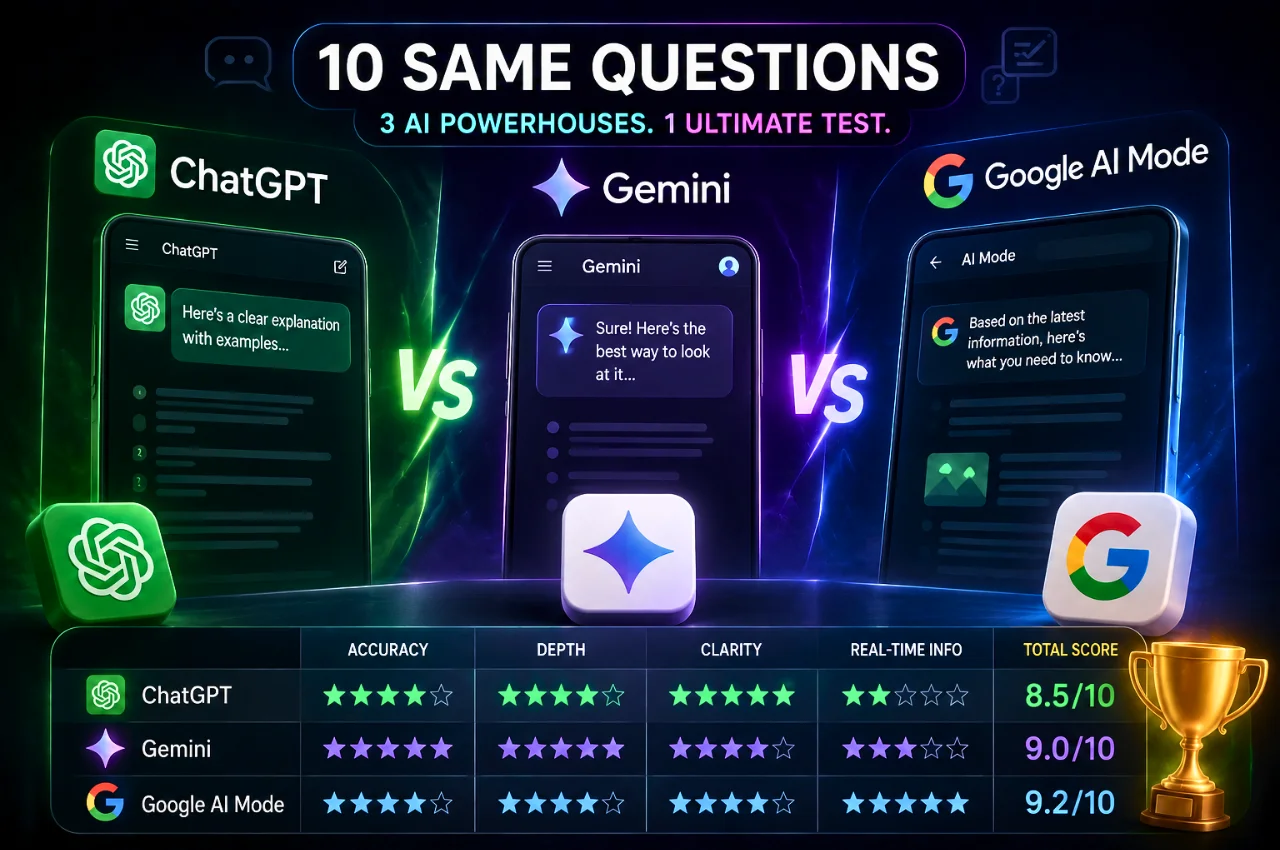
I have been using all three of these tools regularly for months. And over that time, I noticed something that kept bothering me.
Every comparison article I read online was either clearly sponsored by one side, or it compared these tools on questions that almost nobody in India would actually ask. Things like “write a haiku about autumn leaves” or “solve this calculus problem.” Useful, maybe, for someone. But not for a college student preparing for UPSC. Not for a small business owner in Kanpur trying to understand GST. Not for a parent looking for advice in Hindi. Not for a freelancer trying to write better client emails.
So I decided to test all three tools on ten questions that real Indians actually ask in real situations. No trick questions. No benchmark games. Just the kind of things that come up in actual daily life, work, and study.
I ran every single question on ChatGPT (GPT-5.2, free tier where possible), Gemini 3 (free tier), and Google AI Mode (available free in India for all users). Same question, same wording, on the same day. I did not cherry-pick the best responses. I noted what each tool actually said, where it got things wrong, and where it genuinely surprised me.
Here is exactly what happened.
How I Set Up the Test
Before I share the results, a few things worth knowing so you can judge the test fairly.
I used the free versions of all three tools wherever possible. Most people reading this are not paying ₹1,950 or ₹1,999 per month for a premium subscription, and comparing paid tiers against free tiers would be misleading. Where a feature is only available on paid, I noted it.
I did not tell any tool what the test was. I just asked the question naturally, the way anyone would type it.
I judged each response on three things: accuracy (was the information actually correct?), usefulness (was the answer something you could immediately use?), and honesty (did the tool admit when it did not know something, or did it sound confident while giving wrong information?).
The third criterion — honesty — turned out to be the most important differentiator, and the most surprising.
Question 1: “What is the last date to file ITR for salaried employees in India this year?”
This was my first test, and it immediately revealed something important about how these three tools are built differently.
ChatGPT gave me a confident answer: July 31. It also noted that this is typically the deadline for salaried employees without audit requirements. The answer was correct in general, but when I pressed it to confirm whether this was specifically for the current assessment year, it hedged and said I should verify with the Income Tax department website because its knowledge had a cutoff. Fair enough — but it led with confidence before adding that caveat at the end.
Gemini went straight to a live search and came back with the current year’s specific deadline, citing the official Income Tax India notification. It even mentioned whether any extension had been announced. This was the most useful response — directly actionable, sourced, current.
Google AI Mode did something similar to Gemini but presented it more conversationally, explaining what the deadline meant, who it applied to, and what happens if you miss it. More explanation than Gemini, slightly less crisp.
Winner for this question: Gemini, for pulling live data without prompting and citing the actual source.
What this taught me: For anything date-sensitive, deadline-driven, or involving government notifications, Gemini and AI Mode have a structural advantage because they access live information. ChatGPT’s training data has a cutoff, and it cannot always tell when information has changed.
Question 2: “Explain the difference between RAM and ROM to a 12-year-old in simple Hindi”
I wanted to test language handling and the ability to simplify technical concepts — a genuinely common need for Indian parents and teachers.
ChatGPT produced a clean, well-structured Hindi explanation that was accurate and used good analogies. It compared RAM to a study table (where you keep things you are currently working on) and ROM to a cupboard (where you store things permanently). The Hindi was grammatically correct and natural.
Gemini also answered in Hindi, used similar analogies, but added a short English summary at the end even though I had not asked for one. The explanation was good but slightly longer than necessary for a 12-year-old.
Google AI Mode gave me a response that mixed Hindi and English more than I wanted. The explanation was accurate but felt like it was translating rather than thinking in Hindi.
Winner for this question: ChatGPT, for the cleanest Hindi that actually sounded like something you would say to a child, not a translated textbook.
What this taught me: For creative, language-specific, or explanation tasks where tone and naturalness matter, ChatGPT consistently produces more polished output. Gemini’s Hindi is functional but feels slightly more mechanical.
Question 3: “My phone’s battery is draining fast. Give me five things to check right now.”
This was a practical troubleshooting question — the kind someone asks when they are frustrated and need immediate, usable help.
All three answered this reasonably well, which tells you something too: for common, well-documented problems, the gap between these tools is smaller than people think.
Also Read: how AI works inside your smartphone
ChatGPT gave a clean numbered list: screen brightness, background apps, location services, push email settings, and battery saver mode. Each point had one brief explanatory sentence. Ready to use immediately.
Gemini gave the same core advice but added a sixth point about checking for app updates and a note about checking battery health in settings. More complete, slightly more cluttered.
Google AI Mode gave me the list plus a follow-up prompt at the bottom: “Would you like me to walk you through checking background apps on your specific Android version?” That conversational follow-up was a small but genuinely useful touch that neither of the others offered.
Winner for this question: Tie between ChatGPT and Google AI Mode. ChatGPT for clean, immediate usability. AI Mode for the conversational follow-through.
Question 4: “Is it safe to take paracetamol and ibuprofen together?”
This is one of the most commonly Googled medical questions in India. I included it deliberately because how an AI handles medical questions — particularly whether it gives confident wrong answers or appropriately directs you to a professional — matters more than most people realise.
ChatGPT gave a reasonable answer: these two drugs work through different mechanisms and are sometimes used together under medical supervision, but self-medicating with both without a doctor’s guidance carries risks, particularly for people with kidney or stomach issues. It ended with a clear recommendation to consult a pharmacist or doctor before combining them. Accurate, cautious, appropriate.
Gemini gave a similar answer but added a detail I did not expect: it specifically mentioned that in India, many people self-medicate with paracetamol-ibuprofen combinations sold as fixed-dose combinations, and that the safety profile differs from taking them separately. That India-specific context was genuinely valuable and something ChatGPT missed.
Google AI Mode also handled this well, with a conversational explanation and clear advice to consult a pharmacist. But it did not add the India-specific context Gemini included.
Winner for this question: Gemini, for the India-specific nuance about fixed-dose combinations that is actually relevant to how most Indians encounter this question.
What this taught me: For medical, legal, or financial questions with India-specific context — local drug availability, Indian laws, Indian tax rules — Gemini often adds relevant local detail that generic global AI answers miss.
Question 5: “Write a professional email in English to a client explaining why a project will be delayed by one week”
This is a task that millions of Indian professionals need to do regularly. I wanted to see not just whether the answer was correct, but whether the email sounded like something a real person would actually send.
ChatGPT produced an email that was polished, appropriately apologetic without being grovelling, professional, and included a revised timeline and an offer to discuss. Of the three, this felt most like something a senior professional would write. I would send it with minimal editing.
Gemini produced a similar email but used slightly more formal language that veered into corporate-speak in a couple of places. Good structure, slightly stiff tone.
Google AI Mode gave me a solid email but then added a note at the bottom: “Would you like a more formal version, or a shorter version?” That option to immediately iterate was useful for someone who was not sure which tone their client preferred.
Winner for this question: ChatGPT for the most immediately usable output. AI Mode for flexibility.
What this taught me: For writing tasks — emails, professional communication, content drafts, explanations — ChatGPT’s output is the most consistently natural and polished. This is where its years of training on human writing genuinely shows.
Question 6: “What happened in today’s IPL match?”
I asked this on a day when there was actually an IPL match happening. This was a live information test.
ChatGPT could not answer. It told me its knowledge had a cutoff and it could not access real-time sports scores. Honest, but not useful.
Gemini pulled live results from Google Search and gave me the score, key performances, and a two-line summary of how the match went. Fast, accurate, immediately useful.
Google AI Mode did the same as Gemini but presented it slightly more conversationally, adding context about how the result affected the points table. Marginally more complete.
Winner for this question: Google AI Mode, narrowly ahead of Gemini.
What this taught me: For anything live — sports, news, stock prices, weather, event results — ChatGPT simply cannot compete on the free tier. This is not a criticism of ChatGPT’s intelligence. It is a structural limitation of how it is built. If live information is important to you, Gemini or AI Mode is the right tool.
Question 7: “I am a class 11 student. Explain Newton’s Third Law with an example I would relate to”
Education is one of the most important use cases for AI in India, and the ability to explain concepts with relatable local examples matters enormously for students who may not connect with the typical textbook examples.
ChatGPT explained the law clearly and used the example of a person jumping from a boat — classic, accurate, but not especially relatable for a class 11 student in India.
Gemini used the example of pushing against a wall, then added a second example: a cricket player hitting a ball with a bat. The force the bat exerts on the ball is matched by the force the ball exerts on the bat — which is why your hands sting when you hit a hard delivery. That example landed immediately. Every Indian student who has played cricket or watched it understood that intuitively.
Google AI Mode used a similar cricket example but extended it to ask whether I wanted a diagram or a practice question. The offer to generate a practice question on the same topic was genuinely useful for a student.
Winner for this question: Gemini for the cricket example that actually connected. AI Mode for the follow-up learning offer.
What this taught me: Gemini’s training on Indian content makes it better at surfacing examples that resonate with Indian students. This difference seems small in one question but compounds significantly across a study session.
Question 8: “Summarise this paragraph for me” — and I pasted a 400-word excerpt from a dense government circular about GST compliance
This was a reading comprehension and summarisation test using the kind of document Indian business owners and accountants regularly deal with.
All three handled this well, which reflects how far AI summarisation has come. The real differences were in format and depth.
ChatGPT gave me a clean five-point bullet summary that extracted the key compliance requirements, deadlines, and penalties. Directly usable for anyone who needed to act on the circular quickly.
Gemini gave a flowing paragraph summary that was accurate but required slightly more reading. Better for understanding the full context, less good for quick action.
Google AI Mode gave me the bullet summary plus a follow-up: “Would you like me to explain any of these points in simpler language?” That option to immediately drill down into any specific point was useful for someone who was not familiar with the subject matter.
Winner for this question: ChatGPT for immediate usability, AI Mode for the interactive follow-through.
Question 9: “Write a short poem in Hindi for my mother’s birthday”
I included a creative task in Hindi to test both language quality and emotional resonance.
This is the question where the gap between the tools was most visible and most personal.
ChatGPT wrote a poem that was grammatically correct, had a consistent rhythm, and expressed genuine warmth. It felt like something a thoughtful person had written, not a translation of an English poem.
Gemini wrote a poem that was also technically correct but felt slightly constructed — the emotions were named rather than shown. Lines like “aap meri prerna hain” (you are my inspiration) are accurate but common, the kind of phrase you would find in a thousand similar poems.
Google AI Mode produced a shorter poem with simpler vocabulary that, ironically, felt more genuine because of its simplicity. Less polished, more heartfelt.
Winner for this question: ChatGPT for quality. AI Mode for emotional authenticity in its simplicity.
What this taught me: For creative writing in Indian languages, ChatGPT and Google AI Mode both have strengths. Gemini’s Hindi creative output is good but feels more templated.
Question 10: “What are three things I should know before buying a second-hand phone in India?”
I saved a practical consumer question for last — the kind of thing a first-time buyer in a tier-2 city might ask.
ChatGPT gave solid advice: check IMEI status on the government portal, verify that the phone is not on a finance block (EMI unpaid by previous owner), and test all hardware including camera, charging port, and speakers before paying. All accurate, all directly actionable.
Gemini added a fourth point I had not asked for but was glad to see: check whether the phone’s warranty is transferable, and whether the original invoice is available, because some brands in India allow warranty transfer with invoice proof. That unsolicited but relevant addition was useful.
Google AI Mode gave similar advice but also mentioned a specific government portal — the CEIR portal — by name and explained that you can check whether a phone has been reported stolen by entering the IMEI number. That specific, actionable detail was the most useful single piece of advice across all three responses to this question.
Winner for this question: Google AI Mode, for the CEIR portal mention which is something most buyers genuinely do not know about.
The Overall Scoreboard
Let me be honest about what this test actually shows. This is not a rigorous scientific benchmark. It is ten questions from one person’s perspective of what matters in daily Indian life. But after running these tests, patterns were clear.
Google AI Mode won or tied in five of the ten questions. Its strength is the combination of live information access and conversational follow-through. The offer to continue, clarify, or expand after every answer changes how the tool feels to use. It is less like querying a database and more like talking to someone who wants to help you understand.
Gemini won or tied in four of the ten questions. Its standout strength is India-specific context — local examples, live data, and an awareness of Indian regulatory and cultural context that surfaces in ways that matter. The cricket analogy in the physics question and the GST-specific detail in the medical question were not things I prompted for. They appeared because Gemini’s training and search integration made them relevant. also read: Gemini 3 official capabilities
ChatGPT won or tied in five of the ten questions. Its strength is the quality of written output — professional emails, creative writing, structured explanations. If the task involves producing words that need to sound like a thoughtful human wrote them, ChatGPT consistently delivers the most polished result.
The clear loser in this specific test was ChatGPT’s inability to access live information. For half of the questions I asked — the ones involving current dates, live events, and real-time government data — ChatGPT was at a structural disadvantage that no amount of intelligence could overcome.
What No One Tells You About Using These Tools
Here is the part that most comparison articles skip entirely.
None of these tools should be your only source for anything important. All three produced at least one response during my testing where the information was either subtly incomplete or confidently stated in a way that could mislead someone who did not already know the subject. The difference is that Gemini and AI Mode at least cite sources you can check. ChatGPT’s free tier often does not.
The best workflow — which experienced Indian users have figured out and which I now use myself — is to use these tools in combination. Use Gemini or AI Mode to get current, live information with sources. Use ChatGPT to write, explain, or structure that information into something polished and usable. Use Google AI Mode’s conversational follow-up to drill deeper into anything you do not fully understand.
Treating any single tool as the definitive answer to everything is the mistake. Treating all three as a toolkit — knowing which one to reach for depending on the task — is where the real productivity gain is.
Also Read: how large language models actually work
Frequently Asked Questions
Which is better for Indian students, ChatGPT or Gemini?
For current affairs and UPSC preparation, Gemini is clearly stronger because it accesses live news and government notifications. For explaining concepts, solving problems, and getting structured study guides, ChatGPT and Google AI Mode are more reliable. For most students, using Gemini for research and current affairs, and ChatGPT for explanation and writing practice, produces better results than sticking to one tool.
Is Google AI Mode the same as Gemini?
No, though they share some underlying technology. Gemini is Google’s standalone AI assistant available at gemini.google.com. Google AI Mode is a feature built directly into Google Search — accessible via the AI Mode tab in the search interface. AI Mode is more focused on search-like queries and has a stronger integration with real-time web results and conversational follow-up within a search context. Gemini is more of a full assistant for longer tasks, document analysis, and creative work.
Does ChatGPT work in Hindi as well as Gemini?
Both handle Hindi well, but for different types of tasks. ChatGPT produces more natural, fluent Hindi for creative and conversational output. Gemini handles Hindi queries about current Indian events, government schemes, and local context more reliably because of its search integration. For a general-purpose Hindi query, both are good. For creative Hindi writing, ChatGPT has a slight edge. For current affairs in Hindi, Gemini wins.
Are all three tools free to use in India?
ChatGPT has a free tier with limited access to GPT-5.2 features. The full GPT-5.2 experience requires ChatGPT Plus at approximately ₹1,999 per month. Gemini has a free tier with access to Gemini 3 Flash. Gemini Advanced with full Gemini 3 Pro features comes with Google One AI Premium at approximately ₹1,950 per month, which also includes 2TB of Google Drive storage. Google AI Mode is completely free for all users in India with no subscription required.
Which tool is best for writing professional emails in Indian English?
ChatGPT is consistently the strongest for professional writing. Its output requires the least editing and best matches the tone expected in Indian corporate and business communication. For most professional writing tasks — emails, proposals, reports, LinkedIn posts — ChatGPT produces the most immediately usable result.
Should I trust AI answers for medical or legal questions?
No AI tool should be your final source for medical or legal decisions. All three tools I tested handle these questions with appropriate caution and recommend consulting a professional. Use AI to understand terminology, get a general overview, or prepare questions before a doctor’s appointment or legal consultation. Do not use any AI answer as a substitute for professional advice on matters that affect your health, finances, or legal standing.
Final Thoughts
The question “which AI is best” is the wrong question. After running these ten tests, I am more convinced than ever that the right question is: best for what?
Google AI Mode is best for live information, conversational depth, and anything that benefits from real-time search. Gemini is best for India-specific context, live data with citations, and tasks that sit at the intersection of research and language. ChatGPT is best for writing, explaining, and producing polished text output.
The person who benefits most from AI in 2026 is not the one who picks a favourite and sticks with it. It is the person who takes ten minutes to understand what each tool is actually good at — and then reaches for the right one depending on what the task demands.
All three of these tools are free to try. My suggestion is simple: run your own version of this test. Pick five questions that actually matter in your life or work. Ask all three. See what you find. The results will be more useful than anything I or anyone else can tell you.