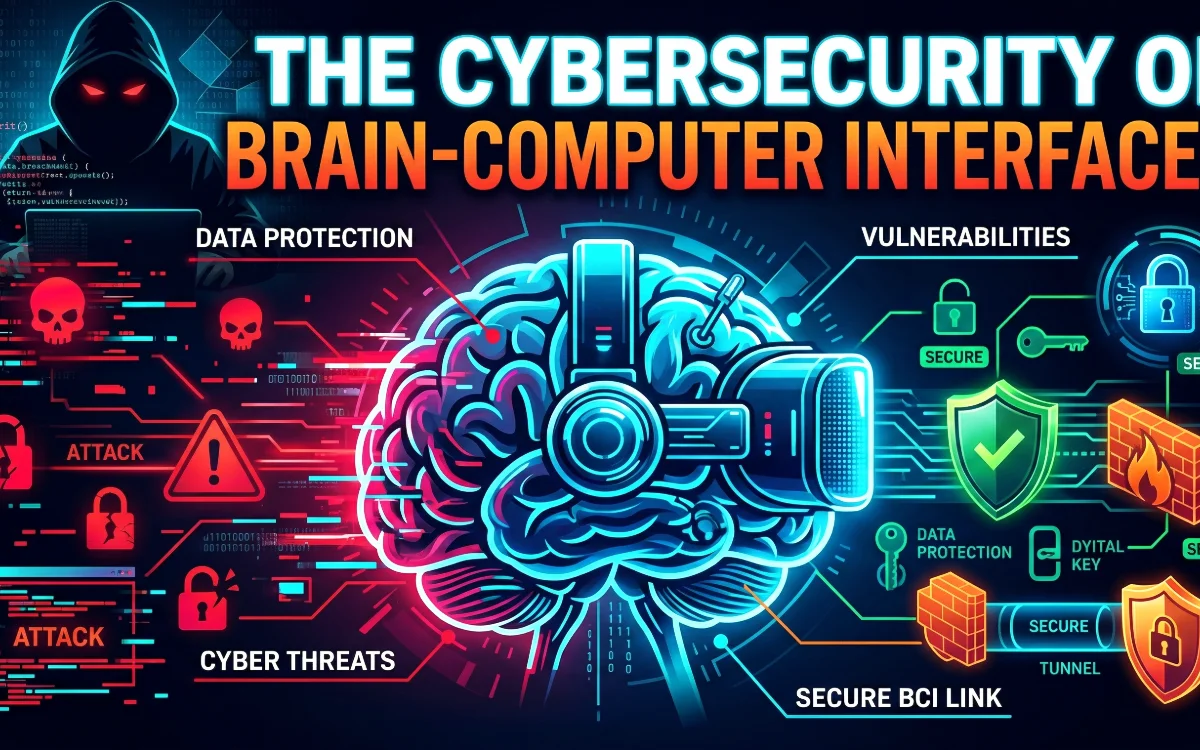
In 2026, cybersecurity isn’t just about protecting passwords or bank accounts. It’s about protecting something much more personal: your neural data.
Brain-computer interfaces (BCIs) are moving beyond medical research labs into real-world testing environments. From assistive communication devices to experimental productivity tools and immersive gaming systems, BCIs are gradually becoming part of the connected ecosystem.
But as the brain connects to the internet, a new category of risk emerges.
From what I’ve seen while covering emerging hardware security and AI systems, BCI cybersecurity could become one of the most pressing technology debates of the next decade—because unlike passwords, your brain can’t be reset.
Let’s take a practical, real-world approach.
What Exactly Is a Brain-Computer Interface?

A Brain-Computer Interface (BCI) is a system that:
- Detects electrical signals from the brain
- Converts them into digital commands
- Enables communication between humans and machines
There are two main types:
1. Non-Invasive BCIs
- Worn externally (headsets or wearable bands)
- Use EEG sensors to detect brain signals
- Already used in medical rehabilitation and research
2. Invasive BCIs
- Surgically implanted
- Provide higher precision
- Used primarily in advanced medical treatment
Today, BCIs are helping paralyzed patients type using thought-driven signals, control robotic hands, and restore some motor function. But as capabilities expand, so too do cybersecurity risks.
Why BCI Cybersecurity Is Unlike Traditional Cybersecurity
Traditional cybersecurity protects:
- Login credentials
- Financial records
- Emails and chats
- Photos and personal files
BCIs potentially involve:
- Emotional states
- Focus patterns
- Intent recognition
- Cognitive responses
This introduces a new category: neurodata.
And here’s the key difference:
If someone steals your password, you can change it.
If someone captures your neural patterns, you can’t simply “update” your brain.
This makes the protection completely different.
How BCIs Actually Connect to the Internet
Most people imagine BCIs as standalone devices. In reality, many systems rely on connected infrastructure.
A typical BCI workflow looks like this:
- Sensors detect brain signals
- Signals are transmitted wirelessly
- AI models interpret patterns
- Results are processed locally or in the cloud
- Commands are executed
Each stage introduces a potential vulnerability.
In my experience analyzing IoT and wearable security, wireless transmission is often the weakest link.
Real-World Risk Scenarios (Practical Examples)
Let’s move beyond theory and look at realistic scenarios.
Scenario 1: Medical BCI Patient
Imagine a patient using a BCI to control a prosthetic limb.
The device relies on:
- Wireless signal transmission
- AI-based signal interpretation
- Regular firmware updates
If encryption is weak or compromised by a firmware update, attackers could theoretically disrupt the device’s performance.
Although current systems include safeguards, cybersecurity audits should be conducted on a regular basis—just as with pacemakers or insulin pumps.
Scenario 2: Workplace Cognitive Monitoring
Some experimental corporate environments are testing wearable BCIs to monitor:
- Focus levels
- Fatigue
- Reaction times
Now consider the privacy implications:
- Who owns that neurodata?
- Can employers store emotional pattern data?
- Could it affect performance evaluations?
Cybersecurity here intersects directly with ethics and labor law.
Scenario 3: Consumer Gaming Headsets
Gaming is often the first sector to adopt experimental tech.
A BCI-enabled gaming headset connected via Bluetooth introduces risks such as:
- Wireless spoofing
- Data interception
- Firmware tampering
While the risk may sound futuristic, we’ve seen similar vulnerabilities in early smart home devices.
History shows that consumer tech often prioritizes speed over security at launch.
Key Cybersecurity Threat Categories in BCIs
Here are the major threat vectors experts are monitoring in 2026:
1. Neural Data Interception
If wireless encryption is insufficient, signal patterns could be captured during transmission.
2. Device Manipulation
Malicious actors could attempt to alter interpretation algorithms.
3. AI Model Poisoning
Since BCIs depend heavily on AI training, compromised training data could distort system behavior.
4. Behavioral Profiling
Neural data could reveal stress patterns, emotional triggers, or attention cycles — valuable data for advertisers or institutions.
How Companies Are Securing BCIs Today
Developers are not ignoring these risks. Several protection layers are already being implemented.
✅ End-to-End Encryption
Neural signals are encrypted during transmission.
✅ On-Device Processing
Instead of sending raw signals to the cloud, many systems now process data locally.
Less cloud reliance = lower exposure risk.
✅ Secure Boot and Firmware Verification
Devices verify software integrity before operating.
✅ AI Robustness Testing
AI models are tested against adversarial manipulation attempts.
✅ Multi-Factor Access Controls
Access to BCI dashboards or cloud systems requires layered authentication.
Traditional Cybersecurity vs BCI Cybersecurity
| Category | Smartphones & PCs | Brain-Computer Interfaces |
|---|---|---|
| Data Type | Files & credentials | Neural signals |
| Reset Option | Password change | No reset possible |
| Risk Level | Financial & identity | Cognitive privacy |
| Regulation | Established laws | Emerging frameworks |
| Public Awareness | High | Very Low |
BCI cybersecurity isn’t an extension of phone security — it’s a completely new frontier.
The Role of Regulation: Neuro-Rights
Security technology alone is not enough.
Legal experts are now discussing “neuro-rights,” including:
- Mental privacy protection
- Cognitive liberty
- Protection against algorithmic manipulation
- Ownership of neural data
Without strong regulation, even technically secure systems could misuse data legally.
From what I’ve observed, legislation often lags innovation — and BCIs are advancing quickly.
Practical Advice for Future BCI Users
If you ever consider using a BCI device, here’s real-world guidance:
✔ Choose Companies With Transparent Data Policies
Read:
- Where is your data stored?
- Is it processed locally?
- Is it shared with third parties?
✔ Prefer Local Processing Over Cloud Dependency
Less data transmission reduces exposure risk.
✔ Update Firmware Regularly
Security patches matter even more for neural devices.
✔ Avoid Unverified Third-Party Integrations
Unauthorized apps increase attack surfaces.
✔ Understand Consent Agreements
Neural data agreements may carry long-term implications.
The Bigger Question: Can Thoughts Be Hacked?
Current BCIs don’t read entire thoughts.
They understand signal patterns associated with a target command—like moving a cursor or selecting a letter.
However, as AI improves, neural precision increases.
This means cybersecurity will have to evolve along with it.
Because once neural interfaces become widespread worldwide, public trust will determine their adoption.
Pros and Risks of Connected BCIs
Potential Benefits
- Life-changing medical treatments
- Assistive communication
- Accessibility improvements
- Hands-free computing
- Advanced human-machine interaction
Cybersecurity Risks
- Neural data interception
- Behavioral profiling
- AI system manipulation
- Regulatory gaps
- Privacy erosion
The opportunity is extraordinary — but so are the stakes.
Final Thoughts
Every major technological revolution has created new security challenges.
The internet required encryption.
Smartphones required biometric protection.
Cloud computing required zero-trust architecture.
Brain-computer interfaces will require something more profound:
Protecting cognitive privacy itself.
From what I’ve seen, the success of BCI technology won’t just depend on the speed of innovation—it will depend on whether people trust that their most personal data, their neural signals, is secure.
Because in a connected world, cybersecurity may soon mean not just protecting your identity—but also protecting your brain.