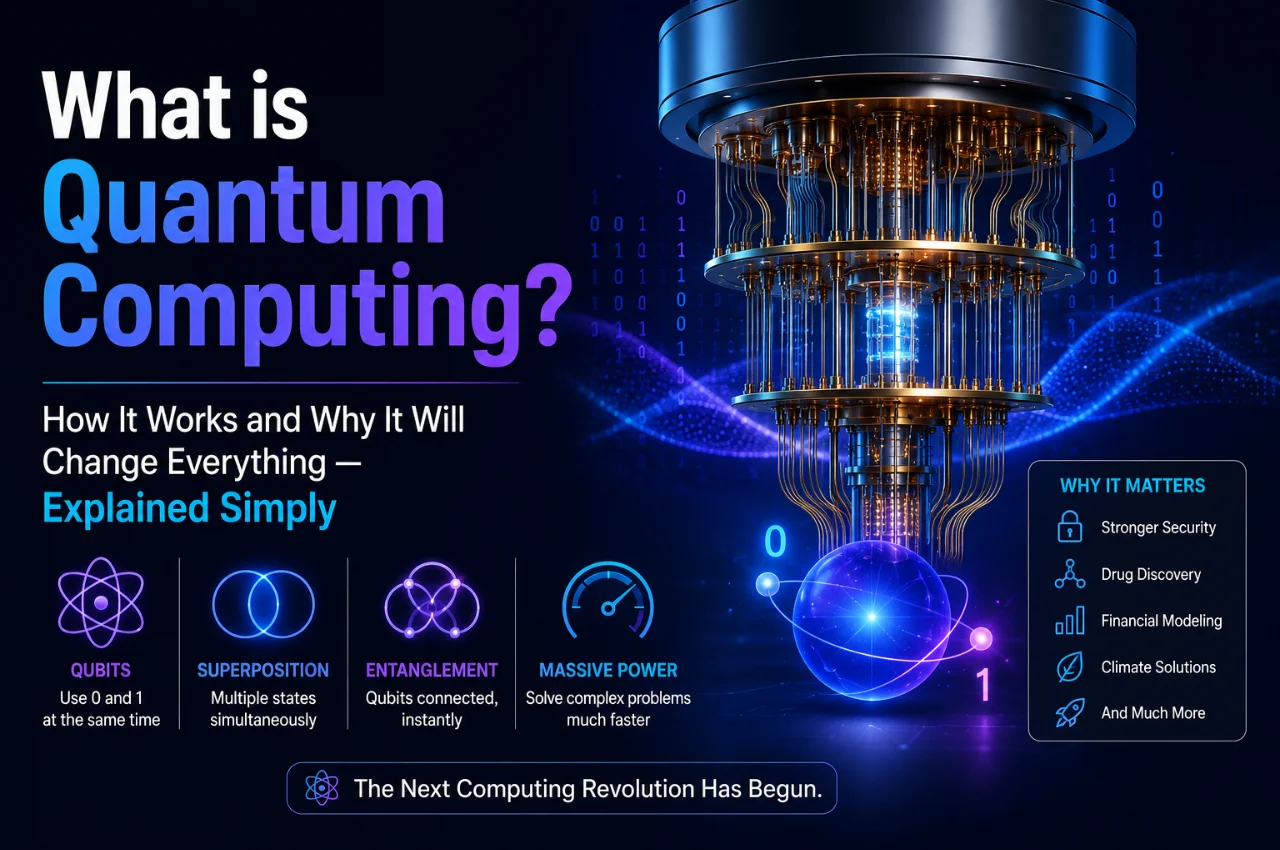
Imagine you are in a giant maze. A regular computer solves the maze by trying one path at a time — dead end, back up, try another path, dead end, back up, try another — until it eventually finds the exit. It might try thousands of paths before finding the right one.
A quantum computer does something fundamentally different. It tries every single possible path through the maze simultaneously — and instantly knows which one leads to the exit.
This is not a perfect analogy, but it captures the essence of what makes quantum computing so extraordinary, and why it represents one of the most significant technological developments of the 21st century.
This guide explains what quantum computing is, how it works, what makes it different from every computer you have ever used, and what it will change — in plain, simple language, without physics textbooks or engineering degrees required.
What is Quantum Computing?
Quantum computing is a type of computing that uses the principles of quantum mechanics — the physics that governs the behavior of matter and energy at the smallest possible scales, the level of individual atoms and subatomic particles — to process information in ways that classical computers fundamentally cannot.
To understand why this is significant, you first need to understand how every computer you have ever used actually works.
Every laptop, smartphone, and supercomputer in existence today — no matter how powerful — operates on the same basic principle. It processes information as bits. A bit is the smallest unit of information, and it can exist in one of two states: 0 or 1. Off or on. False or true. Every calculation, every image, every video, every piece of software, every word in this article — is ultimately represented as an enormous series of 0s and 1s, processed one operation at a time.
This system has taken us remarkably far. The chips in modern phones perform billions of operations per second and contain tens of billions of transistors in a space smaller than your fingernail. But no matter how fast classical computers get, they are still fundamentally limited by their binary nature — they process information sequentially, one bit at a time.
Quantum computing breaks this constraint entirely. It does not use bits. It uses quantum bits — called qubits — that can exploit the strange, counterintuitive laws of quantum physics to process information in a completely different way. And the result, for specific types of problems, is not just faster computation — it is a different kind of computation that can solve problems classical computers could not solve in the lifetime of the universe.
The Three Quantum Properties That Make It Possible
To understand how quantum computing works, you need to understand three properties of quantum physics that have no equivalent in classical computing. These properties are what give qubits their extraordinary power.
Superposition — Being Multiple Things at Once
In classical computing, a bit is always either 0 or 1. It cannot be both simultaneously. A light switch is either off or on. There is no in-between.
In quantum mechanics, a quantum particle can exist in multiple states simultaneously until it is observed or measured. This property is called superposition. The famous thought experiment of Schrodinger’s Cat — a cat in a sealed box that is simultaneously alive and dead until you open the box and look — illustrates this counterintuitive property of quantum systems.
A qubit exploits superposition. While it has not been measured, a qubit can represent both 0 and 1 at the same time — or more precisely, it exists in a combination of both states simultaneously. This is not the same as saying we just do not know whether it is 0 or 1. The qubit genuinely exists in both states simultaneously until observation collapses it to one.
The practical implication is significant. A classical computer with 3 bits can represent one of 8 possible values (000, 001, 010, 011, 100, 101, 110, or 111) at any given moment. A quantum computer with 3 qubits can represent all 8 of those values simultaneously. With 300 qubits, a quantum computer can represent more states simultaneously than there are atoms in the observable universe. This exponential scaling is what gives quantum computers their potential for certain types of calculation.
Entanglement — Instant Connection Across Distance
Entanglement is perhaps the strangest property in quantum physics, and Albert Einstein famously called it “spooky action at a distance” because it troubled him deeply.
When two qubits become entangled, they form a special relationship — the state of one instantly determines the state of the other, regardless of the physical distance between them. Measure one entangled qubit and collapse it to 0 or 1, and the other qubit instantly reflects the correlated state — whether it is sitting next to the first qubit or theoretically on the other side of the planet.
In quantum computing, entanglement is used to link qubits together so they work as a coordinated system rather than independent units. When qubits are entangled, operations on one affect all the entangled qubits simultaneously. This allows quantum computers to perform massively parallel operations across many qubits at once — a capability that has no classical equivalent.
Interference — Amplifying Right Answers, Eliminating Wrong Ones
The third key property is quantum interference. In physics, interference occurs when waves overlap — reinforcing each other where they are in phase (constructive interference) and cancelling each other out where they are out of phase (destructive interference).
Quantum computing algorithms use interference deliberately to amplify the probability of measuring the correct answer and suppress the probability of measuring incorrect answers. This is how quantum algorithms guide the computation toward the right solution out of the enormous number of possibilities that superposition creates.
Superposition creates all the possibilities simultaneously. Entanglement links qubits to work together. Interference selectively amplifies the right answer. Together, these three properties create a computational system unlike anything that came before.
How Does a Quantum Computer Actually Work? — Step by Step
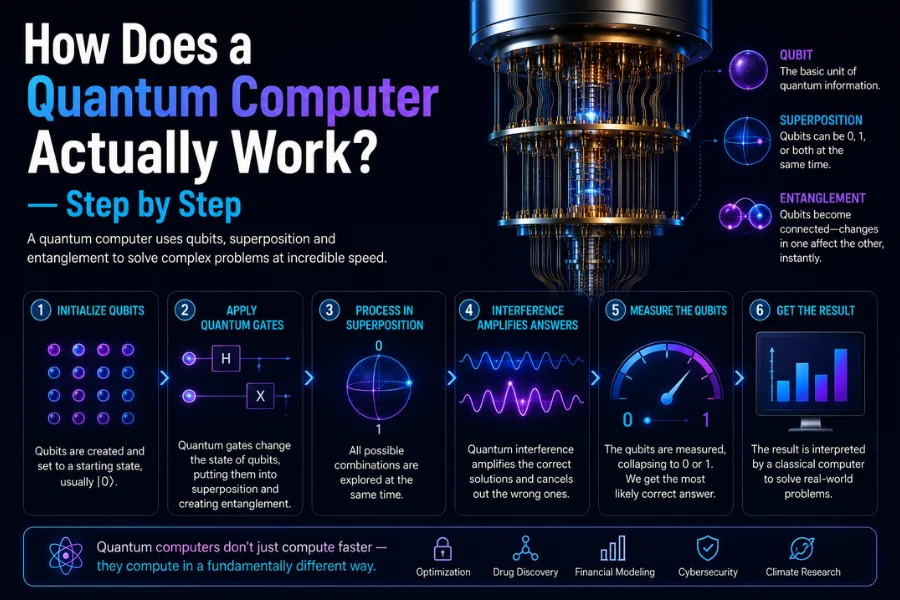
Now that you understand the three core properties, here is how they combine in an actual quantum computation.
Step one — initialization. The qubits are set to their initial state — typically all set to 0. The quantum system is prepared for computation.
Step two — superposition. Quantum gates apply superposition to the qubits, placing them in combinations of 0 and 1 simultaneously. This is analogous to creating all possible states of the problem at once — like having every possible path through the maze open simultaneously.
Step three — entanglement and gate operations. Quantum gates — the quantum equivalent of the logic gates in classical computers — manipulate qubits and create entanglement between them. These operations represent the algorithm being run — the set of instructions that will process the quantum information.
Step four — interference. The algorithm is designed so that quantum interference amplifies the probability of qubits collapsing to the state that represents the correct answer, while suppressing all the incorrect answers. This is the most mathematically sophisticated part of quantum computing and the reason quantum algorithms require entirely new design approaches compared to classical algorithms.
Step five — measurement. The qubits are measured. The act of measurement collapses the superposition — each qubit resolves to a definite 0 or 1. The result read out from the measurement is the answer to the computation.
Step six — error correction and repetition. Quantum systems are extraordinarily sensitive to interference from the environment — a stray vibration, a temperature fluctuation, even nearby electromagnetic fields can disrupt a qubit’s quantum state, a problem called decoherence. Modern quantum computers run computations multiple times and use sophisticated error correction techniques to extract reliable answers despite this noise.
How is a Quantum Computer Built?
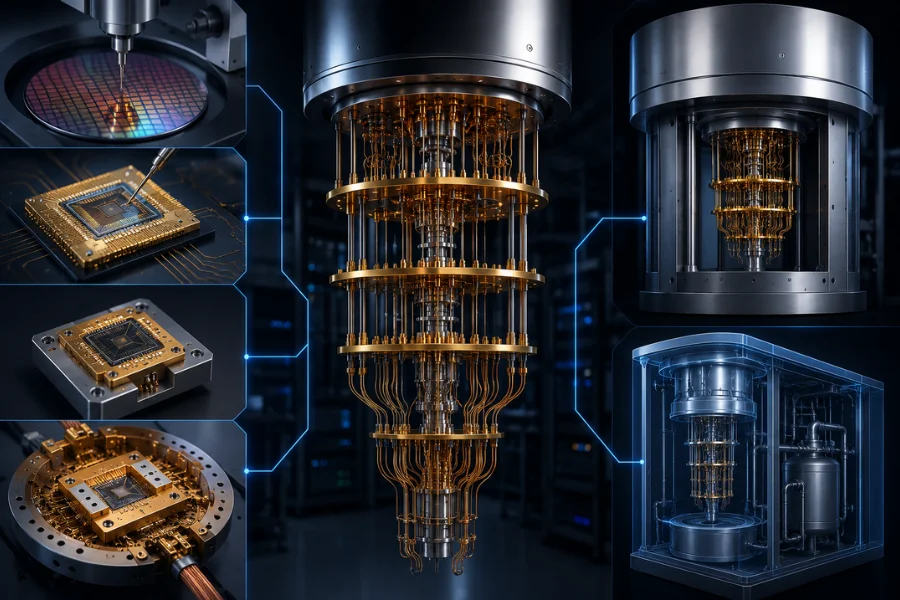
The physical reality of a quantum computer is as remarkable as its theoretical properties.
Most current quantum computers operate at temperatures close to absolute zero — approximately minus 273 degrees Celsius, colder than outer space. This extreme cooling is necessary because qubits are extraordinarily sensitive. At room temperature, thermal energy from the surrounding environment constantly disrupts quantum states through decoherence, making computation impossible. The cryogenic systems that maintain these temperatures are among the engineering marvels of modern technology.
Qubits themselves can be implemented through various physical approaches. Superconducting circuits — used by IBM and Google — create qubits from superconducting loops of material where electrons flow without resistance at near absolute zero. These are currently the most advanced and widely deployed approach. Trapped ions — used by companies like IonQ and Quantinuum — suspend individual charged atoms in electromagnetic fields and use laser pulses to manipulate their quantum states. Trapped ion qubits are more accurate but currently harder to scale to large numbers. Photonic qubits use individual particles of light, or photons, as qubits — offering the potential for room-temperature operation. Silicon spin qubits encode quantum information in the spin of individual electrons in silicon chips, potentially enabling integration with existing semiconductor manufacturing.
The largest quantum computers in 2026 have thousands of physical qubits. However, physical qubits are noisy and error-prone — it takes many physical qubits working together to create a single reliable logical qubit that can be used for computation. This ratio — often hundreds of physical qubits per logical qubit with current technology — is one of the central engineering challenges of the field.
What Can Quantum Computers Do That Classical Computers Cannot?
This is the most important practical question about quantum computing — and it requires a nuanced answer, because quantum computers are not better than classical computers at everything. They are dramatically better at specific types of problems.
Drug discovery and molecular simulation is one of the most promising applications. Simulating the behavior of molecules at the quantum level — how atoms interact, how proteins fold, how chemical reactions occur — is computationally intractable for classical computers beyond a relatively small number of atoms. A molecule with 300 atoms has more possible quantum states than classical computers could process if they ran for the entire age of the universe. Quantum computers can naturally simulate quantum systems, potentially enabling the discovery of new drugs, materials, and chemical processes that are completely beyond the reach of current computing.
Optimization problems arise in logistics, finance, energy, manufacturing, and virtually every complex system. Finding the optimal solution among an enormous number of possibilities — the most efficient route for thousands of delivery vehicles, the optimal allocation of resources across a complex supply chain, the best portfolio allocation across thousands of assets — is a type of problem where quantum algorithms can provide exponential advantages over classical approaches.
Cryptography is the application of quantum computing that generates the most concern in the cybersecurity community. A sufficiently powerful quantum computer running an algorithm called Shor’s algorithm could break the encryption that protects most of today’s internet communications and financial transactions. RSA and elliptic curve cryptography — the mathematical foundations of HTTPS, digital signatures, and most public-key encryption — would be vulnerable. This is not an immediate threat, because sufficiently powerful quantum computers do not exist yet, but the global cybersecurity community is actively working on quantum-resistant encryption standards to prepare for the day they do.
Machine learning and artificial intelligence acceleration is an area of active research. Quantum algorithms could potentially process complex datasets and train certain types of machine learning models significantly faster than classical approaches, particularly for problems involving high-dimensional data and complex optimization.
Financial modeling involves enormous numbers of variables and potential scenarios. Quantum computers could enable more accurate risk assessment, fraud detection, and market simulation than is currently possible.
Materials science and energy research benefit from the same molecular simulation capability that helps drug discovery. Designing better batteries, more efficient solar cells, room-temperature superconductors, and new structural materials all require molecular-level simulation that quantum computers are uniquely positioned to perform.
What Quantum Computers Cannot Do
Understanding the limitations of quantum computing is as important as understanding its capabilities.
Quantum computers are not universal replacements for classical computers. For most everyday computing tasks — browsing the web, sending email, streaming video, writing documents, playing most games — classical computers are faster, cheaper, and more practical. Quantum computers provide advantages only for specific problem classes involving very large solution spaces, complex quantum simulations, or certain mathematical operations.
Quantum computers are not yet reliable enough for most commercial applications. Current quantum hardware suffers from significant error rates due to decoherence and noise. Achieving the error rates necessary for large-scale practical applications requires advances in quantum error correction that have not yet been fully demonstrated at scale.
Quantum computers are not currently accessible to most people or organizations in the practical sense. They require extraordinary physical infrastructure — cryogenic systems, vibration isolation, electromagnetic shielding — that makes them accessible primarily through cloud services provided by IBM, Google, Amazon, and Microsoft.
Quantum algorithms for most practical problems are still being developed. Having quantum hardware is only half the challenge — developing quantum algorithms that actually exploit quantum advantages for real-world problems is a separate, ongoing research effort that is far from complete.
Quantum Computing and Cybersecurity — What You Need to Know
The cybersecurity implications of quantum computing are significant enough to deserve dedicated attention.
Most of the encryption protecting the internet today — including the HTTPS that secures your banking transactions, the encryption protecting your email, and the digital signatures that verify software — relies on mathematical problems that are computationally hard for classical computers but potentially easy for sufficiently powerful quantum computers.
Specifically, RSA encryption relies on the difficulty of factoring large numbers — multiplying two large prime numbers together is easy, but finding the original primes from the result is computationally infeasible for classical computers. Shor’s algorithm, running on a sufficiently large and reliable quantum computer, could factor large numbers exponentially faster than any classical algorithm.
This creates what security researchers call “harvest now, decrypt later” risk — adversaries could be collecting encrypted data today with the intention of decrypting it once quantum computers are powerful enough to break the encryption. For data that must remain secret for decades — government communications, medical records, financial history — this is a genuine concern right now, not just a future issue.
In response, NIST — the National Institute of Standards and Technology in the United States — finalized the first set of post-quantum cryptography standards in 2024. These are new encryption algorithms specifically designed to be resistant to quantum attacks. The global transition to quantum-resistant encryption has begun, and is expected to take years to complete across the entire internet infrastructure.
India’s National Quantum Mission, launched with a budget of 6,003 crore rupees, specifically includes quantum communication and quantum cryptography as priority research areas — reflecting the Indian government’s recognition of both the opportunity and the security challenge that quantum computing presents.
Where is Quantum Computing Today? — The State of the Technology in 2026
Quantum computing in 2026 is at an extraordinary but still early stage. The technology is real, it is advancing rapidly, and it is being actively used by researchers and select commercial customers — but general-purpose practical quantum advantage over classical computers for real-world business problems has not yet been definitively demonstrated at scale.
IBM has the most extensive quantum computing program accessible to the public through its IBM Quantum platform. IBM has publicly committed to specific roadmaps for expanding qubit counts and improving error rates, and it offers cloud access to its quantum processors for researchers and developers worldwide.
Google made a landmark claim in 2019 of achieving “quantum supremacy” — performing a specific calculation faster than any classical computer could. In 2023, Google’s quantum team published results of a more meaningful demonstration of quantum error correction milestones using their Sycamore processor. Google’s Willow quantum chip, announced in late 2024, represented a significant advance in error correction.
Microsoft is pursuing a fundamentally different approach using topological qubits — a type of qubit that is theoretically more resistant to error — and announced a major milestone in this approach in 2025.
China has made significant investments in quantum computing and quantum communication, demonstrating quantum key distribution over record distances and making several notable hardware announcements.
India’s National Quantum Mission is funding research at IITs and national laboratories, with the goal of developing indigenous quantum computing capabilities and establishing India as a significant player in the global quantum technology landscape.
Amazon Web Services, Microsoft Azure, and IBM all offer quantum computing as a cloud service — allowing researchers and businesses to run quantum algorithms on actual quantum hardware without owning any quantum equipment.
The honest state of the technology is best described as the NISQ era — Noisy Intermediate-Scale Quantum — a term coined by physicist John Preskill to describe quantum computers that have enough qubits to do interesting things but are still too noisy and error-prone for most practical commercial applications. The transition from NISQ to fault-tolerant quantum computing — the stage where quantum computers are reliable enough for large-scale practical use — is the central challenge the field is working toward.
Quantum Computing vs Classical Computing vs AI — How They Relate
These three technologies are frequently discussed together and their relationship is worth clarifying.
Classical computing is the foundation of all current digital technology. Every laptop, smartphone, cloud server, and supercomputer uses classical computing — bits, transistors, and sequential logical operations. Classical computers will remain the dominant form of computing for everyday tasks indefinitely.
Quantum computing is a specialized computing paradigm that offers dramatic advantages over classical computing for specific types of problems — particularly simulation, optimization, and certain mathematical operations. Quantum computers are not replacing classical computers. They are complementing them — handling the problems where quantum approaches offer advantages, while classical computers continue to handle everything else.
Artificial intelligence and machine learning run on classical computers today. The neural networks that power ChatGPT, Gemini, image recognition, and every other AI system you interact with run on classical processors — primarily specialized chips called GPUs and TPUs. Quantum computing could potentially accelerate certain AI tasks in the future, but current AI progress does not depend on quantum computing, and the two fields are largely developing independently.
The vision for the future is a hybrid landscape — classical computers handling everyday computation, AI systems providing intelligence and pattern recognition, and quantum computers handling specific computationally intractable problems that neither classical computers nor AI can solve.
How Quantum Computing Will Change Different Industries
Pharmaceutical and healthcare industry transformation could be the most impactful near-term application. If quantum computers can simulate molecular behavior accurately enough to predict how drug candidates will interact with biological systems, the cost and time to develop new medicines could drop dramatically. Diseases that currently lack effective treatments because the relevant molecular interactions are too complex to model classically could become treatable.
Finance and banking will use quantum optimization for portfolio construction, risk assessment, fraud detection at scale, and derivative pricing. The ability to process far more variables and scenarios simultaneously could make financial models significantly more accurate.
Climate and energy research will benefit from quantum simulation of new battery chemistries, solar cell materials, and catalysts for carbon capture. Designing the materials needed for a clean energy economy requires molecular-level simulation that quantum computers are uniquely suited to perform.
Logistics and supply chain optimization for global operations involves solving optimization problems of a scale that currently requires significant approximation. Quantum optimization algorithms could find solutions that classical approaches cannot, reducing waste and cost across global supply chains.
Cybersecurity will be fundamentally transformed — quantum computers threaten existing encryption while quantum key distribution offers theoretically unbreakable secure communication channels.
Artificial intelligence research will explore quantum machine learning approaches that could improve the efficiency of training specific types of models.
Key Takeaway
Quantum computing is not science fiction and it is not just a faster classical computer. It is a fundamentally different kind of computation that harnesses the counterintuitive laws of quantum physics — superposition, entanglement, and interference — to solve specific classes of problems that would take classical computers longer than the age of the universe.
The technology is real, actively advancing, and accessible through cloud services today. It is also genuinely early — the engineering challenges of building reliable large-scale quantum computers are significant and have not yet been fully solved. The transition from today’s noisy, error-prone quantum processors to the fault-tolerant quantum computers that will deliver transformative practical applications will likely take another decade or more.
But the direction is clear. Quantum computing will change drug discovery, materials science, cryptography, finance, logistics, and artificial intelligence — not by replacing the computers we use today, but by handling the problems those computers cannot touch.
Understanding quantum computing now — even at a conceptual level — means understanding one of the most consequential technologies taking shape in the world around you.
Frequently Asked Questions
Will quantum computers replace regular computers?
No. Quantum computers are specialized tools that excel at specific types of problems — large-scale optimization, molecular simulation, and certain mathematical operations. For everyday computing tasks — browsing, email, streaming, gaming, word processing — classical computers are faster, cheaper, and more practical. Quantum and classical computers will work alongside each other, each handling the problems it does best.
When will quantum computers be available to the public?
Quantum computers are already accessible today through cloud services from IBM, Google, Amazon, and Microsoft — anyone can run quantum algorithms on real quantum hardware through these platforms. However, quantum computers powerful and reliable enough to solve major practical commercial problems better than classical computers are still likely years away from widespread availability.
Can a quantum computer break my passwords today?
No. Current quantum computers are not powerful or reliable enough to threaten modern encryption. The encryption protecting your banking, email, and messaging remains secure today. However, a sufficiently powerful future quantum computer running Shor’s algorithm could potentially break current public-key encryption, which is why the global cybersecurity community is actively developing and transitioning to quantum-resistant encryption standards.
What is a qubit?
A qubit is the quantum equivalent of the classical bit — the fundamental unit of information in quantum computing. Unlike a classical bit, which is always either 0 or 1, a qubit can exist in a superposition of both 0 and 1 simultaneously until it is measured. This property, combined with entanglement and interference, is what gives quantum computers their extraordinary potential for specific types of problems.
What is India doing in quantum computing?
India launched its National Quantum Mission with a budget of 6,003 crore rupees, one of the largest national quantum investments in Asia. The mission focuses on developing quantum computers, quantum communication networks, quantum sensing, and quantum cryptography. Research is being conducted at IITs, national laboratories, and in partnership with global technology companies. India aims to develop an indigenous quantum computing capability and establish itself as a significant player in the global quantum technology ecosystem.
Is quantum computing related to artificial intelligence?
Quantum computing and artificial intelligence are currently largely separate fields that both run on classical hardware today. Quantum computing is a different type of hardware that could potentially accelerate specific AI tasks in the future — particularly certain optimization problems in machine learning. But current AI progress does not depend on quantum computing, and the transformative AI tools available today run entirely on classical processors.
Final Thoughts
Quantum computing occupies a rare position in the technology landscape — it is simultaneously the most hyped and the most genuinely revolutionary emerging technology of our time. The hype often outpaces the reality of where the technology currently stands. But the reality itself is extraordinary enough to warrant serious attention.
A technology that can simulate molecular interactions to discover new medicines, break and rebuild the foundations of internet security, and solve optimization problems that would take classical computers the lifetime of the universe — that technology deserves to be understood, at least at a conceptual level, by anyone navigating the digital world.
The principles of superposition, entanglement, and interference are genuinely strange. They do not match how the world looks at the scale of everyday human experience. But they are real — proven in laboratories, exploited in working machines, and advancing toward applications that will reshape industries and capabilities in ways we are only beginning to fully appreciate.
Quantum computing is not the future. It is the present — early, imperfect, and full of enormous promise.