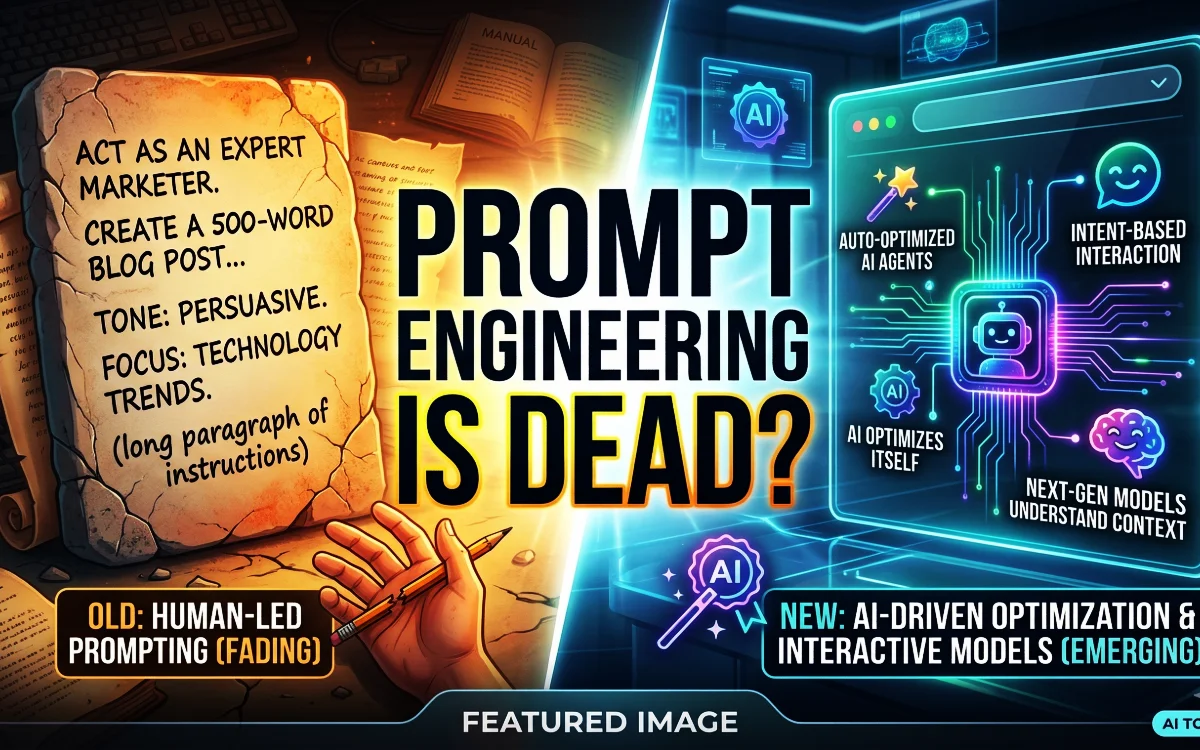
Just two years ago, prompt engineering was one of the hottest skills in tech. Entire courses, YouTube channels, and job roles were dedicated to teaching people how to write the “perfect prompt” for AI tools.
Users learned these tricks:
- Writing long, structured prompts
- Using role-based instructions
- Adding formatting commands
- Incorporating step-by-step reasoning prompts
But in 2026, something unexpected is happening.
Modern AI systems are becoming so capable that complex prompts are disappearing. Instead of carefully crafting instructions, users can simply describe what they want in natural language.
From what I’ve seen while testing new AI tools, it seems the era of complex prompt engineering is coming to an end—it will be replaced by something called intuitive AI.
What Prompt Engineering Originally Meant
Prompt engineering emerged during the initial wave of generative AI models.
At that time, AI required very specific instructions to produce good results.
For example, a typical prompt might look like this:
“Act like a professional technology journalist with 10 years of experience. Write a 1,000-word article in a conversational tone, including headings, bullet points, and an FAQ section.”
Without detailed prompts, early models often gave vague or general answers.
So users learned to carefully craft prompts to guide AI.
This skill quickly became useful for:
- Content creators
- Developers
- Marketers
- Researchers
But the need for detailed prompting is rapidly changing..
Why AI No Longer Needs Complex Prompts
Three major improvements in AI models are driving this shift.
1. Better Context Understanding
Modern AI systems can understand unclear instructions much more accurately.
For example, instead of writing a long prompt like this:
“Write a 1200-word SEO-optimized article about AI-powered smart plugs, including real-world examples, comparison tables, and FAQs.”
Now you can simply say:
“Explain how smart plugs reduce electricity bills.”
The AI automatically understands the structure and correctly generates the answer.
In my experience testing new models, even shorter prompts often produce well-structured content.
2. AI Learns User Intent Automatically
New AI systems analyze intent rather than instructions.
They examine:
- conversation context
- user history
- topic complexity
- expected format
This allows the AI to decide how detailed the response should be without requiring explicit instructions.
Instead of prompting structure manually, users focus on ideas.
3. AI Agents Handle Multi-Step Tasks
Earlier AI systems required step-by-step prompts.
For example:
- Generate topic ideas
- Create outline
- Write article
- Edit article
Now AI agents perform these steps automatically.
A single instruction can trigger an entire workflow.
This reduces the need for prompt engineering entirely.
What “Intuitive AI” Actually Means
Intuitive AI refers to systems designed to behave more like human collaborators.
Instead of responding literally to commands, these systems:
- interpret intent
- anticipate needs
- ask clarifying questions
- adjust responses dynamically
Think of it as conversation-driven AI instead of instruction-driven AI.
This change dramatically lowers the barrier for everyday users.
Real-World Example 1: Content Creation
Two years ago, content creators used long prompts to generate articles.
Typical prompt:
“Write a detailed article, include headings, SEO keywords, and FAQs.”
Today, creators often type something like:
“Write about AI reducing electricity bills.”
The AI automatically:
- structures the article
- adds headings
- includes examples
- formats the content
The user focuses on editing instead of prompting.
Real-World Example 2: Coding Assistance
Developers previously needed highly specific prompts like:
“Generate Python code to scrape a website using BeautifulSoup and store results in CSV.”
Now developers can simply say:
“Create a script that collects product prices from a website.”
Modern AI systems infer:
- programming language
- libraries
- structure
- error handling
This significantly speeds up development workflows.
Real-World Example 3: Everyday Productivity
Students or professionals often interact with AI casually.
Instead of writing:
“Summarize this research paper in simple language, in bullet points.”
They simply say:
“Explain this paper.”
The AI automatically adjusts for complexity.
Prompt Engineering vs Intuitive AI
| Feature | Traditional Prompt Engineering | Intuitive AI |
|---|---|---|
| Instruction Style | Detailed commands | Natural conversation |
| Learning Curve | High | Very low |
| Workflow | Manual prompting | AI-driven automation |
| User Focus | Prompt structure | Idea generation |
| Accessibility | Limited to trained users | Open to everyone |
The key shift is this: users no longer need to learn how AI thinks.
AI is learning how humans communicate.
Why Prompt Engineering Isn’t Completely Dead
Despite the hype, prompt engineering still has value in some areas.
Advanced users still benefit from structured prompts when dealing with:
- complex data analysis
- specialized research
- automation workflows
- multi-agent systems
In these cases, detailed prompts help control outputs precisely.
However, the average user rarely needs that level of complexity.
The New Skill: AI Collaboration
Instead of prompt engineering, the new skill emerging is AI collaboration.
This involves:
- guiding AI with feedback
- refining responses through conversation
- evaluating output quality
- adding human expertise
From what I’ve observed, successful AI users focus less on writing perfect prompts and more on iterating intelligently.
Pros and Cons of Intuitive AI
Advantages
- Easier for beginners
- Faster workflows
- More natural interaction
- Reduced technical barrier
- Broader accessibility
Limitations
- Less precise control in some cases
- AI assumptions may be incorrect
- Complex tasks may still require structured prompts
Even intuitive systems occasionally misunderstand vague instructions.
Human oversight remains essential.
The Bigger Industry Trend
The shift away from prompt engineering reflects a larger change in AI design philosophy.
Early AI tools required humans to adapt to machines.
Modern AI tools are being designed to adapt to humans.
This transition is similar to how computers evolved:
- Early computers required programming knowledge
- Graphical interfaces made them accessible to everyone
Intuitive AI may play a similar role in the AI revolution.
What This Means for the Future
Over the next few years, AI systems will likely:
- anticipate user needs more accurately
- integrate deeper into operating systems
- manage complex tasks autonomously
- require less technical instruction
Instead of learning prompt tricks, users may simply focus on communicating ideas clearly.
The technology will handle the rest.
FAQ – People Also Ask
1. Is prompt engineering becoming obsolete?
Not entirely. It remains useful for advanced tasks, but everyday users increasingly rely on natural language interaction.
2. What is intuitive AI?
Intuitive AI refers to systems that understand user intent through conversation rather than requiring structured prompts.
3. Do you still need prompt engineering skills?
Professionals working with complex AI workflows may still benefit from it, but casual users often don’t need it anymore.
4. Why are AI prompts becoming simpler?
New AI models understand context and intent better, reducing the need for highly detailed instructions.
5. What skill replaces prompt engineering?
AI collaboration — guiding AI through feedback and conversation — is becoming more important.
Final Thoughts
Prompt engineering played a crucial role in the early years of generative AI. It helped users unlock the potential of systems that needed careful guidance.
But as AI becomes more capable, the need for complex instructions is diminishing.
In 2026, the real change isn’t that prompt engineering is disappearing—it’s that AI is learning to understand humans more naturally.
And as technology becomes simpler, the barrier between people and machines is becoming less and less.