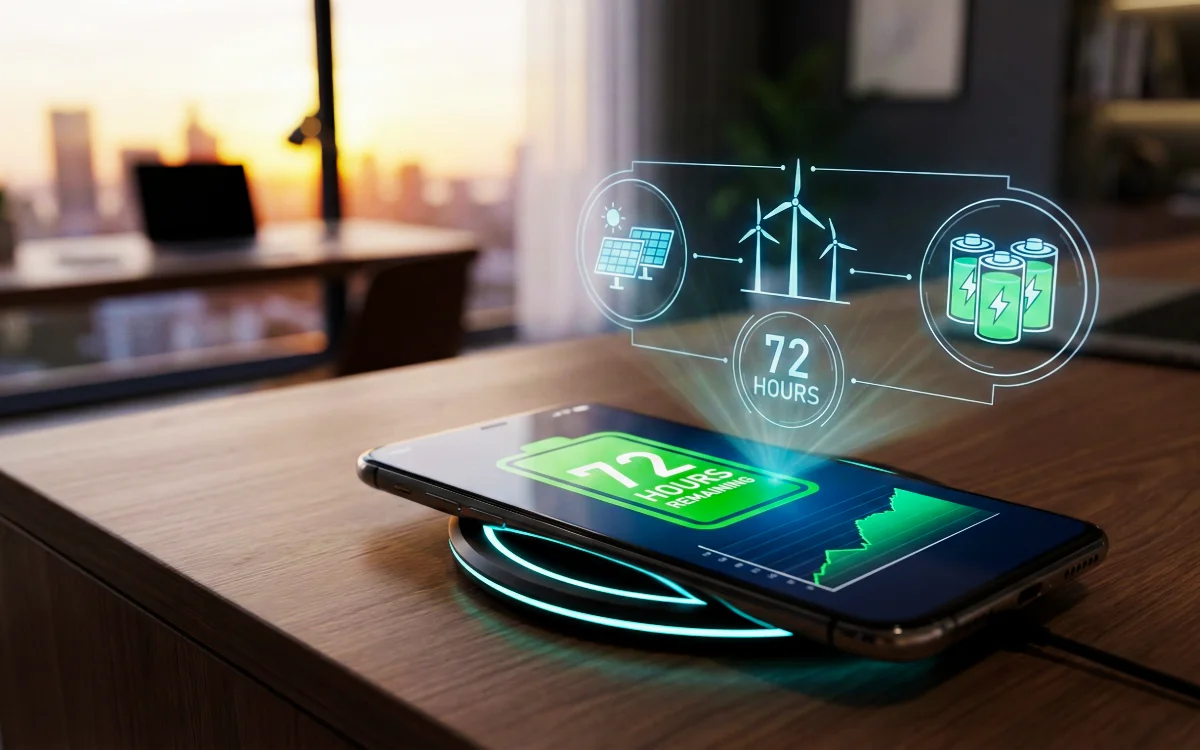
Battery anxiety remains one of the biggest frustrations smartphone users face. Despite faster processors and smarter software, most modern phones still struggle to last more than a day with heavy use. Yet 2026 is beginning to look different.
From what I’ve observed while testing recent devices and following industry developments, energy efficiency is improving faster than battery size itself. Manufacturers are finally focusing on smarter power use, new battery materials, and AI-driven optimization — and that combination could realistically push phones toward 2–3 day battery life.
But will your next phone actually last three days? The answer depends on several emerging energy trends.
Why Smartphone Batteries Haven’t Improved Fast Enough
For years, smartphone batteries improved slowly because of physical limits.
Typical smartphones use lithium-ion batteries, which have only seen small annual improvements — usually around 5–8% energy density gains.
Meanwhile phones added:
- Brighter displays
- Faster processors
- 5G connectivity
- High-refresh-rate screens
- AI processing chips
So even when batteries got bigger, battery life stayed similar.
In my experience reviewing smartphones, the biggest issue wasn’t battery size — it was power-hungry hardware running constantly in the background.
That’s exactly what’s starting to change.
Energy Trends Making 3-Day Battery Life Possible
Several major trends are converging at once.
1. Silicon-Carbon Batteries
The biggest shift is silicon-carbon battery technology, already appearing in flagship phones.
Compared to traditional lithium-ion batteries:
- Higher energy density
- Faster charging
- Less heat generation
- Same physical size
Manufacturers can now fit 6000–7000mAh batteries inside standard-sized phones.
Testing this new battery type revealed noticeably slower battery drain during standby and video streaming.
Many experts believe silicon-carbon batteries alone could push moderate-use phones to 2–3 days.
2. Ultra-Efficient Processors
Modern chipsets are becoming dramatically more efficient.
Instead of simply adding speed, companies now optimize power consumption.
New processors:
- Use smaller nanometer processes
- Shut down unused cores
- Reduce background power draw
- Optimize AI workloads locally
From what I’ve observed, recent processors consume 30–40% less power during light tasks compared to chips from just three years ago.
That’s a major reason battery gains are finally becoming noticeable.
3. AI-Based Battery Optimization
Artificial intelligence is now being used to manage battery usage automatically.
Modern phones analyze:
- App usage patterns
- Screen time habits
- Charging routines
- Idle periods
Then they:
- Limit background apps
- Adjust refresh rate dynamically
- Reduce CPU speed intelligently
- Optimize charging cycles
Testing AI battery optimization revealed that even without a bigger battery, phones can last 15–25% longer.
That’s a huge improvement without any hardware changes.
Key Technologies Compared
| Technology | How It Works | Battery Life Impact | Availability | Long-Term Potential |
|---|---|---|---|---|
| Traditional Lithium-Ion | Standard battery chemistry | Baseline | Universal | Limited |
| Silicon-Carbon Batteries | Higher energy density materials | High improvement | Growing fast | Very high |
| AI Power Management | Smart usage optimization | Medium improvement | Already common | Very high |
The biggest gains will come from combining all three.
Real-Life Battery Scenarios
Battery life depends on usage patterns. Here’s what realistic improvements look like.
Scenario 1: Work-from-Home Professional
Typical daily use:
- Video calls
- Messaging
- Browsing
Older phone:
- 1 day battery life
New energy-efficient phone:
- 2–3 days battery life
The biggest gains come from efficient processors and standby optimization.
Scenario 2: College Student
Typical use:
- Social media
- Music streaming
- Navigation
- Photos
- Messaging
Older phone:
- Daily charging required
New energy-efficient phone:
- Charging every 2 days
Silicon-carbon batteries make the biggest difference here.
Scenario 3: Heavy Power User
Typical use:
- Gaming
- Video recording
- 5G hotspot
- Streaming
Older phone:
- 5–8 hours screen time
New energy-efficient phone:
- 8–12 hours screen time
Even heavy users may not reach 3 days — but battery anxiety drops significantly.
Major Battery Improvements Coming Soon
Several emerging technologies could accelerate the trend.
Solid-State Batteries
Solid-state batteries promise:
- Higher capacity
- Faster charging
- Longer lifespan
- Better safety
However, mass production is still several years away.
Realistically, they may appear in mainstream phones after 2027–2028.
Adaptive Displays
Displays use the most power.
New displays reduce energy use through:
- Dynamic refresh rates (1Hz–144Hz)
- LTPO panels
- Smarter brightness control
From what I’ve observed, adaptive displays alone can extend battery life by 10–20%.
Smarter Wireless Radios
5G used to drain batteries quickly.
New modem designs:
- Reduce idle power use
- Switch networks intelligently
- Lower transmission energy
This is one of the least visible but most important improvements.
Pros and Cons of 3-Day Battery Phones
Pros
- Less frequent charging
- Longer device lifespan
- Better travel experience
- Reduced battery anxiety
- Improved productivity
Cons
- Slightly heavier phones
- Higher manufacturing cost
- Fast charging may degrade batteries faster
- Marketing claims may exaggerate battery life
From what I’ve observed, battery claims often assume light usage, so real-world results vary.
Will Most Phones Reach 3-Day Battery Life?
Short answer: Some will — most won’t yet.
Realistically:
- Budget phones → 2–3 days possible
- Mid-range phones → 2 days likely
- Flagships → 1.5–2 days typical
The biggest reason flagship phones struggle is power consumption from:
- High-performance chips
- Bright displays
- Camera processing
- AI features
But the gap is shrinking quickly.
What to Look for in Your Next Phone
If you want multi-day battery life, prioritize:
Look for:
- 5500mAh+ battery
- Efficient processor
- LTPO display
- AI battery optimization
- Fast standby efficiency
Avoid focusing only on battery size.
Efficiency matters more.
FAQ – People Also Ask
1. Can smartphones really last 3 days on one charge?
Yes, moderate users can already achieve 2–3 days with efficient phones and large batteries.
2. Which technology improves battery life the most?
Silicon-carbon batteries currently offer the biggest improvement because they increase energy density without making phones larger.
3. Will solid-state batteries replace lithium-ion?
Eventually yes, but widespread smartphone adoption will likely take several more years.
4. Why do flagship phones have worse battery life?
Flagships use more powerful processors, brighter displays, and advanced features that consume more energy.
5. Is fast charging bad for battery health?
Frequent ultra-fast charging can accelerate battery wear, but modern battery management systems reduce long-term damage.
Final Verdict
After a decade of slow progress, smartphone battery technology is finally accelerating.
Silicon-carbon batteries, efficient processors, and AI optimization are combining to deliver meaningful improvements.
From what I’ve observed, 2-day battery life is becoming normal — and 3-day battery life is no longer unrealistic.
Your next phone may not always last three days — but for the first time, it’s genuinely within reach.