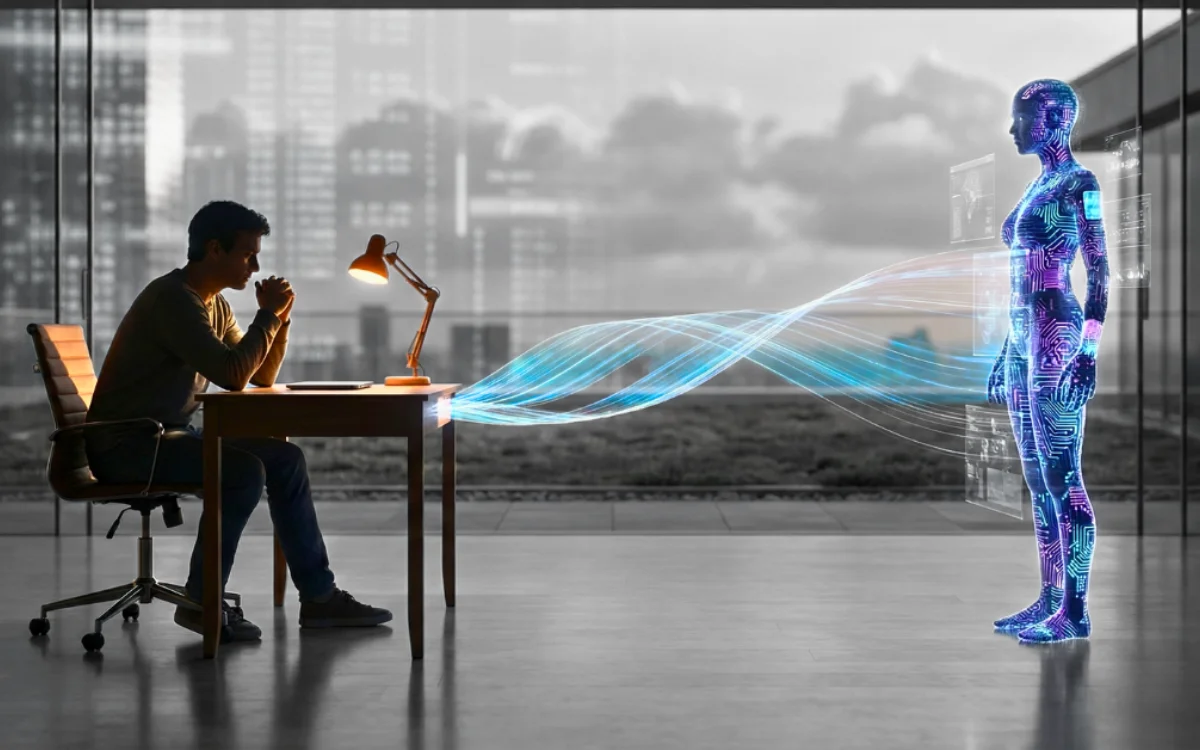
This question isn’t science fiction anymore. It’s being asked in offices, classrooms, homes, and late at night by people who are quietly worried about their future.
Will AI replace humans?
Not just jobs — but us.
The honest answer is not a simple yes or no. It requires logic, realism, and a very human understanding of how the world actually works (not how headlines want you to feel).
Let’s break it down calmly, without hype, fear-mongering, or blind optimism.
First, what AI actually is (and what it isn’t)
AI today is extremely powerful at patterns, speed, and scale.
It can:
- Analyze millions of data points instantly
- Generate text, images, code, and music
- Automate repetitive and rule-based tasks
- Assist humans in decision-making
But here’s the critical part most people miss:
AI does not understand meaning. It predicts outcomes.
AI doesn’t want anything.
It doesn’t care about results.
It doesn’t understand consequences the way humans do.
It works because humans defined:
- The goal
- The data
- The constraints
- The reward system
Without humans, AI has no direction.
The uncomfortable truth: some human work will disappear
Let’s not lie to ourselves.
Yes — AI will replace certain types of human work, especially jobs that are:
- Repetitive
- Rule-based
- Predictable
- Data-heavy
Examples:
- Basic data entry
- Simple customer support
- Template-based writing
- Manual reporting
- Routine coding tasks
These roles are not disappearing because AI is “evil”, but because:
They were already optimized for efficiency, and AI is better at efficiency.
This has happened before:
- Machines replaced manual labor
- Computers replaced typists
- The internet replaced travel agents
Technology doesn’t destroy work — it changes the type of work.
What AI cannot replace (and won’t anytime soon)
This is where reality kicks in.
AI struggles — badly — with anything that involves:
1. Human judgment
AI can suggest.
Humans decide.
Judgment requires:
- Context
- Ethics
- Responsibility
- Understanding long-term impact
When something goes wrong, society doesn’t blame the algorithm — it blames the human.
2. Emotional intelligence
AI can simulate empathy.
It cannot experience it.
It doesn’t feel:
- Fear
- Love
- Guilt
- Responsibility
- Purpose
A therapist, teacher, leader, or caregiver is not valuable because of information — but because of human connection.
3. Creativity with intent
AI can generate content.
Humans create meaning.
AI can remix what already exists.
Humans create because:
- They want to express something
- They feel something needs to exist
- They want to change minds or culture
Art without intention is decoration.
Meaning requires a human.
4. Accountability
This is the most important one.
If:
- A medical decision fails
- A legal judgment harms someone
- A business decision causes damage
Someone must be accountable.
AI cannot go to court.
AI cannot feel guilt.
AI cannot take responsibility.
Humans remain necessary because society runs on accountability.
The real shift: humans vs humans using AI
The real competition is not:
Humans vs AI
It is:
Humans who use AI vs humans who don’t
AI is a multiplier, not a replacement.
- A designer with AI beats a designer without it
- A marketer with AI beats one who ignores it
- A developer using AI works faster than one who resists it
This pattern repeats in every industry.
People who adapt don’t disappear.
People who refuse change struggle.
Why “AI will replace humans” is a lazy narrative
This idea sounds dramatic, but it ignores reality:
- Economies need consumers
If humans are replaced entirely, who buys products? - Power systems need control
Governments and institutions will never give full control to machines without humans overseeing them. - Innovation comes from dissatisfaction
AI optimizes existing systems. Humans question whether the system should exist at all. - Progress is social, not just technical
Technology adoption is limited by culture, ethics, law, and trust — all human domains.
The jobs that will grow because of AI
Ironically, AI creates demand for:
- Human oversight roles
- Ethics and policy experts
- Trainers, reviewers, and editors
- Strategic thinkers
- Educators and mentors
- Creators who add perspective, not volume
The more AI-generated noise exists, the more valuable clear human thinking becomes.
The deeper fear isn’t about AI — it’s about relevance
When people ask:
“Will AI replace humans?”
What they often mean is:
“Will I still matter?”
That fear is understandable.
But relevance has always required adaptation.
Every generation faced this moment:
- Farmers during industrialization
- Workers during automation
- Businesses during the internet
AI is not the first disruption — it’s just the fastest.
Also Read: How to Make Videos With AI and Earn Money? (Beginner Guide for 2026)
A realistic future (not dystopian, not utopian)
The most likely future looks like this:
- AI handles speed, scale, and repetition
- Humans handle judgment, values, and meaning
- Work becomes more cognitive, less mechanical
- Learning becomes continuous, not optional
Humans don’t disappear.
Human roles evolve.
Final answer: will AI replace the need for humans?
No.
But it will replace the need for:
- Unskilled repetition
- Passive thinking
- Refusing to learn
- Doing things “because that’s how it’s always been done”
AI doesn’t replace humans.
It exposes who was never thinking deeply to begin with.
And that’s uncomfortable — but also an opportunity.