Every time you stream a video, unlock your phone with face recognition, or use a smart security camera, data is being processed somewhere.
Traditionally, that “somewhere” was a distant data center — often hundreds or thousands of kilometers away.
But what happens when speed is critical?
What if a delay of even one second is too slow?
That’s where edge computing comes in.
Quick Answer
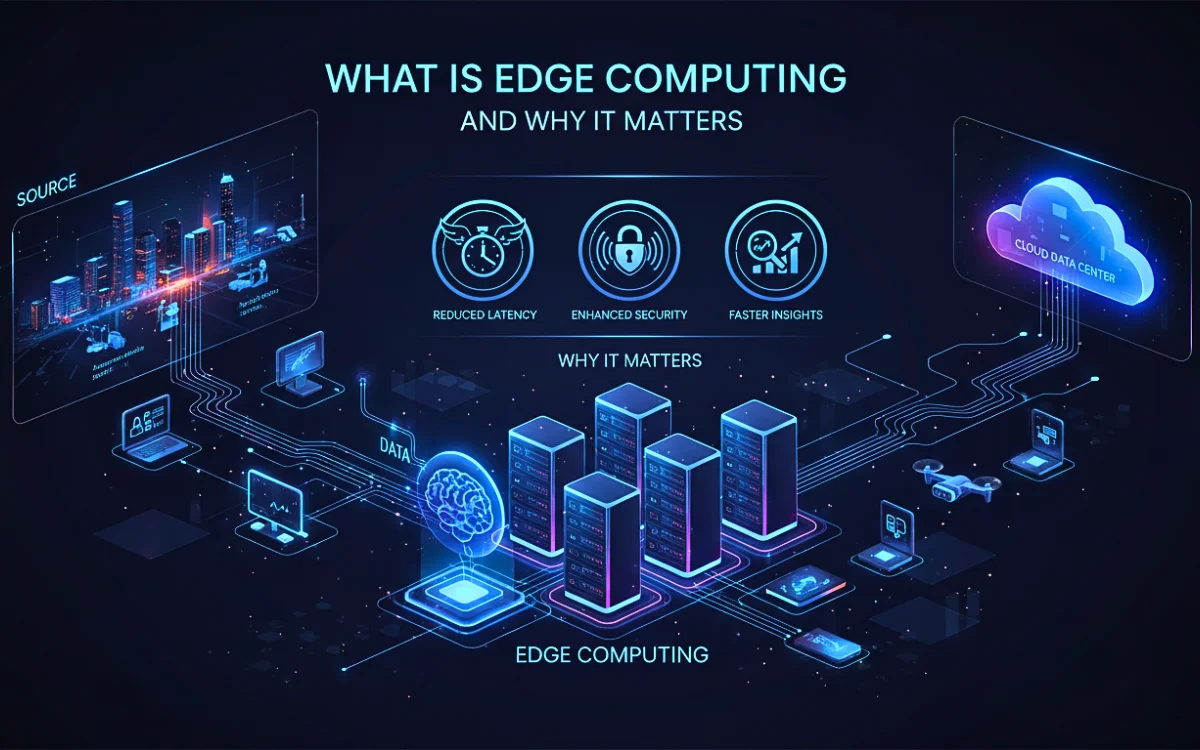
Edge computing is a method of processing data closer to where it is created instead of sending it to a faraway cloud server.
Instead of:
Device → Internet → Cloud → Back to Device
It becomes:
Device → Nearby Processing → Immediate Response
This reduces delay (latency), improves speed, enhances privacy, and makes systems more reliable.
Why Traditional Cloud Computing Has Limits
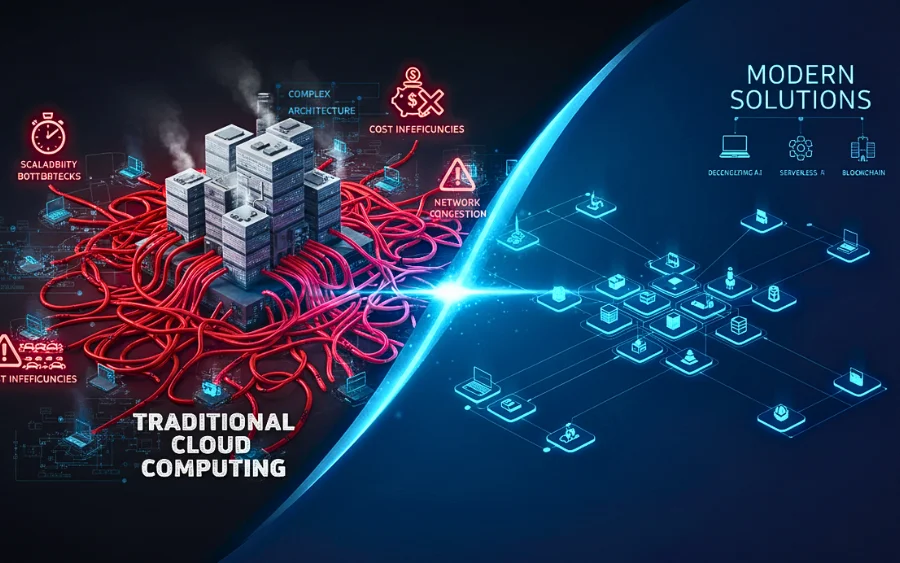
Cloud computing changed the internet by allowing companies to store and process data remotely.
But cloud-only systems have challenges:
- Network delays
- Heavy bandwidth usage
- Internet dependency
- Privacy concerns
For basic tasks like email or file storage, cloud works perfectly.
But for:
- Self-driving cars
- Smart factories
- Real-time medical monitoring
- Industrial robots
Even small delays can be dangerous.
What Exactly Is “The Edge”?
“The edge” refers to devices or local servers positioned closer to users or machines.
Examples of edge devices:
- Smartphones
- IoT sensors
- Smart cameras
- Local mini data centers
- Routers with processing capability
Instead of sending raw data to the cloud, these devices process important parts locally.
Simple Real-Life Example
Imagine a smart security camera.
Without edge computing:
- Camera records video
- Sends it to cloud server
- Cloud analyzes motion
- Sends alert back to user
With edge computing:
- Camera detects motion locally
- Processes it instantly
- Sends notification immediately
This saves time and bandwidth.
How Edge Computing Works (Step-by-Step)
- Data Collection – Sensors or devices collect information
- Local Processing – Edge device analyzes data nearby
- Instant Action – System responds immediately
- Cloud Sync (Optional) – Important data is sent to cloud for storage or deeper analysis
This hybrid approach combines speed with scalability.
Where Edge Computing Is Used Today
🚗 Autonomous Vehicles
Cars process sensor data in real time to avoid obstacles.
Even milliseconds matter.
🏭 Smart Manufacturing
Factories use edge computing to monitor machines and detect faults instantly.
This prevents downtime.
🏥 Healthcare Devices
Wearables and hospital monitors analyze patient data locally for faster alerts.
📱 Smartphones
Many modern phones now perform AI tasks directly on the device instead of cloud servers.
Examples include:
- Face recognition
- Voice processing
- Camera enhancements
🏙️ Smart Cities
Traffic lights and surveillance systems process data locally to improve response times.
Key Benefits of Edge Computing
1️⃣ Lower Latency
Data is processed near the source, reducing delays.
2️⃣ Better Reliability
Systems continue working even if internet connection drops.
3️⃣ Reduced Bandwidth Costs
Less data is sent to the cloud.
4️⃣ Improved Privacy
Sensitive data can stay local instead of traveling across networks.
5️⃣ Scalability
Supports billions of connected IoT devices.
Edge vs Cloud: What’s the Difference?
| Feature | Cloud Computing | Edge Computing |
|---|---|---|
| Processing Location | Central data centers | Near the device |
| Speed | Depends on internet | Very fast |
| Latency | Higher | Very low |
| Bandwidth Usage | High | Reduced |
| Privacy | Data sent remotely | More local control |
Most modern systems now use both together.
Why Edge Computing Matters More in 2026 and Beyond
We are entering a world with:
- Billions of IoT devices
- AI-powered systems
- Autonomous machines
- Real-time applications
Cloud alone cannot handle everything efficiently.
Edge computing supports:
✔ Faster automation
✔ Smarter cities
✔ Safer vehicles
✔ Real-time analytics
✔ More responsive user experiences
It’s becoming foundational infrastructure for the next generation of technology.
Challenges of Edge Computing
It’s not perfect.
Some challenges include:
- Higher device complexity
- Security management at multiple locations
- Infrastructure costs
- Maintenance of distributed systems
Companies must carefully balance edge and cloud resources.
The Future of Edge Computing
In the coming years, we will see:
- More AI chips built directly into devices
- Expansion of 5G and advanced networks
- Growth of micro data centers
- Stronger cybersecurity measures
Edge computing will power smart ecosystems, not just individual devices.
Final Verdict
Edge computing is about processing data closer to where it is created, enabling faster responses, better privacy, and improved system reliability.
As more devices become intelligent and connected, edge computing will play a critical role in supporting modern digital infrastructure.
It’s not replacing cloud computing — it’s enhancing it.