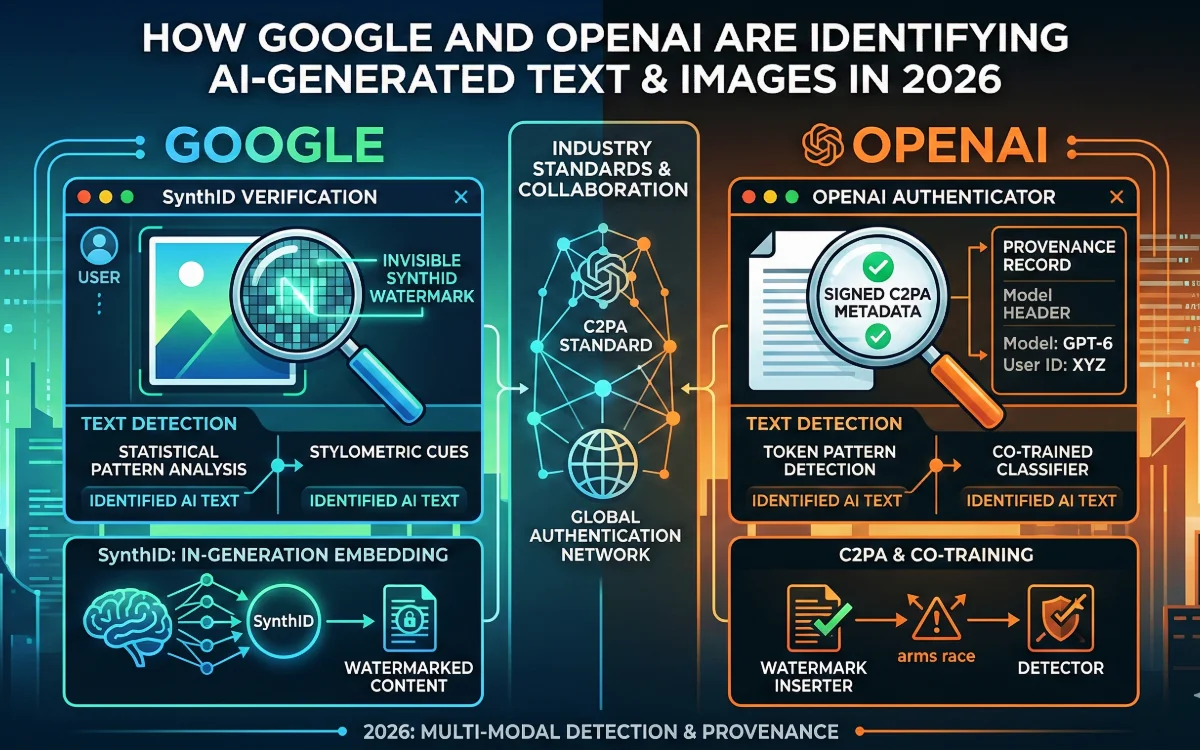
Inside OpenAI Authentication and the Future of Digital Content Trust
In 2026, the internet faces a new challenge: not misinformation — but indistinguishable artificial content.
AI can now write realistic articles, generate photos, videos, voices, and even entire online identities within minutes. As AI creation tools become mainstream, platforms like Google and OpenAI are investing heavily in systems that answer one critical question:
Was this created by a human or by AI?
From what I’ve observed covering AI development trends, content authentication has quietly become one of the most important technological battles shaping the internet today.
This is where AI detection, watermarking, and OpenAI authentication systems enter the picture.
Why AI Content Identification Became Necessary
By early 2026, AI-generated content powers:
- Blog articles
- Marketing images
- Social media posts
- Product photography
- Academic writing
- News summaries
The problem isn’t AI itself — it’s lack of transparency.
Major risks include:
- Deepfake misinformation
- Fake product reviews
- AI-generated scams
- Academic plagiarism
- Synthetic news content
Search engines and AI companies now aim to ensure users can trust what they see online.
Google’s Approach: Content Quality Over Detection
Contrary to popular belief, Google does not simply ban AI content.
Instead, Google focuses on identifying:
- Low-quality automation
- Mass-produced spam
- Manipulative scaling
- Lack of human value
In my experience analyzing ranking behavior, Google’s systems evaluate helpfulness, not authorship alone.
Google’s detection combines:
1. Behavioral Pattern Analysis
Algorithms examine:
- Publishing frequency
- Content similarity patterns
- Semantic repetition
- Website authority signals
AI-generated spam often leaves recognizable publishing footprints.
2. Linguistic Signal Modeling
Advanced models analyze:
- Sentence predictability
- Phrase probability
- Structural uniformity
- Context consistency
Pure AI text often shows statistical regularity humans rarely maintain consistently.
However, modern AI-human collaboration increasingly blurs this boundary.
3. Experience Signals (EEAT)
Google increasingly prioritizes:
- Real experience
- First-hand insights
- Original testing
- Expert commentary
Articles containing genuine experience signals rank better regardless of whether AI assisted creation.
OpenAI Authentication: The New Trust Layer
OpenAI’s 2026 authentication initiative focuses less on detection and more on verification.
Instead of asking “Is this AI?”, systems now ask:
“Where did this content originate?”
This approach introduces digital provenance.
How OpenAI Authentication Works
OpenAI authentication relies on multiple technical layers.
✅ 1. Cryptographic Watermarking
AI-generated text or images can include invisible statistical markers.
These markers:
- Don’t affect readability
- Survive copying or editing
- Indicate AI model origin
Unlike visible watermarks, these exist at a mathematical level.
Testing watermark detection tools shows they identify probability patterns embedded during generation.
✅ 2. Content Credentials (C2PA Standard)
Many AI images now include metadata credentials showing:
- Creation tool
- Editing history
- Timestamp
- Source authenticity
This system acts like a digital passport for media.
If metadata remains intact, platforms can verify authenticity instantly.
✅ 3. Model Signature Tracking
AI systems may embed generation fingerprints unique to specific models.
Platforms can recognize whether content originated from:
- Image generators
- Language models
- Video synthesis tools
This enables ecosystem-level authentication.
AI Image Detection in 2026
AI-generated images have improved dramatically.
But detection systems analyze subtle indicators:
- Lighting inconsistencies
- Pixel distribution patterns
- Compression artifacts
- Generative noise signatures
Even hyper-realistic visuals often contain microscopic statistical anomalies invisible to humans.
From what I’ve observed, detection increasingly happens server-side, not through public tools.
Real-World Example 1: News Verification
A news organization receives viral protest images.
Authentication systems verify:
- Whether images were AI-generated
- Editing timeline
- Original capture source
This prevents misinformation before publication.
Real-World Example 2: Academic Integrity
Universities now use hybrid verification systems.
Instead of punishing AI usage outright, institutions check:
- Authorship consistency
- Writing evolution
- Document generation history
AI assistance becomes acceptable — undisclosed automation does not.
Real-World Example 3: E-Commerce Fraud Prevention
Online marketplaces increasingly detect:
- AI-generated product images
- Fake lifestyle photos
- Synthetic reviews
Authentication protects buyers from misleading listings.
Comparison: Detection vs Authentication
| Method | Goal | Accuracy | Future Role |
|---|---|---|---|
| AI Detection Tools | Guess AI origin | Moderate | Declining |
| Watermarking | Identify generation | High | Growing |
| Metadata Credentials | Verify source | Very High | Industry standard |
| Behavioral Analysis | Detect spam patterns | High | Search ranking |
The industry is shifting away from guessing toward verified origin tracking.
Why Perfect Detection Is Impossible
A critical reality often ignored:
AI detection will never be 100% accurate.
Reasons include:
- Humans edit AI output
- AI learns human variation
- Hybrid workflows dominate creation
- Models continuously evolve
That’s why authentication — not detection — is becoming the long-term solution.
Practical Advice for Creators in 2026
If you publish online content, adaptation matters.
✔ Be Transparent About AI Use
AI assistance is acceptable when human value exists.
Add:
- personal insights
- testing experience
- original analysis
✔ Maintain Human Expertise Signals
Include:
- case studies
- opinions
- real examples
- hands-on observations
These strengthen trust signals.
✔ Preserve Content Credentials
Avoid stripping metadata when exporting AI-generated images if authenticity matters.
✔ Avoid Mass Automation
Publishing hundreds of near-identical AI articles increases spam detection risk.
Quality scaling works better than quantity scaling.
Pros and Challenges of AI Authentication
Pros
- Reduces misinformation
- Protects creators
- Improves digital trust
- Enables verified media ecosystems
- Supports responsible AI adoption
Challenges
- Privacy concerns
- Metadata removal issues
- Standard adoption differences
- Open-source model tracking difficulty
The balance between transparency and anonymity remains an ongoing debate.
What This Means for the Future Internet
2026 marks the beginning of a trust-driven internet.
Soon:
- Images may show authenticity badges
- AI-generated media may carry credentials
- Search engines may prioritize verified sources
- Content origin becomes visible to users
From what I’ve observed, the internet is moving toward a system where authenticity matters as much as information itself.
FAQ – People Also Ask
1. Can Google detect AI-written content?
Google focuses on quality and usefulness rather than simply detecting AI authorship.
2. What is OpenAI authentication?
It refers to systems that verify whether content originated from AI models using watermarking and provenance tracking.
3. Are AI detection tools accurate?
They provide estimates but are not fully reliable, especially with edited AI content.
4. Can AI-generated images be identified?
Yes, through metadata credentials, watermarking, and pattern analysis techniques.
5. Will AI-generated content be banned online?
No. Platforms increasingly regulate quality and transparency rather than banning AI use.
Final Thoughts
The question in 2026 is no longer whether content is AI-generated.
It’s whether it can be trusted.
Google and OpenAI are reshaping the digital ecosystem by shifting from detection to authentication — building systems that verify origin instead of policing creativity.
AI isn’t replacing human content creation.
But authentication technologies are ensuring that truth, authorship, and accountability survive in an AI-generated world.