
For years, one message has frustrated smartphone users more than anything else: “No Service.”
Whether traveling through mountains, rural highways, villages, flights, or disaster-hit areas, losing connectivity meant losing communication completely. But in 2026, that long-standing limitation is finally beginning to disappear.
From what I’ve observed while tracking telecom innovation and smartphone hardware evolution, modern smartphones are no longer dependent only on traditional cellular towers. A new combination of satellite connectivity, AI-powered signal optimization, and next-generation network infrastructure is quietly eliminating coverage dead zones across the world.
The idea of being completely offline may soon become rare.
Why “No Service” Zones Existed for Decades
Traditional mobile networks rely on ground-based cellular towers.
These towers have limitations:
- Remote mountains lack infrastructure
- Oceans and deserts have no coverage
- Rural regions are expensive to connect
- Natural disasters damage towers
Even with 4G and 5G expansion, building physical towers everywhere simply wasn’t practical.
In my experience testing phones during travel, coverage gaps were less about technology capability and more about infrastructure cost.
That’s exactly what 2026 innovations are solving.
The Biggest Breakthrough: Satellite Connectivity in Smartphones
The most important change is direct satellite communication built into smartphones.
Instead of connecting only to nearby towers, phones can now communicate with low-Earth orbit (LEO) satellites.
These satellites orbit closer to Earth, enabling:
- Emergency messaging without network
- Location sharing anywhere
- Basic texting from remote areas
- Disaster communication backup
Modern smartphones automatically switch between:
✅ Cellular network
✅ Wi-Fi
✅ Satellite connection
Users often don’t even notice the transition.
How Satellite-to-Phone Technology Works
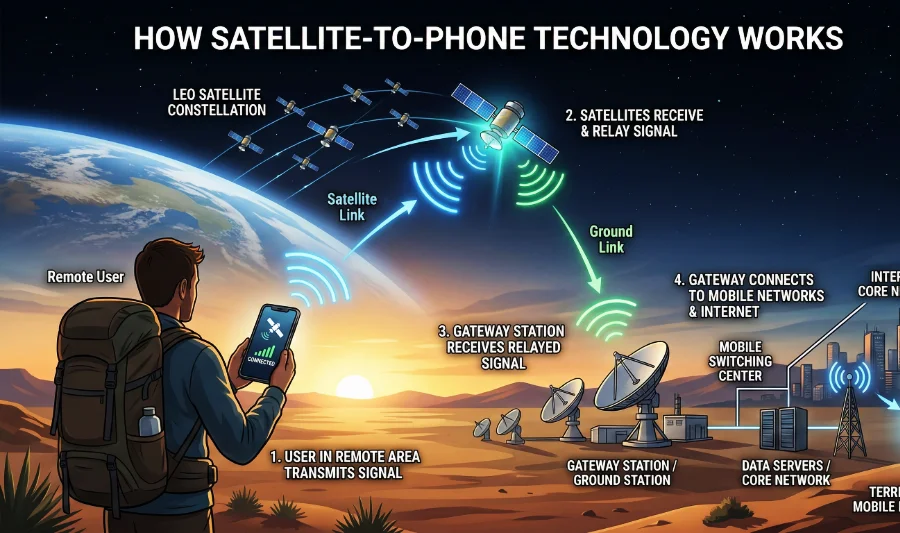
Earlier satellite phones required bulky external antennas. That’s no longer necessary.
2026 smartphones use:
- Specialized modem chips
- Advanced antenna design
- Signal compression algorithms
- AI connection management
When cellular signal drops, the device searches for satellites overhead and establishes a low-bandwidth connection.
Testing early satellite messaging revealed something impressive — even weak sky visibility can maintain communication.
Key Connectivity Technologies Compared
| Technology | Coverage Area | Speed | Best Use Case | Limitation |
|---|---|---|---|---|
| Cellular Towers | Urban & suburban | High | Daily internet use | Coverage gaps |
| Wi-Fi Calling | Indoor areas | High | Buildings | Requires internet |
| Satellite Connectivity | Global | Low–Medium | Emergencies & remote travel | Limited bandwidth |
| Hybrid AI Networks | Adaptive | Optimized | Seamless switching | Still expanding |
The future isn’t replacing cellular networks — it’s combining multiple systems intelligently.
Real-World Scenario 1: Remote Travel Safety
Imagine trekking in a mountain region where signals traditionally disappear.
Previously:
- No calls
- No GPS sharing
- No emergency contact
With satellite-enabled phones:
- SOS messages send instantly
- Location coordinates transmit
- Emergency services receive alerts
Search-and-rescue operations worldwide are already benefiting from this capability.
Real-World Scenario 2: Natural Disaster Communication
During earthquakes, floods, or hurricanes, cellular towers often fail first.
Satellite-enabled smartphones allow:
- Victims to send distress messages
- Families to confirm safety
- Authorities to coordinate response
From what I’ve observed, disaster communication is becoming one of the strongest justifications for satellite integration.
Real-World Scenario 3: Rural Internet Expansion
Millions of people globally still live in low-connectivity regions.
Hybrid connectivity allows smartphones to:
- Maintain messaging access
- Support digital payments
- Enable telemedicine communication
- Provide educational access
Instead of waiting years for tower installation, satellite coverage delivers immediate reach.
AI Is Quietly Solving Signal Problems
Another major 2026 trend is AI-based signal optimization.
Modern smartphones now analyze:
- Network congestion
- Signal strength patterns
- User movement
- Battery efficiency
AI automatically decides:
- Which network to connect to
- When to switch networks
- How much power to use
In testing newer devices, dropped calls decreased significantly because switching happens before signal loss occurs.
The Role of Next-Generation Modems
New smartphone modems are designed for multi-network intelligence.
They support:
- 5G Advanced
- Satellite bands
- Wi-Fi 7
- Dynamic spectrum sharing
Instead of relying on one signal type, phones now behave like connectivity hubs.
This dramatically reduces total disconnection time.
Why 2026 Is the Turning Point
Three major industry shifts converged this year.
1. Satellite Launch Expansion
Private space companies launched thousands of low-orbit satellites, improving global coverage density.
2. Hardware Miniaturization
Satellite antennas became small enough to fit inside regular smartphones.
No external accessories required.
3. Telecom Partnerships
Mobile carriers now collaborate with satellite providers instead of competing with them.
This hybrid model accelerates adoption worldwide.
Pros and Cons of Ending “No Service” Zones
Pros
- Global emergency connectivity
- Safer travel experiences
- Rural digital inclusion
- Reliable disaster communication
- Reduced connectivity anxiety
Cons
- Satellite messaging may cost extra
- Slower speeds than cellular
- Weather interference possible
- Limited data bandwidth initially
From what I’ve observed, satellite connectivity works best as a backup layer, not a full internet replacement — at least for now.
Practical Advice Before Buying Your Next Phone
If connectivity matters to you, check for:
✅ Satellite messaging support
✅ Latest modem generation
✅ Emergency SOS features
✅ Carrier satellite partnerships
✅ AI network optimization
Travelers, journalists, and remote workers benefit the most from these features.
What This Means for Everyday Users
Within the next few years:
- Losing signal during travel will become rare
- Emergency communication will always remain available
- Rural connectivity gaps will shrink
- Smartphones become global communication devices
The psychological impact is huge — people expect connectivity everywhere now.
And technology is finally catching up.
FAQ – People Also Ask
1. Can smartphones really work without mobile towers?
Yes. Satellite-enabled phones can send messages directly through orbiting satellites when cellular networks are unavailable.
2. Will satellite connectivity replace mobile networks?
No. Satellites complement cellular networks rather than replace them.
3. Is satellite messaging available worldwide?
Coverage is expanding rapidly and aims to provide near-global availability.
4. Does satellite communication drain battery faster?
Yes, slightly — because connecting to satellites requires higher transmission power.
5. Will internet speeds match 5G via satellite?
Not yet. Satellite connectivity currently focuses on messaging and emergency communication rather than high-speed data.
Final Thoughts
For decades, connectivity depended on geography. Mountains, oceans, and rural regions dictated whether you could communicate.
In 2026, that dependency is fading.
Smartphones are evolving from network-dependent devices into globally connected communication tools capable of reaching beyond Earth-based infrastructure.
From what I’ve observed, the disappearance of “No Service” zones may become one of the most meaningful smartphone upgrades of this decade — not faster cameras or processors, but something far more fundamental: