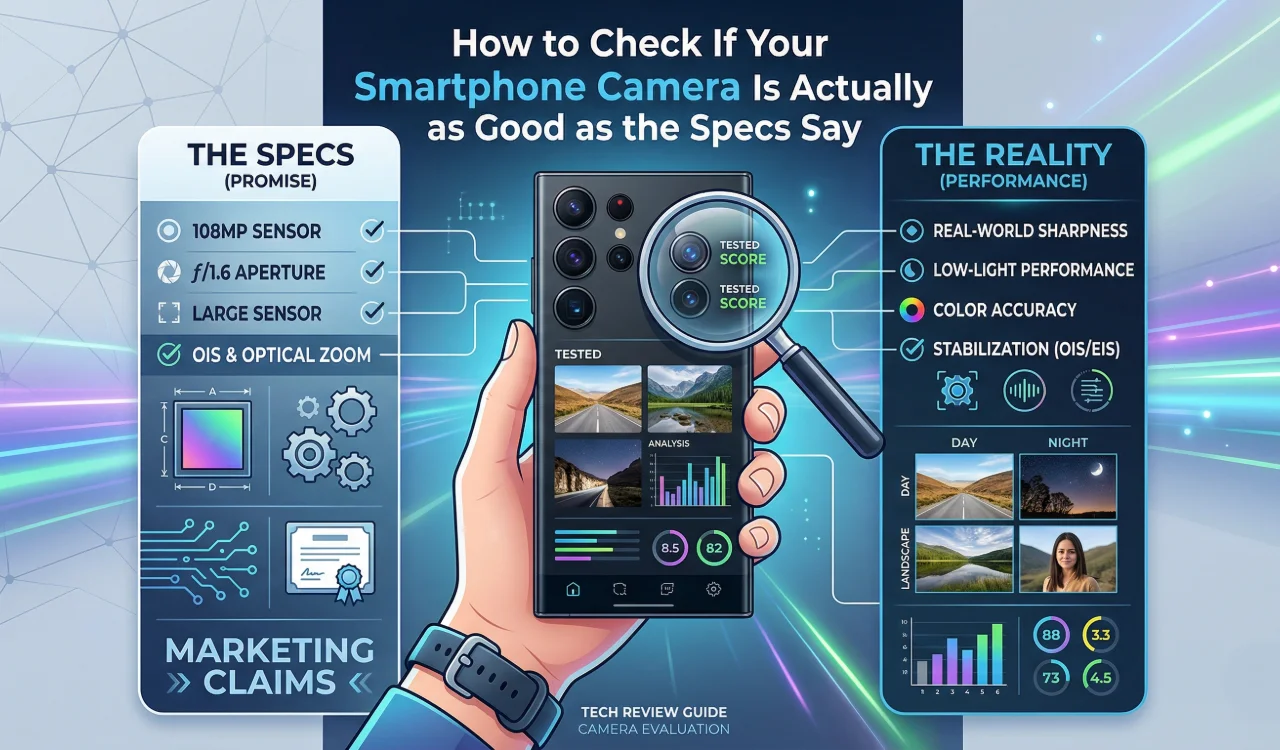
Whenever we buy a smartphone, we find its specifications listed—features such as a 200MP camera, 100x zoom, and AI enhancements. However, how can we verify whether what is written is actually true?
Then you take a photo of your lunch and it looks exactly like the photos from your last phone.
Sound familiar?
Here’s the truth nobody in the marketing department will say out loud: smartphone camera specs are one of the most consistently misleading numbers in all of consumer technology. More megapixels don’t mean better photos. A bigger number doesn’t mean a better camera. And the phone that wins on paper often loses badly in your hand, in real light, shooting real things.
So how do you actually figure out if your camera delivers what it promised? Let’s go through it properly — what the specs actually mean, which ones to ignore completely, and how to test your own phone right now without any equipment whatsoever.
The Megapixel Lie — Let’s Just Deal With This First
Megapixels are the most overused, most misunderstood, and most misleading spec in smartphone photography. Full stop.
Megapixels measure resolution. Nothing more. They tell you how many pixels are in the final image. What they don’t tell you is anything about the quality of those pixels, how well the camera handles light, how accurate the colours are, or basically anything else that actually matters when you’re taking a photo of something you care about.
A 200MP photo is simply a very large image. That’s it. It doesn’t mean better low-light performance, richer shadows, more accurate colour, or more natural depth. In many cases it means the opposite — higher megapixel sensors split available light across more pixels, so each pixel receives less light, which means more noise, especially in anything other than perfect daylight.
Here’s the kicker that the spec sheet won’t mention: most high-megapixel phones don’t even shoot at full resolution by default. A phone advertised at 200MP typically combines multiple pixels into one larger virtual pixel — a technique called pixel binning — and outputs a 12MP or 50MP image. You have to dig into a special mode to get the full 200MP file, which is enormous, slower to process, and in most real-world viewing conditions not actually better.
Think of it like a restaurant advertising 200 ingredients on the menu. Sounds impressive. Tells you nothing about whether the food is actually good.
What Actually Determines Camera Quality
If megapixels aren’t the answer, what is? Four things. In order of importance.
1. Sensor Size
The spec you should actually be looking at is sensor size. A larger sensor physically captures more light — and that has a cascading effect on almost everything: low-light performance, noise levels, dynamic range, and the natural separation between subject and background that makes photos look professional instead of flat.
The reason flagship phones with moderate megapixel counts consistently beat high-resolution budget phones is simple — sensor size matters more than pixel count. A large-sensor 48MP phone will destroy a tiny-sensor 200MP phone. Every single time. Without exception.
Sensor size is almost never featured prominently in ads. You’ll have to look it up on GSMArena or dig into the full specs page. It’s measured in fractions of an inch — something like 1/1.28″ is large and good. Something like 1/2.8″ is small and not.
2. Aperture — The f/ Number
Aperture is the size of the opening that lets light in. A lower f/ number — f/1.5 or f/1.8 — means a wider opening, more light, better low-light shots, and more natural background blur. A higher number like f/2.8 means less light reaches the sensor and everything gets harder in anything other than bright conditions.
Samsung’s Galaxy S25 Ultra’s f/1.5 aperture on its main sensor is a big reason its low-light performance stays competitive despite having to split light across 200 million pixels. The wide aperture compensates. Physics is physics.
3. Optical Image Stabilisation
OIS uses a tiny physical gyroscope mechanism to counteract your hand’s natural movement while you’re shooting. Without it, photos taken in low light or while moving will come out blurry no matter how many megapixels the sensor has.
Digital stabilisation — EIS — is software-based and significantly worse. Don’t let a brand slide EIS past you as a substitute. If the spec sheet says EIS only, that’s a red flag.
4. Computational Photography and Software
Every image your phone takes goes through post-processing before you even see the result — HDR stacking, noise reduction, tone mapping, AI scene detection — all without you asking. This is the invisible layer that separates great cameras from good ones.
It’s why Google’s Pixel phones consistently outperform phones with better hardware specs on paper. The Tensor chip’s image processing is extraordinarily well-tuned. The Pixel 10 Pro delivers the most consistent skin tones and white balance accuracy across varied lighting of any phone tested in 2025. That’s not hardware winning. That’s software doing years of quiet work behind every shot.
The DxOMark Score — Useful, But Not Gospel
If you’ve been phone shopping recently you’ve definitely seen DxOMark scores thrown around. Here’s what that number actually means and why you should treat it as a starting point rather than a final verdict.
DxOMark combines real-world shooting and lab evaluations across a huge range of scenarios — bright outdoor scenes, low light, zoom performance, portrait mode, video. Individual sub-scores for Photo, Video, Zoom, and Bokeh feed into one overall number.
In August 2025, DxOMark launched Camera Protocol v6 — their most significant testing update yet. The new protocol added 50 new portrait scenes covering moonlight through direct sunlight, expanded skin tone diversity to reflect global usage, and now includes over 3,000 lab photos and 800+ natural scene images across more than 100 real-world shooting scenarios. Genuinely rigorous.
But here’s the limitation nobody mentions when they’re quoting the score: a high overall DxOMark number doesn’t mean that phone is right for you. A phone that scores brilliantly in lab portrait tests might produce colours you personally find oversaturated and artificial. A phone ranked lower overall might have the best zoom performance of anything you’ve ever held. Use DxOMark to spot big performance gaps and identify clear strengths — don’t let a single number make your decision for you.
Six Tests You Can Run Right Now — No Equipment Needed
You don’t need a lab. You don’t need a colour calibration chart. These six tests take twenty minutes and will tell you more about your camera’s real performance than any spec sheet ever could.
Test 1: The Low-Light Indoor Shot
Go into a room lit by a single lamp. Point at something with texture — a bookshelf, fabric, a plant. Shoot without flash, without night mode first, then again with night mode on.
What you’re looking for: Is the image noisy and muddy, or does it hold detail? Do shadows go completely black or can you still see into them? Does the white balance go orange under warm bulbs or does the camera self-correct? This one test reveals sensor quality, aperture performance, noise reduction, and white balance all at once. It’s where cheap cameras fall apart completely and mid-range ones expose their limits.
Test 2: The Zoom Reality Check
Find something far away — a sign, a building detail, some text. Shoot at 2x. Then 5x. Then push to maximum zoom.
You’re looking for the exact moment image quality falls off a cliff. On a phone with a proper periscope telephoto lens, 2x and 5x should look genuinely sharp. The moment you cross into pure digital zoom — which is just software cropping — the image goes soft, smeary, and artificial almost immediately. The further that cliff is from where you started zooming, the better the actual hardware.
Test 3: The Moving Subject Test
Ask someone to walk across the room at normal pace while you shoot a burst. Or find a ceiling fan, a dog, a child — anything that doesn’t stay still.
How many of those burst shots are actually sharp? Is the autofocus tracking the subject properly or hunting around and missing? A good camera will nail focus on a moving subject consistently. A mediocre one gives you five blurry shots for every usable one and makes you feel like the problem is your hands.
Test 4: The Backlit Portrait
Stand someone in front of a window during daylight. Classic backlit scenario that trips up weak cameras constantly.
Does the person’s face go completely dark because the camera exposed for the bright window? Or does HDR processing lift the shadows on their face while keeping the background from blowing out entirely? This tests dynamic range — one of the most important real-world metrics and one of the least mentioned anywhere in the marketing.
Test 5: The Fine Detail Test
Get as close as the camera will focus to something with fine texture — fabric, a printed page, a leaf. Shoot it.
Can you read small text clearly? Does the texture look crisp or smeared? Watch specifically for over-sharpening — some phones, Samsung notably, apply heavy AI sharpening that makes images look hyper-detailed in a way that’s actually artificial and slightly unsettling, like someone’s turned up the clarity slider to 100 in Lightroom and walked away. The S25 Ultra also tends to push saturation slightly beyond what was actually there. Whether that bothers you is personal preference. But knowing it’s happening is useful.
Test 6: The Selfie Consistency Test
Take ten selfies in ten different lighting situations — bright outdoor, indoor overhead light, dim indoor, backlit from a window. Don’t adjust anything manually between shots.
Are skin tones consistent across all ten, or do you go orange indoors and pale outdoors? Does autofocus stay on your face or hunt around? Does portrait mode separate your hair cleanly from the background or create a messy halo effect around your head that makes you look like you’ve been badly cut out of a magazine?
This tests white balance consistency, autofocus reliability, and depth-mapping quality — all things that matter enormously in day-to-day use and appear nowhere on a spec sheet.
📊 Specs That Matter vs. Specs That Don’t
| Spec | How Much It Matters | What To Actually Look For |
|---|---|---|
| Megapixels | Low — often misleading | 12MP+ is fine for almost everything |
| Sensor Size | Very High | Larger is better — look for 1/1.5″ or bigger on flagship |
| Aperture (f/ number) | High | Lower = more light = better. f/1.5–f/1.8 is excellent |
| Optical Image Stabilisation | High | OIS only — EIS is not the same thing |
| Optical Zoom | High | 3x or 5x optical is real. “Digital zoom” is just cropping |
| Processor/Chipset | High | Drives all image processing — Snapdragon 8 Gen 4, A18 Pro, Tensor G5 |
| DxOMark Score | Medium | Useful for comparison — check sub-scores, not just overall |
| “AI Camera” features | Low to Medium | Marketing label — test the actual output, ignore the label |
| Number of lenses | Low | Four mediocre lenses lose to two great ones every time |
Where the Spec Sheet Winners and Real-World Shooters Diverge
The iPhone 17 Pro shoots at 48MP on its main sensor. Looks modest next to Samsung’s 200MP on paper. In practice, it consistently wins on colour accuracy, natural rendering, and skin tone fidelity across varied lighting. Night Mode performance is exceptional — crisp, natural images in near-darkness without the artificial glow that some phones add to make night shots look more dramatic than they actually were.
The Google Pixel 10 Pro’s hardware isn’t the most impressive on paper. Its Night Sight consistently outperforms phones with objectively better hardware specs in low light — purely because the software processing is that much further ahead. Point-and-shoot reliability in tricky conditions. Consistently accurate white balance. It’s the camera equivalent of a chef who makes extraordinary food with ordinary ingredients.
Samsung’s Galaxy S25 Ultra is genuinely the zoom king. Its quad-telephoto system with 100x hybrid zoom does things no other phone comes close to for shooting subjects at distance. Wildlife, sports, architecture. Nothing touches it there. But if you want the most natural, accurate colour rendering, you’ll likely prefer what comes out of an iPhone or Pixel day to day.
There’s no single best camera. There’s the best camera for what you actually shoot.
The Bottom Line
A 200MP camera that produces worse photos than a 12MP camera isn’t a bug or a paradox. It’s the entire point of this article.
The specs that matter most — sensor size, aperture, OIS, and processing quality — are the ones buried deep in spec pages or not mentioned at all. The specs plastered across the box and screamed in the ads — megapixels, number of lenses, maximum zoom numbers — are mostly marketing furniture designed to make one number look bigger than a competitor’s number.
Run those six tests. Look at the specs that actually matter. Check DxOMark sub-scores rather than just the headline number. And the next time a brand announces a 300MP camera, remember — the restaurant with 300 ingredients on the menu isn’t automatically making the best food. It’s just the one with the longest menu.
Frequently Asked Questions
Q1: Is a higher DxOMark score always better for my needs? Not necessarily. The overall score is a broad average across dozens of scenarios. If you shoot mostly video or portraits, check those specific sub-scores instead of the overall ranking. A phone ranked 8th overall might have the best portrait score tested — and if portraits are all you shoot, that’s the phone you want.
Q2: Does RAM affect camera performance? Indirectly, yes. More RAM lets the camera app hold more frames for processing — useful for burst shooting and rapid switching between shots. But it’s secondary. The chipset’s image signal processor matters far more than general RAM. A phone with a weaker chipset and more RAM will still lose to one with a stronger chipset and less RAM almost every time.
Q3: Should I ever shoot in 200MP mode? Rarely. Files are enormous — sometimes 60–80MB each — processing slows down, and in most viewing conditions you genuinely can’t tell the difference from a binned 50MP or 12MP shot. Use it specifically when you need to crop heavily in post, or when you’re printing very large. For everything else — social media, phone screens, standard prints — default mode is fine.
Q4: Does cleaning the camera lens actually matter? More than most people realise. A smudged lens — fingerprints, pocket lint, skin oils — reduces sharpness noticeably, increases lens flare in bright light, and creates a hazy, low-contrast look in scenes with strong backlighting. It’s the easiest free camera upgrade available and the one almost everyone ignores. Clean it before anything important. Every time.
Q5: Is the front camera quality worth checking separately? Yes — don’t assume it matches the rear camera. Front cameras are physically constrained by tiny fixed sensors and can’t match rear camera quality regardless of the megapixel count. The best ones now shoot 4K with autofocus and decent portrait mode. If selfie quality matters to you, specifically look for front camera reviews and tests rather than assuming a great rear camera means a great selfie camera.
Sources: MakeUseOf — Smartphone Cameras Never Advertise the Specs That Actually Matter (January 2026), DxOMark — Camera Protocol v6 Launch (August 2025), DxOMark — Smartphone Camera Test Protocol: A Closer Look (October 2025), Gizmochina — DxOMark Rankings Explained (January 2026), Vibetric — Best Smartphone Cameras Real-World 2025, Rokform — Best Camera Phones 2025 (December 2025), VERTU — 2025 Phone Camera Performance Benchmarks (December 2025), TechGenyz — Smartphone Camera Quality Factors (2025).